

Divinity Crystals · Home Décor & Crystal Education
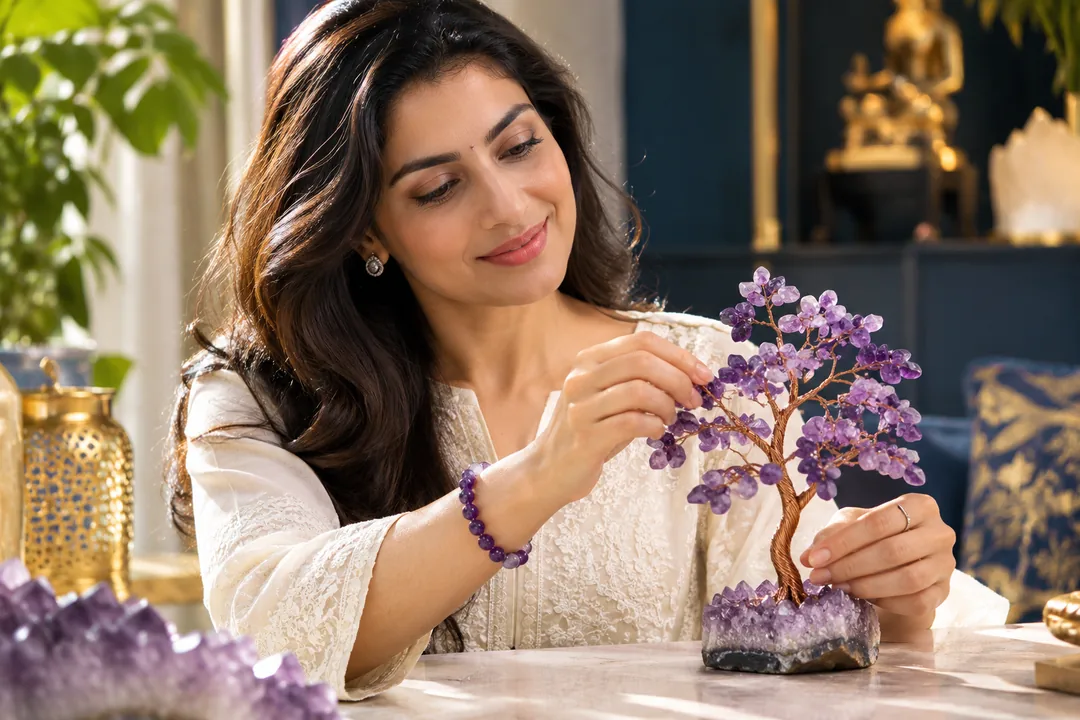
A crystal tree, also called a gemstone-chip tree or crystal bonsai, is a handcrafted decorative object with twisted wire branches, small polished or rough mineral chips as leaves, and a supporting base. Its appeal lies in delicate craftwork: the glint of individual stones, sculptural branches, and a familiar Tree of Life silhouette.
In contemporary Feng Shui-inspired décor and modern crystal practice, people sometimes use these little trees to represent abundance, harmony or personal growth. Indian Vastu-inspired home décor may also use them symbolically. Those traditions are distinct and interpretations vary; a tree ornament cannot guarantee wealth, cure insomnia or physically repair a building defect.
This guide compares a yellow Citrine-style money tree, a violet Amethyst-style tree, and a multicolour seven-chakra tree, then shows how to choose a stable piece, arrange its branches, display it thoughtfully, and clean its mixed gemstone-and-wire construction safely.
Our tree pictures are original editorial illustrations rather than actual merchandise. Browse the Vastu & Feng Shui Crystals collection for the current décor catalogue; a product search did not establish that these exact trees are on sale.
Key takeaways
- A crystal tree combines mineral chips, wire branches and a base; it is not one solid crystal.
- Citrine, Amethyst and seven-colour trees communicate different decorative and traditional symbols.
- Feng Shui and Vastu are distinct cultural frameworks; exact placement claims are not universal facts.
- A tree cannot guarantee income, medically treat sleeplessness or correct a structural problem.
- Confirm the actual chip species, height, weight, base stability and any report before buying.
- Dry dusting, gentle branch shaping and indirect-light storage protect the whole arrangement.
Five subject-specific Crystal Tree visual studies
Three separate gemstone-tree close-ups and two newly drawn educational diagrams. The close-ups are crops of our original editorial artwork; none is a photograph of a verified stock tree or proof of laboratory certification.
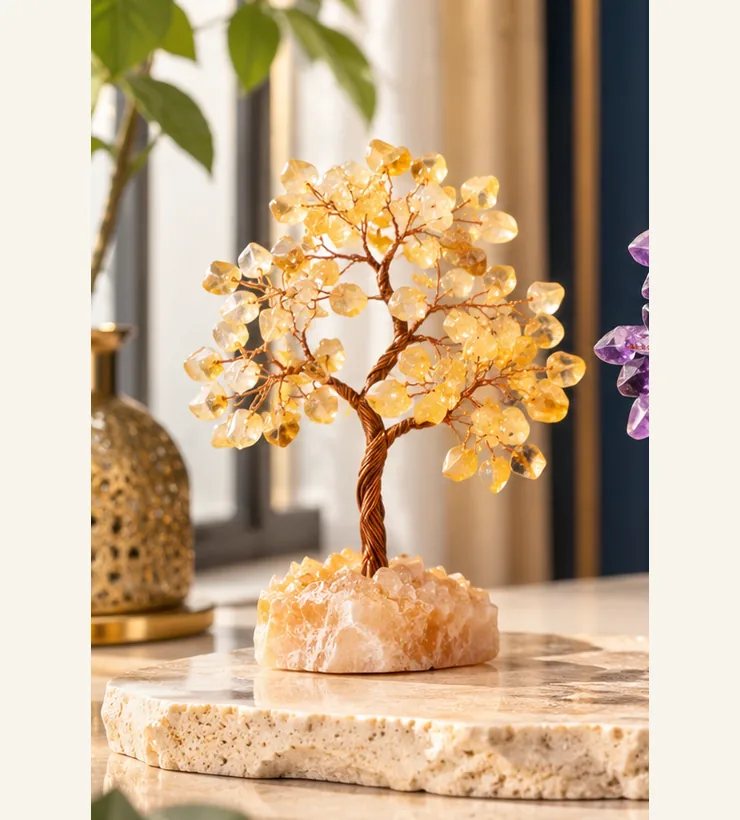
1. Golden Citrine-style tree
A close-up from the original three-tree editorial: small golden-yellow gemstone-like chips wired to a copper-coloured trunk.
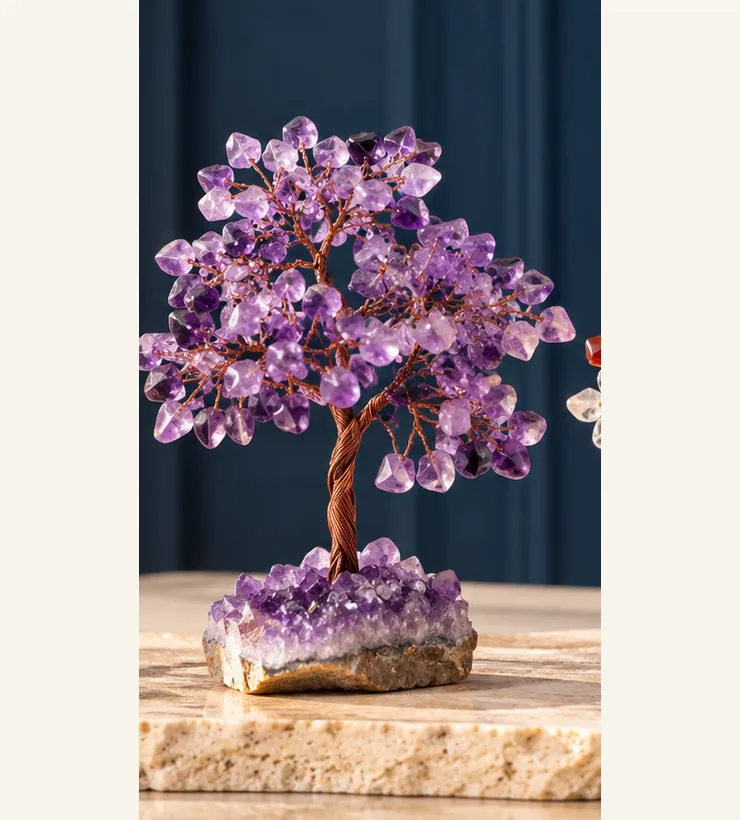
2. Amethyst-style purple tree
A separate close-up showing violet chip “leaves,” branching wire and a stable ornamental base.
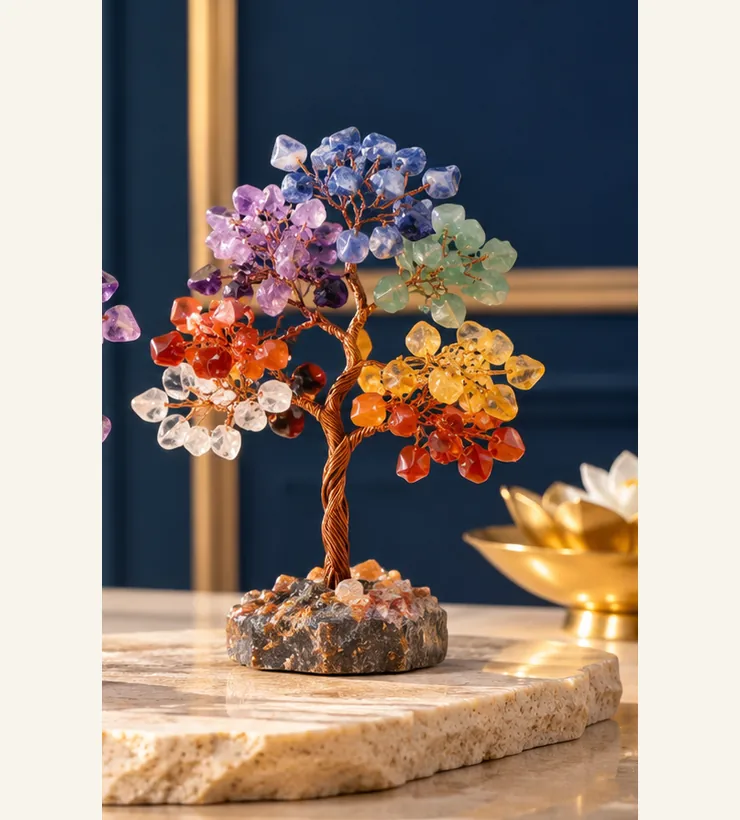
3. Seven-colour chakra tree
A multi-hue decorative tree representing contemporary chakra symbolism; individual chip species would need checking.
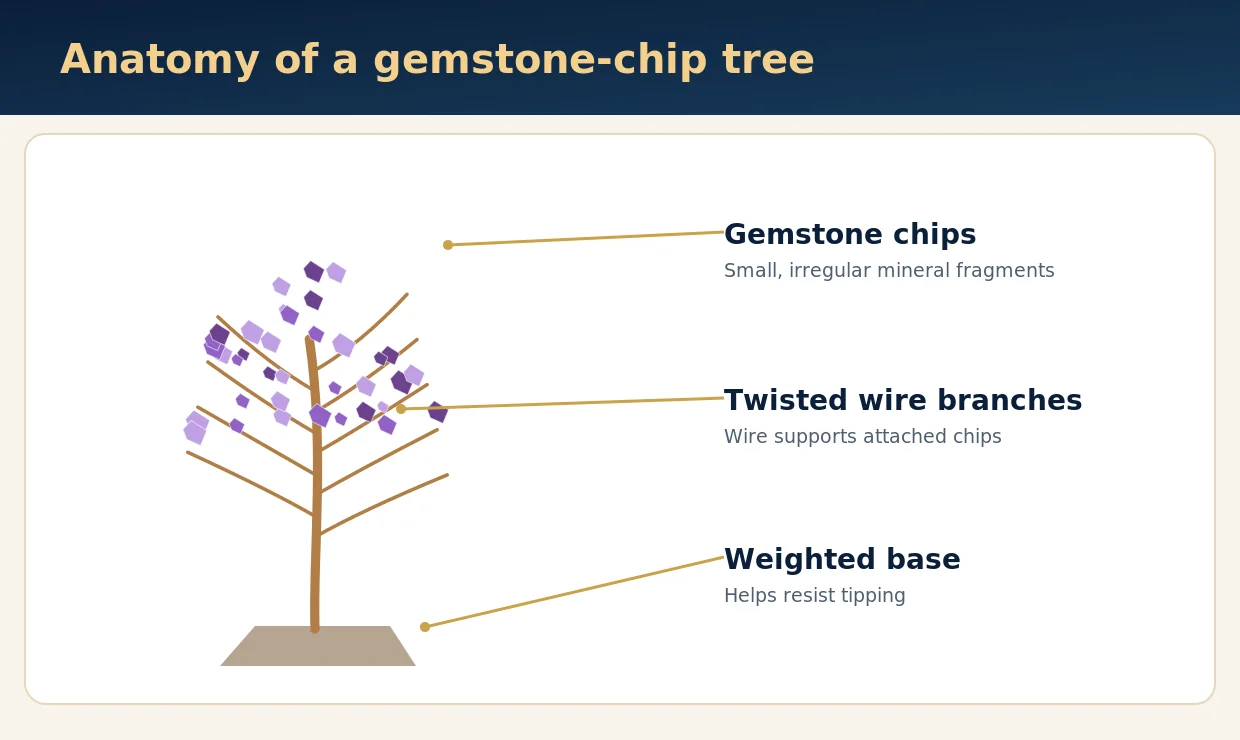
4. How a crystal tree is made
An original annotated illustration of gemstone chips, twisted wire branches and a weighted support base.

5. How to clean and store it
An original three-panel care diagram emphasizing gentle dry dusting, base support and padded storage.
The Tree of Life: why the design feels meaningful
Human cultures have used trees in art, mythology and architecture to represent the passage of time, roots, renewal and interconnection. The miniature gemstone-tree sculpture borrows these familiar qualities. Wire branches can curve upward like new growth, while colourful chip leaves add texture and individual variation. It works as decorative art even without any spiritual interpretation.
Some contemporary crystal sellers describe a tree as a “360-degree energy fountain” or an air purifier for bad vibrations. The branched shape does not establish a measurable special field, and mineral chips are not equivalent to a mechanical air filter. A peaceful room atmosphere is better supported by suitable lighting, clean surfaces, comfortable furniture and a design you enjoy.
Within modern crystal traditions, a small tree may be a useful personal reminder to remain rooted, cultivate relationships, or follow through on a practical goal. This is symbolism and self-expression rather than a product that alters the body or guarantees a result.
Three popular gemstone-chip tree styles
| Style | Common appearance | Symbolic association | Practical display priority |
|---|---|---|---|
| Citrine money tree | Golden or honey-yellow chips with metal-wire branches | Prosperity, intention and growth in contemporary décor | Stable office shelf away from heat; confirm the actual quartz and any colour treatment |
| Amethyst tree | Violet or lilac quartz chips | Reflection and calm in modern crystal traditions | Keep out of prolonged harsh sunlight and away from fragile edges |
| Seven-chakra tree | Seven chip colours in separate zones or mixed branches | Modern seven-chakra colour symbolism | Identify each chip type individually and handle varying material sensitivities conservatively |
1. Citrine-style money tree: growth as a personal symbol
Warm yellow chips and copper-toned wire make a Citrine-style tree particularly effective in a navy or ivory home office. Some contemporary Feng Shui enthusiasts associate it with a “wealth corner,” sometimes described as southeast-facing, but the specific rules differ among approaches. Positioning a tree cannot reliably produce revenue or replace budgeting, marketing or good business decisions.
Citrine is the yellow-to-orange colour variety of quartz. The gemstone market includes substantial amounts of heat-treated quartz, so a yellow chip is not independent proof of untreated Citrine. Review our Citrine natural-versus-treated guide if identity and treatment are important to you.
2. Amethyst tree: a quieter colour statement
Violet chip leaves can look refined beside soft neutrals, books or a small meditation corner. Amethyst is a purple variety of quartz, and some specimens can fade with prolonged intense light. Treat an Amethyst tree as décor, not a cure for insomnia or anxiety.
For safety, avoid placing a heavy or awkwardly balanced tree on a bedside shelf where it could fall while someone sleeps. A stable, shaded tabletop or bookshelf may be a better choice. GIA advises care with intense light and heat for some gemstones, including Amethyst. See GIA’s general jewellery care advice.
3. Seven-chakra tree: a contemporary multicolour composition
Seven-colour trees are often marketed with chips representing red, orange, yellow, green, blue, indigo and violet chakra imagery. Different makers can use different minerals to achieve those colours, and some leaves may be dyed or manufactured. It is not safe to assume that every colour corresponds to one precise species or that the item is independently laboratory certified.
In modern crystal traditions, the coloured tree can be a symbol of connectedness or a visual prompt for reflection. It has not been shown to align measured physiological energy centres or repair family conflict. Choose it for colour, craft and a meaning that feels appropriate to you.
Feng Shui and Vastu: traditions, not interchangeable guarantees
Feng Shui has Chinese historical roots in the interpretation and arrangement of environments. Vastu Shastra arises from Indian traditions concerned with architectural and spatial relationships. They have different histories and should not be collapsed into a single universal map of rooms and energy.
A contemporary gemstone bonsai tree can be used symbolically within either modern home-decor context, but specific instructions like “every Citrine tree belongs in the southeast” or “a seven-chakra tree must correct the centre of every home” are not universal scientific facts. The tree is a decorative choice, not a substitute for building repairs, ventilation, lighting, accessibility or professional advice.
If you follow a particular household tradition, you can give a position personal significance while still prioritising ordinary object safety.
Where to place a crystal tree
- Choose a level, stable shelf, console or desk where the base sits flat.
- Make sure the tree is clear of shelf edges, open windows, doors and busy walking routes.
- Prefer pleasant indirect light rather than prolonged harsh sunlight or heat from lamps.
- Allow enough clearance for the branches so chips do not catch on clothing, curtains or bags.
- Keep small chip ornaments away from pets and young children if parts could detach.
- Position it where you genuinely appreciate its appearance instead of forcing a prescribed compass direction.
How to choose the right size
Look for stated total height, canopy width, base footprint and shipping weight, not only an approximate “100 chips” label. A compact desk tree is practical if its wires do not obstruct work or tip when moved.
For a table or meditation corner, consider the relationship between the tree’s size, furniture width and room circulation. A narrow or unusually top-heavy base can be a risk even when the tree itself is small. Ask the seller for a photograph taken alongside a known-scale object.
A secure, well-made tree with fewer real chips may be a better choice than a larger decorative piece with unstable wiring.

Check chips, size, base material, wiring, treatment and any genuine documentation.
Use a stable surface, enough branch clearance, indirect light and sensible distance from children and pets.
Dry-dust gently, support the base, minimise bending and store in padded packaging.
What is a gemstone tree actually made from?
A tree combines small chip-like leaves, bent or twisted metal wires, a sculptural trunk and usually a stable base. Even when a mineral leaf is genuine, the complete object is not “100% natural crystal.” The wire may be copper-coloured rather than pure copper; the base may be a rough mineral, a cast material or a manufactured stand; and some leaves may be glass or dyed stones.
The words natural, untreated and lab certified describe different things. A specific laboratory report may identify a tested mineral sample, but it cannot automatically certify every leaf on a multi-stone tree. Ask for exact-item photos, material disclosure, construction details and the actual report before relying on such claims.
Inexpensive imitations can still be pleasant décor if marketed transparently. High-quality material and design matter most when the seller gives accurate information about what is being sold.
Practical buying checklist for a crystal bonsai tree
| Check | Why it matters | What to ask |
|---|---|---|
| Actual images | Colour, chip count and wire shape can vary by item | Is this the exact piece or a representative image? |
| Stone identity | Trade names and colour alone do not prove mineral species | Which chips are genuine quartz, other minerals, glass or dyed material? |
| Dimensions | Tree height is different from canopy width and base footprint | What are the total height, width, base diameter and weight? |
| Wiring | Repeated bending and weak attachments may shed chips | Which metal or finish is used, and how much shaping is recommended? |
| Base | A top-heavy or uneven object can tip | Is the base weighted, flat and free from cracks? |
| Treatments | Dyes and finishes can affect durability | Are stone chips treated, coated, dyed or composite? |
| Reports | A certificate may cover only one sample | Which laboratory tested what, and does it match this item? |
| Packaging | Fine wires and chips can bend or break during delivery | How are individual branches protected in shipment? |
How to clean a crystal gemstone tree safely
A gemstone-chip tree is a multi-material object. Its care must account for the most fragile component, not simply the hardness of one quartz chip. The wires can tarnish or weaken if repeatedly bent, adhesives may loosen with moisture and unknown bases may be sensitive to cleaning products.
- Stabilise the base. Place the tree securely on a soft, clean surface and support its weight during handling.
- Dust lightly. Remove dust from exposed chips and wire using a clean, very soft dry brush. Avoid forcing bristles into fragile clusters.
- Shape gently. If the maker permits, adjust branches a little at a time while supporting the trunk; do not tug on individual chips.
- Avoid soaking. Do not submerge the entire tree or rinse it under running water as a universal method.
- Protect from heat. Keep it away from steam, direct flame, heaters and prolonged harsh sunlight.
- Store carefully. Use cushioning so fine branches are not crushed and chips cannot rub against harder objects.
Is sage or incense smoke necessary?
No. Smoke does not physically remove dust or restore damaged wire, and burning aromatic material indoors can create air-quality and fire concerns. Personal symbolic rituals are optional; a soft dry brush and safe storage remain the practical maintenance steps. Our Crystal Cleansing Methods guide explains why care must be matched to each mineral and construction.
For gemstone-specific cleaning and light considerations, see GIA’s Citrine care recommendations and GIA’s gemstone-jewellery care guidance.
How to pack a tree for moving
Photograph the original branch layout, gently consolidate loose branch tips if the maker permits, and protect each section with soft non-abrasive padding. Avoid compressing delicate leaves against sharp or harder surfaces. Place the base securely in an appropriately sized inner box to prevent lateral movement.
For a valuable handmade item, ask the maker for packing instructions before disassembling anything. Wire fatigue and chip breakage can occur when a tree is repeatedly reshaped.
When not to use a crystal tree
A gemstone tree is not a substitute for correcting building defects, addressing a dangerous electrical issue, seeking treatment for insomnia or managing family finances. It also does not remove airborne pollutants just because the branches extend in several directions.
There is no need to make exaggerated claims for a decorative object to have real appeal: craft quality, natural-looking colours, personal symbolism and an attractive display are sufficient reasons to appreciate it.
Current Divinity Crystals catalogue and related items
The catalogue review did not identify a confirmed published gemstone-tree or bonsai-tree listing at the time of this rebuild. This article therefore does not invent buttons for “certified Citrine money trees,” “seven chakra money trees,” or other unverified products. The cover, model scene and three photographed detail crops are original editorial illustrations, while the wire-construction and care diagrams are original artwork.
You can browse the Vastu & Feng Shui Crystals category for currently listed home décor and the Raw Crystals collection for real mineral specimens. These categories are not evidence that the exact trees pictured here are in stock.
If you are comparing the gemstones shown as leaves, read our Citrine meaning, treatment and care guide and Crystal Spheres guide for related mineral and decorative context.
Frequently asked questions about crystal trees
What is a crystal tree?
A handcrafted decorative tree typically made from thin twisted wire branches, small gemstone or glass chips, and a stone or synthetic supporting base. The tree shape is artwork, not a living plant.
What does the Tree of Life symbol represent?
Trees commonly symbolise growth, continuity, roots and connectedness across many traditions. Meanings vary between cultures and are not universal claims about a product’s physical power.
Is a gemstone tree traditionally part of Feng Shui?
Modern gemstone-chip trees are widely used in contemporary Feng Shui-inspired décor. Do not assume every recent gemstone or chakra practice appears in classical Chinese Feng Shui texts.
Will a crystal tree attract money?
There is no reliable evidence that an ornament creates income or guarantees financial opportunities. A Citrine-style tree can be a personal prosperity symbol or decorative reminder of practical goals.
Which crystal tree is best for a desk?
Choose by available space, a stable weighted base, low glare, material appearance and personal preference. A petite Citrine- or Amethyst-style piece can work aesthetically.
What is a seven chakra crystal tree?
A modern decorative tree with several colours linked symbolically to seven chakra concepts. The exact mineral species and chip quality vary by maker.
Are crystal tree leaves made from natural gemstones?
Some are; others can be dyed, treated, manufactured glass or imitation chips. Ask for a material list and actual photographs of the item rather than assuming.
How can I tell if the chips are genuine?
Visual colour can suggest a variety, but it cannot reliably prove the mineral. For high-value items request documentation or competent testing of the actual chips.
Are crystal trees made entirely of stone?
Usually not. Trees typically combine chips with metal wire, a base, adhesives and sometimes coatings. Those components change the care and durability requirements.
Can I bend the branches of a crystal tree?
Many wire trees permit limited gentle shaping, but repeated bending can fatigue wires and dislodge chips. Support the base and follow the maker’s instructions.
How should I clean a gemstone-chip tree?
Begin with gentle dry dusting using a soft brush while stabilising the base. Avoid aggressively rubbing chips, pulling wires, immersing adhesives or soaking the assembly.
Can I keep crystal trees near candles?
It is safer to keep flammable decorations and fragile chip trees away from open flames, hot lamps and unstable candle arrangements.
How do I avoid a tree tipping over?
Check that the base is sufficiently heavy, flat and secure, that wires are balanced, and that placement is away from edges, children and pets.
Are the crystals pictured in this article for sale?
The cover and gallery are original editorial illustrations and detail crops, not photos of verified inventory. The catalogue review did not show a confirmed published gemstone-tree SKU.
What should I check before buying one online?
Confirm dimensions, weight, chip species, treatment disclosures, wire finish, base construction, real-item photographs, packaging, returns and any relevant documentation.
Final perspective: let the tree represent growth, without unrealistic promises
A gemstone-chip tree is a piece of handcrafted decoration whose beauty comes from small coloured stones, careful wiring and a balanced Tree of Life silhouette. Whether you enjoy Citrine’s prosperity association, Amethyst’s reflective symbolism or a seven-colour composition, the value can be personal and aesthetic rather than supernatural.
Choose transparent materials, stable construction, accurate photos and safe care. Display the tree where it looks beautiful, and let any intention it represents be supported by everyday actions rather than claims that it guarantees results.