

Divinity Crystals · A practical mineral & tradition guide
A polished crystal sphere is a round object shaped from quartz, another mineral, or sometimes a manufactured material such as glass. Its smooth surface and balanced proportions make it attractive for collector displays, reading corners, decorative arrangements and symbolic practices.
In sacred-geometry imagery, a circle or sphere often represents wholeness and continuity. In contemporary Vastu- and Feng Shui-inspired décor, people sometimes position spheres as reminders of calm, connection or intention. These interpretations are cultural and personal symbols, not evidence that the sphere broadcasts therapeutic energy or alters a building’s physical environment.
This guide explains the classic Amethyst, Rose Quartz and Clear Quartz sphere styles, where a round mineral object can be displayed safely, what to examine before buying and why transparent spheres must be kept away from strong direct sunlight.
Explore our Vastu and Feng Shui Crystals category for existing décor-related products. The original editorial sphere images in this guide are illustrations and are not photographs of identified stock items.

Key takeaways
- A sphere is a shape, not proof of material, origin, treatment or certification.
- Amethyst is purple quartz, Rose Quartz is pink quartz and Clear Quartz is colourless quartz.
- Sacred geometry and Vastu associations are symbolic traditions, not measurable healing or financial guarantees.
- Always use a stable stand and keep heavy round objects away from shelf edges.
- Transparent spheres can concentrate sunlight and present a fire risk; shade them.
- Ask for diameter, weight, actual photographs, treatment disclosures and any genuine test report.
Five ways to appreciate crystal spheres
Five original subject-specific editorial scenes: three popular quartz varieties, a curated collection and a careful Indian home display. They illustrate design choices, not exact merchandise or verified mineral tests.
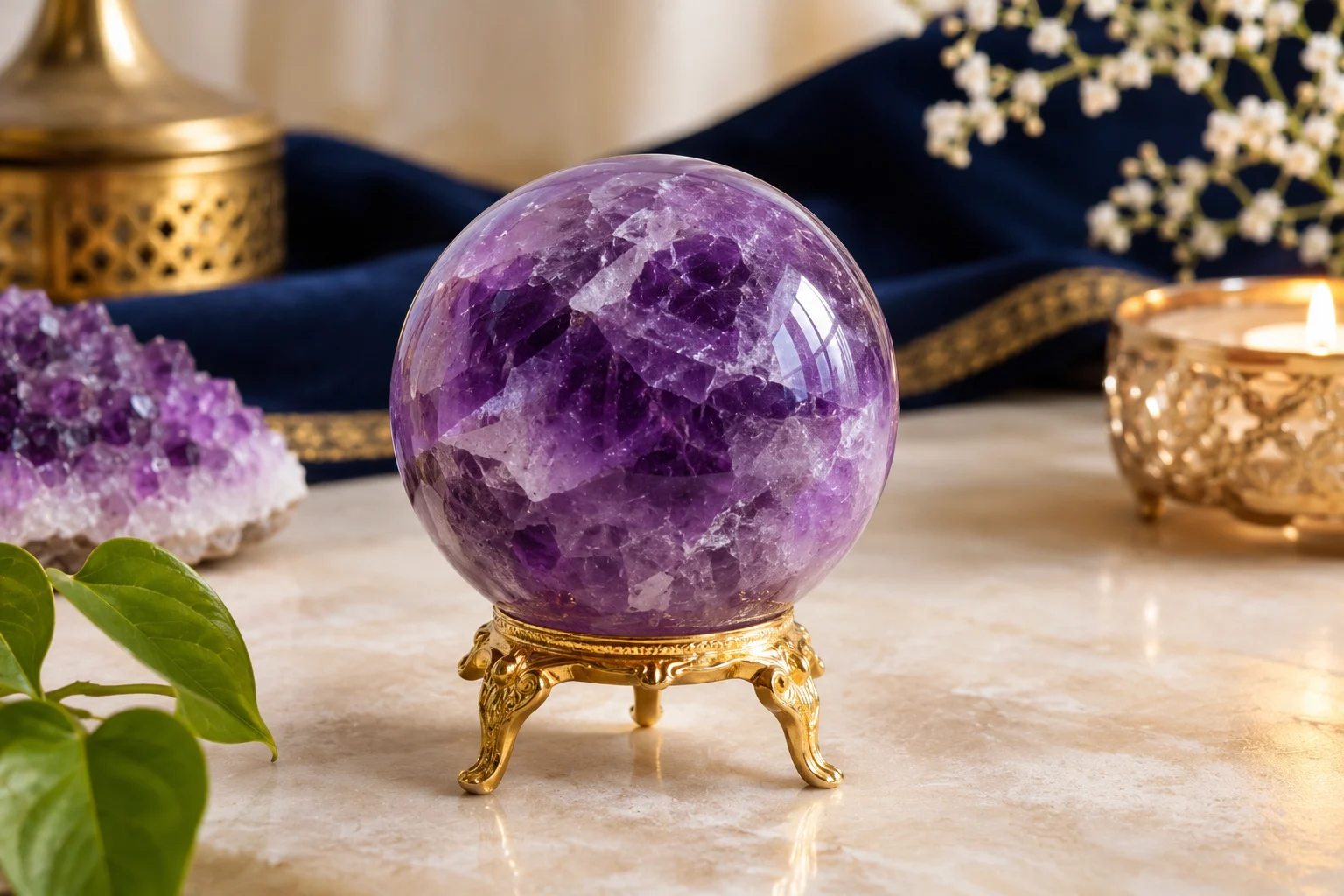
1. Amethyst sphere
A decorative purple sphere often selected for a quiet reading or meditation corner. Colour and inclusions vary by material.
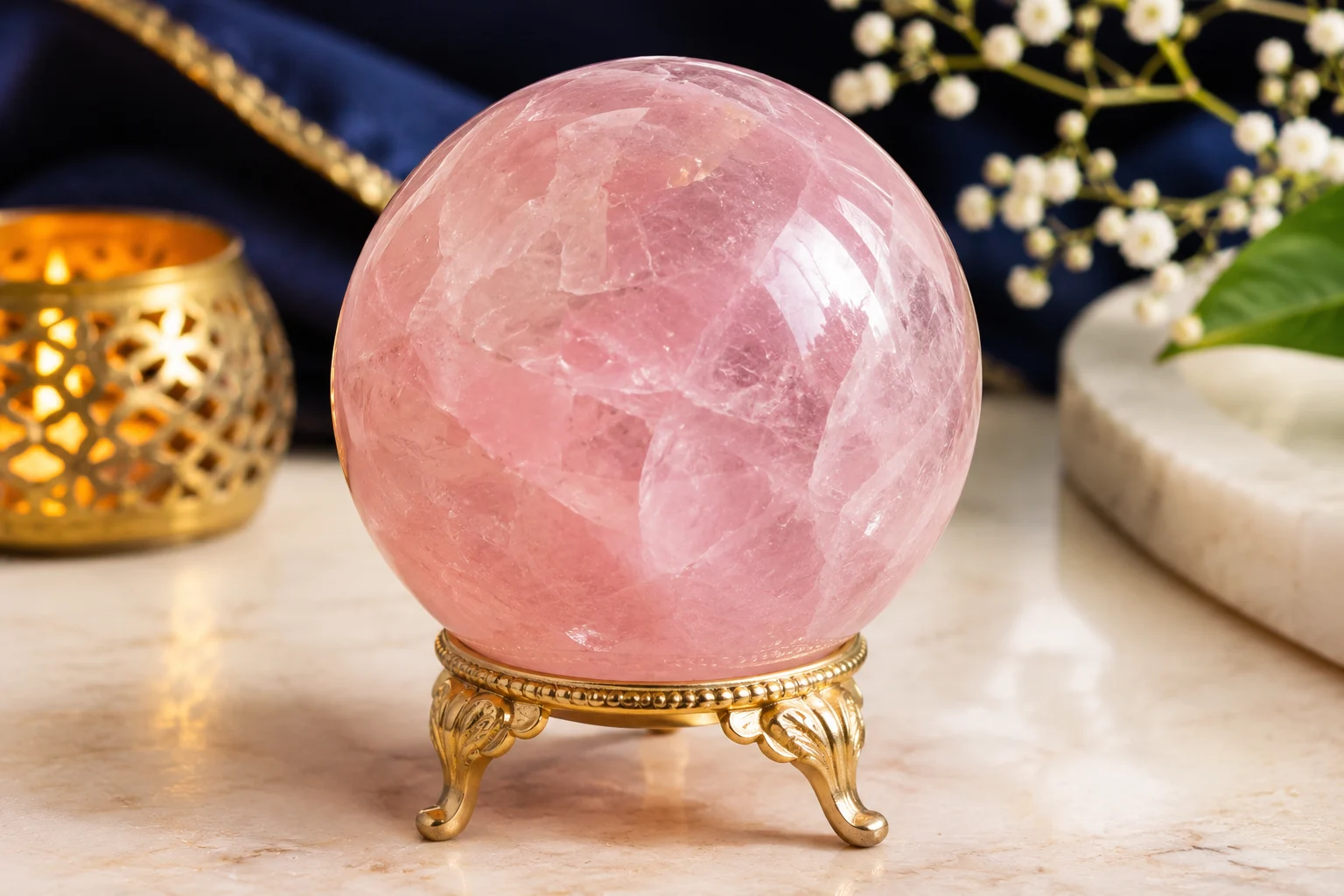
2. Rose Quartz sphere
Pink quartz is commonly associated with affection in modern crystal traditions; choose it for colour and symbolism.
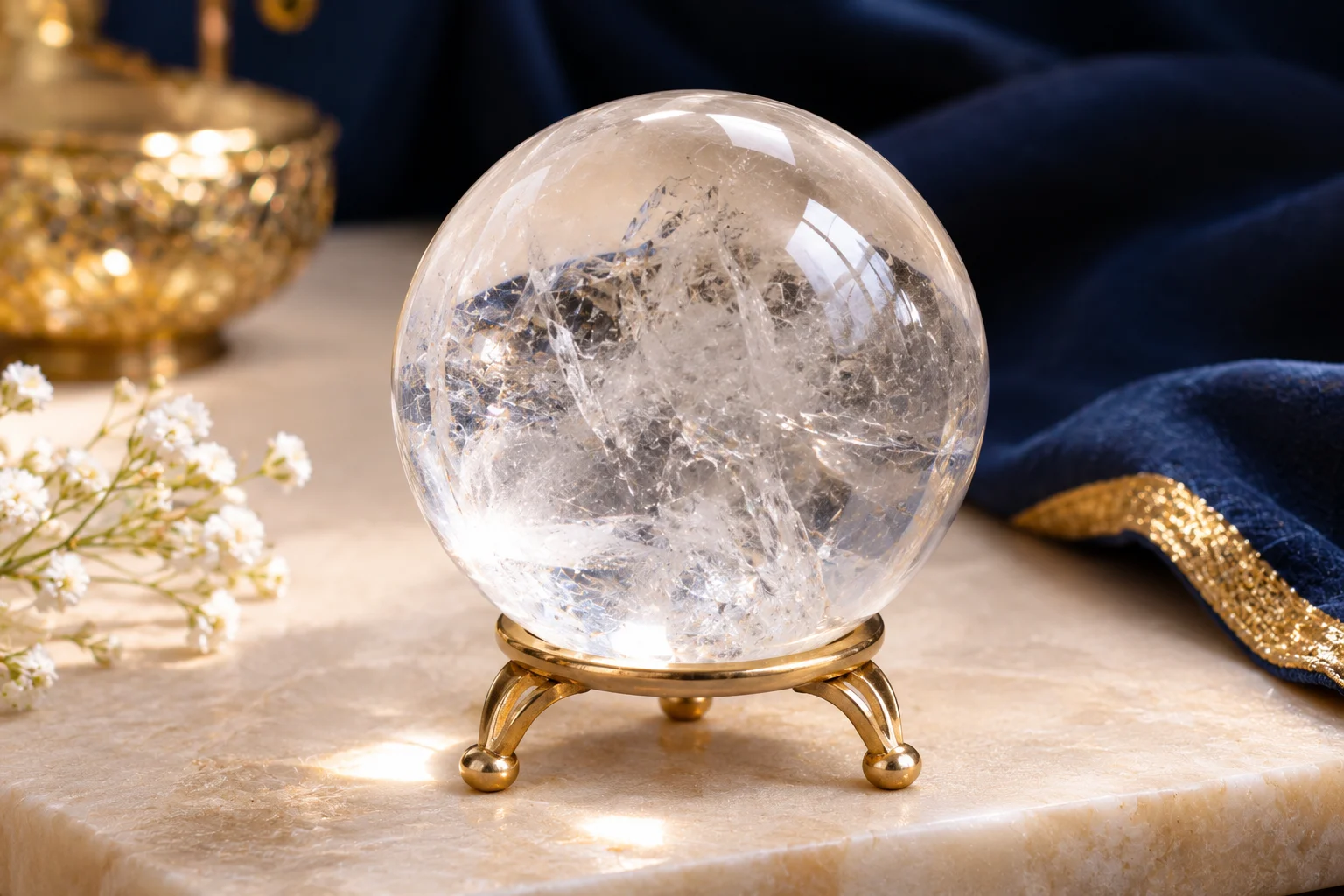
3. Clear Quartz (Sphatik) sphere
Transparent material makes veils and inclusions visible; never put a clear sphere in direct sunlight.
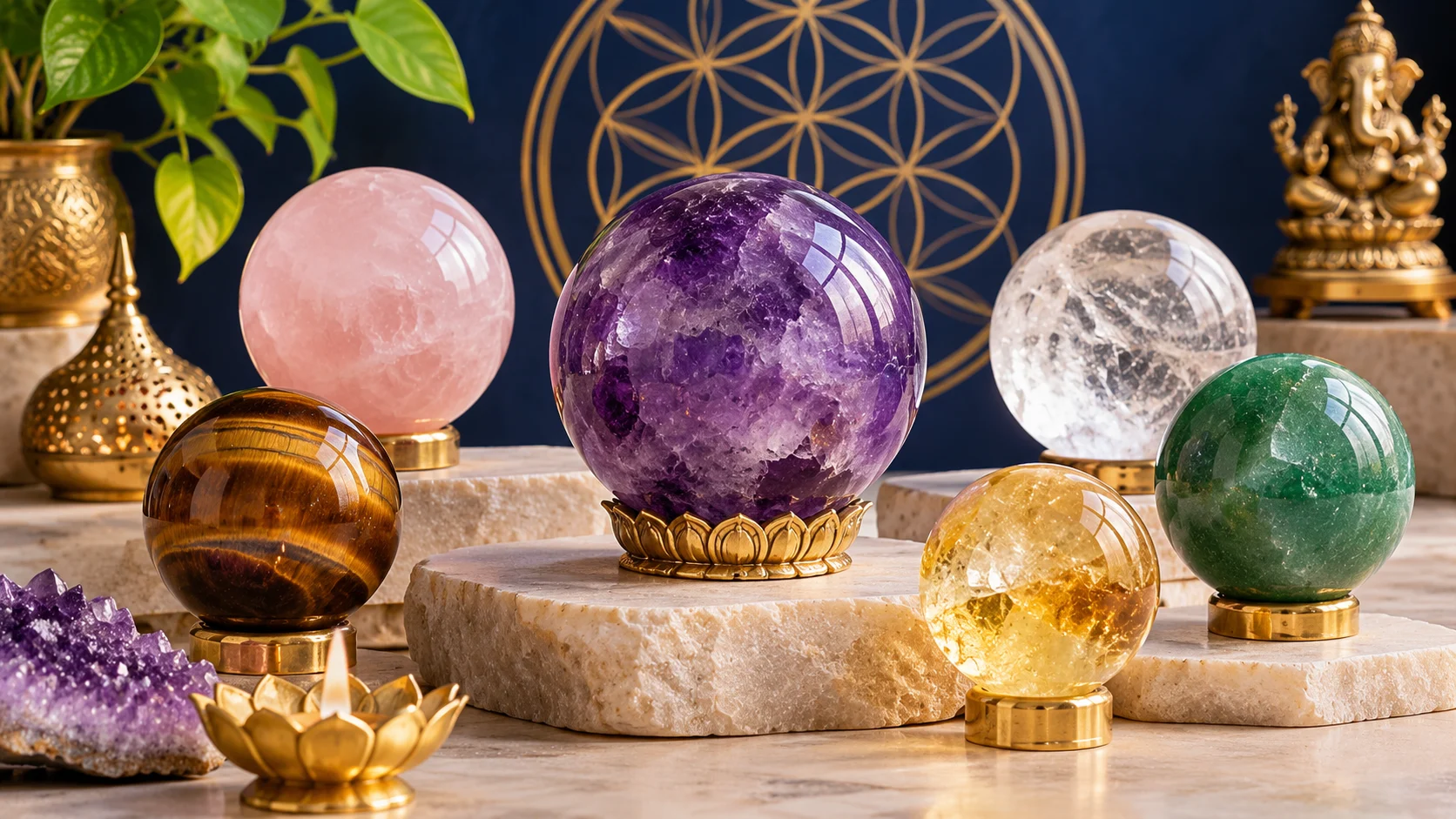
4. Mixed sphere collection
Compare shades, diameters, stands and placement before deciding how to organise a display.
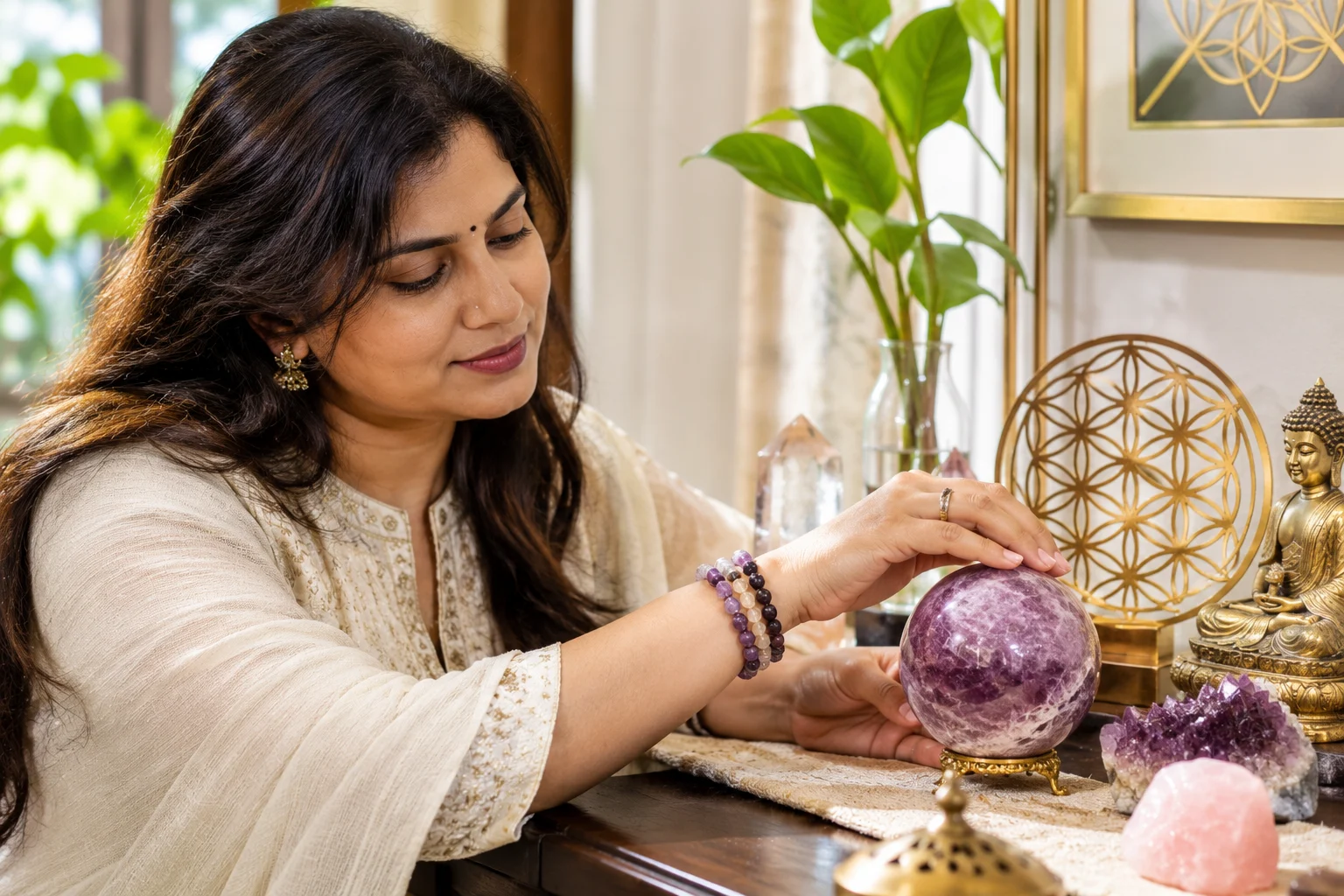
5. Decorative home placement
A stable stand, comfortable viewing height and safe indirect light matter more than rigid placement rules.
The perfect shape of universal harmony: symbolism vs. science
Mathematically, a sphere is the set of all points at the same distance from a centre. This symmetry is visually satisfying and appears in design, architecture, religious art and scientific diagrams. A sphere has no sharp corners, so it can work well as a centrepiece in simple interiors.
Many modern crystal traditions describe the sphere as a representation of unity or a continuous cycle. Some use expressions such as “360-degree energy,” but these are metaphors within belief systems; a polished rock has not been shown to broadcast a special harmonising field in every direction. The mineral’s measurable properties—hardness, density, inclusions, light transmission and surface polish—are separate from symbolic claims.
Popular ways people use crystal spheres
Decorative focus & personal ritual
Place a sphere on a stable interior shelf as a point of visual interest or as a reminder to pause. An attractive object may enrich a space without making claims about stress reduction or guaranteed emotional changes.
Quiet observation or meditation
Some people focus visually on a sphere while journaling or meditating. Scrying, a historical divination practice involving gazing, is a cultural tradition rather than an evidence-based way to predict events.
Some spheres are sold for massage, but a hard, heavy mineral ball is not inherently a safe treatment tool. Avoid pressure over the head, temples, neck, joints or injured areas, and never represent stone rolling as a medical therapy.
Amethyst, Rose Quartz & Clear Quartz: how to choose
These three quartz varieties offer different appearances and traditions, but the mineral-specific care and safe display conditions matter most. The following comparison describes typical materials, not authentication of any pictured specimen.
| Sphere style | Appearance and traditional association | Practical display note |
|---|---|---|
| Amethyst | Violet-to-purple quartz, often chosen for reflection or meditation symbolism. | Keep away from prolonged intense sun because some Amethyst colour may fade. |
| Rose Quartz | Soft pink quartz, linked symbolically to affection and compassionate relationships. | Use a padded, stable stand; shade from strong light and avoid knocks. |
| Clear Quartz / Sphatik | Colourless transparent or translucent quartz, popularly used in mindful décor. | Never place in direct sun: a clear curved object can concentrate light onto nearby materials. |
All three are quartz varieties, commonly rated around 7 on the Mohs hardness scale, but treatments, internal fractures, inclusions, fittings and non-quartz materials can change actual care requirements. See GIA’s Amethyst mineral overview and GIA’s cleaning guidance.

Where to place a crystal sphere for Vastu-inspired décor
Modern practitioners sometimes recommend a centre-of-room position, a quiet bedroom table or a particular compass sector. These are optional symbolic ideas, and there is no reliable basis for claiming that a mineral sphere neutralises conflict, cures illness, removes structural “defects” or produces financial gain.
Whatever meaning you assign to a sphere, use these practical checks first:
Choose a stable stand
Ensure the stand supports the diameter and weight, does not wobble and cannot easily slide.
Use indirect light
Display away from direct sun, concentrated beams, heat sources and open flames.
Keep safe distance
Stay clear of high shelves, children, pets, loose table edges and busy passageways.
Important: transparent spheres and sunlight can cause fires
A clear curved object can act as a lens and concentrate sunlight. Under certain conditions the focused light can heat nearby combustible material enough to ignite it. Fire and rescue services have documented fires associated with glass ornaments and other reflective or refracting household items.
- Do not leave a transparent glass or quartz sphere on a sunny windowsill or in a beam of direct sun.
- Do not position spheres where light can focus onto curtains, paper, upholstery, bedding or wooden furniture.
- A decorative window position that seems safe at one hour may receive direct sunlight later as the sun moves.
- Choose shaded, stable locations; avoid using a candle or lamp immediately beside fragile or heat-sensitive materials.
Read the Essex County Fire and Rescue Service crystal-ball fire report and London Fire Brigade household sunlight warning.
How to select a sphere
- Material: Confirm the gemstone or manufactured material and do not rely on colour alone.
- Size: Ask for actual diameter in mm or cm and estimate the required display space.
- Weight: Large solid spheres can be substantial; choose a support with adequate capacity.
- Condition: Review inclusions, surface scratches, cracks and any repaired areas.
- Treatment: Request disclosure of dye, filling, coating or stabilization if applicable.
- Documentation: If a certificate is advertised, check the issuing lab, scope and item match.
Natural mineral, glass or imitation?
Spherical polishing hides some of the rough structure used for visual identification. Internal veils, zoning, gas bubbles or uniform colour may be clues, but none proves origin by itself.
Glass, resins and mineral composites can be sold in a similar shape. An illustration or a retailer’s stock photo cannot establish what an individual item contains. For a high-value purchase, ask for independent gemstone identification and details of what the laboratory actually examined.
Why a stand matters
A properly fitted stand prevents rolling and protects edges and furniture. Choose a support with the right contact surface; heavy objects belong on stable lower shelves.
How to clean and care for a polished crystal sphere
Cleaning starts with the correct material identification. Quartz itself is comparatively durable, but surface coatings, colour treatments, epoxy, attached bases and internal fractures may require more caution. Never assume all decorative balls tolerate a full water wash.
- Keep the sphere supported securely on a soft cloth throughout cleaning.
- Remove loose surface dust with a clean, very soft cloth or appropriately gentle brush.
- For verified stable polished quartz, use a slightly damp soft cloth if appropriate; dry promptly and thoroughly.
- Avoid abrasive powders, harsh chemicals, prolonged soaking, ultrasonic devices and steam on unknown materials.
- Check the stand for moisture, loose fittings and surface scratches before returning the sphere to display.
Amethyst can be affected by prolonged intense light. Read GIA’s Amethyst Care and Cleaning Guide and our Crystal Cleansing Methods: How to Clean Stones Safely for material-specific differences.
Meaning of the sphere in Vastu, Feng Shui & sacred geometry
Vastu Shastra is an Indian building and spatial-design tradition, while Feng Shui developed in Chinese cultural contexts; they are not interchangeable systems. Modern home-decor guides sometimes combine symbols from both with Western “sacred geometry.” A well-written product description should indicate when it is describing a contemporary association rather than an established historical rule.
In symbolic practice, a sphere may stand for balance or unity, Amethyst for reflection, Rose Quartz for affection, and Clear Quartz for clarity. You are free to enjoy those meanings personally. No laboratory mineral test can verify that an object improves family relationships, removes bad luck or generates a particular “frequency of harmony.”
The practical advantages of a curated display—an organised room, an aesthetically pleasing object, a safe shelf and fewer cluttered surfaces—do not depend on unverified energy mechanisms.
Shopping and documentation at Divinity Crystals
Start with our Vastu & Feng Shui Crystals collection for current décor-related products. Sphere availability must be checked against live listings; the decorative examples above are not a promise that identical polished spheres are currently in stock.
To compare the raw materials that may be shaped into spheres, you can examine these actual product categories and listings: Amethyst raw chunk, Rose Quartz raw chunk, and Clear Quartz (Sphatik) cluster. These links are to raw minerals or clusters, not polished sphere listings.
Before purchasing any spherical stone, confirm the exact material, size, weight, photographs, treatment and testing status, included stand, returns information and safe-use guidance. Statements such as “100% natural” or “lab certified” need specimen-level evidence rather than an across-the-board guarantee.
Frequently asked questions about crystal spheres
What is a crystal sphere?
It is a round decorative or collector object formed by shaping and polishing mineral material (or, in some products, manufactured glass or resin). Its roundness alone does not prove mineral identity or natural origin.
Why are crystal spheres associated with sacred geometry?
The sphere is a familiar mathematical symbol of unity and symmetry. In contemporary spiritual décor, some people use it to represent wholeness, but this symbolism is not evidence of a measurable energy field.
Do spheres radiate energy in 360 degrees?
A sphere has a rounded surface in all directions, but claims that a stone emits healing or Vastu-correcting energy in a perfect radius are not established scientifically.
Where should I put a crystal sphere at home?
Use a stable, level interior surface away from direct sunlight, edges, children’s play areas and heavy foot traffic. A sturdy stand is more important for safety than a particular compass direction.
Can a clear quartz sphere start a fire?
It can be a hazard when strong sunlight passes through or is concentrated by a sufficiently transparent curved ornament, potentially focusing energy onto a nearby surface. Never display clear spheres in direct sun.
Can amethyst or rose quartz spheres fade in sunlight?
Some amethyst can lose colour after prolonged intense light, according to GIA. Light response depends on the specific mineral, inclusions and treatment; indirect light is a prudent display choice.
Is scrying scientifically supported?
Scrying is a historical divination or contemplative practice, not a demonstrated method for obtaining factual information about the future or supernatural entities.
How do I clean a polished quartz sphere?
If the material and any treatments are known to tolerate moisture, wipe gently with a slightly damp soft cloth and dry promptly. For an unidentified, glued or coated specimen, follow the seller’s specific care advice.
How do I prevent a crystal sphere from rolling?
Use a suitably sized, stable stand with an appropriate contact surface; place it away from shelf edges and check for wobble. A sphere may be much heavier than it looks.
How is sphere diameter measured?
Measure the widest straight-line distance through the centre of the sphere, in millimetres or centimetres. Use a suitable non-abrasive measuring tool and confirm seller-stated tolerances.
How can I tell natural quartz from glass?
Bubbles, flow marks and uniformity can raise questions, but neither imperfections nor visual appearance alone prove a specimen is quartz. For material certainty, request reliable test information from a qualified laboratory.
What size sphere should I buy?
Choose for display space, safe weight, handling needs and budget. Larger sizes can be heavy and may need a wider stand; seller dimensions and actual-item photos should guide the decision.
Can children or pets handle crystal spheres?
Heavy round objects can roll, fall and break; small spheres can create choking hazards. Keep them securely displayed and supervise any handling as appropriate.
What should I request before buying?
Ask for the material name, exact or representative photographs, diameter, weight, included stand, natural or manufactured status, treatment disclosures, visible flaws, and documentary evidence for any laboratory claim.
Balance your space with informed choices
Crystal spheres can be beautiful objects for collecting, home décor and symbolic reflection. Their rounded shape has a clear visual appeal, while Vastu and sacred-geometry associations belong to the realm of tradition and personal meaning rather than guaranteed outcomes.
Choose a safe stand and indirect light, understand the actual mineral, verify claims before buying and keep transparent spheres away from direct sunlight. Beautiful décor and careful material handling go together.