
Divinity Crystals · Indian Home Styling, Mineral Décor & Thoughtful Traditions
Crystals can make memorable accents in a home: natural Amethyst points beside books, a pale-pink Rose Quartz carving on a secure shelf, a bright Clear Quartz cluster where it catches indirect light, or a small bowl of Pyrite for metallic contrast. The material, craftsmanship and proportions of the object are part of what makes it appealing.
Vastu Shastra is an Indian tradition concerning architecture, orientation and spatial planning. Contemporary home styling often combines selected Vastu ideas with gemstone symbolism and, sometimes, elements borrowed from Chinese Feng Shui. These practices can carry cultural or personal meaning, but they do not make a stone a proven architectural remedy or a guaranteed source of wealth, health or marriage harmony.
At Divinity Crystals, our role is to help customers select real, properly described stones and care for them well. This guide concentrates on room-by-room décor decisions rather than repeating the ritual steps and direction-based discussions in our Rituals & Vastu guide. We focus on six everyday areas, proportion, safety, real first-party merchandise photographs and material-specific care.
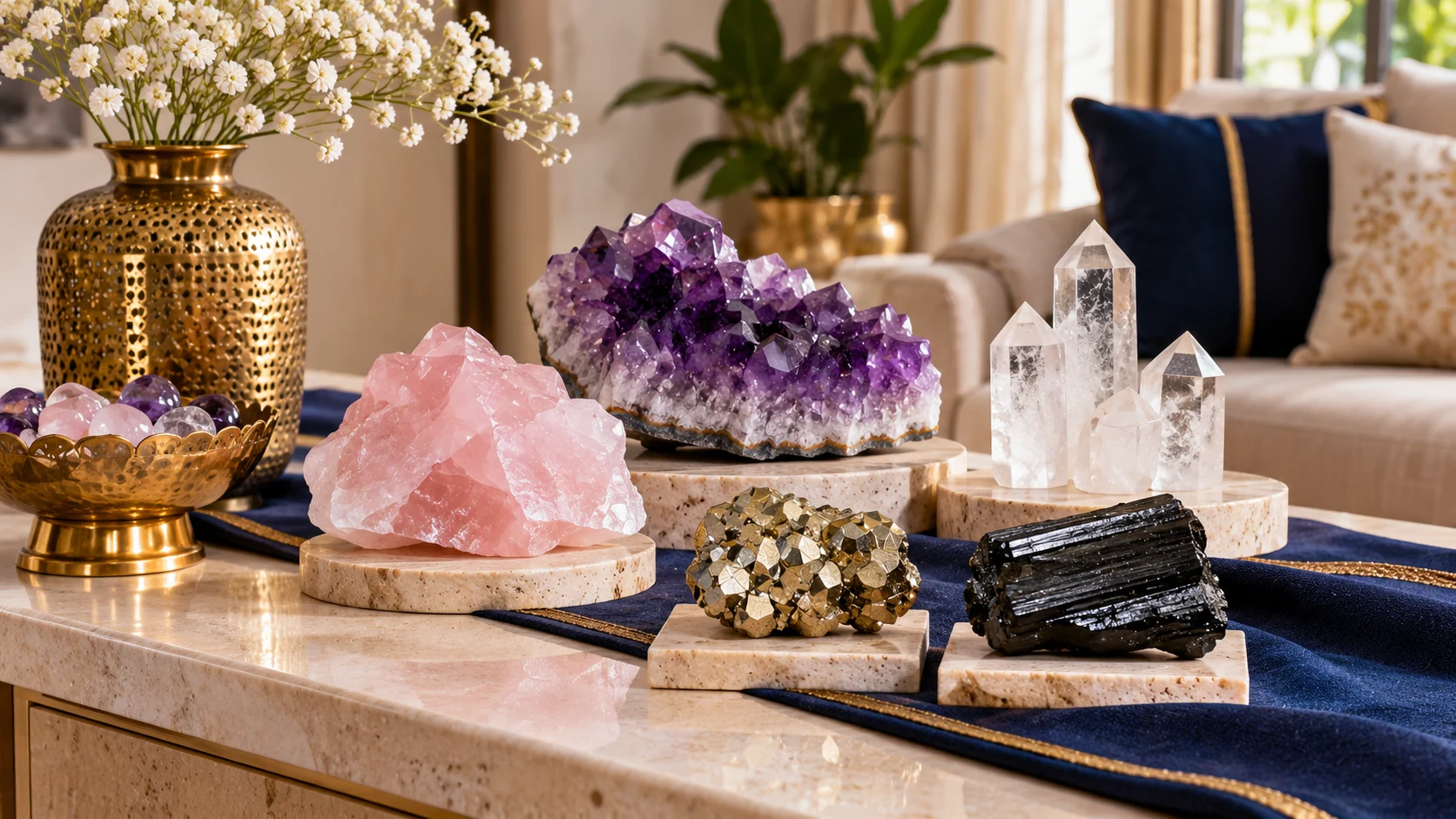
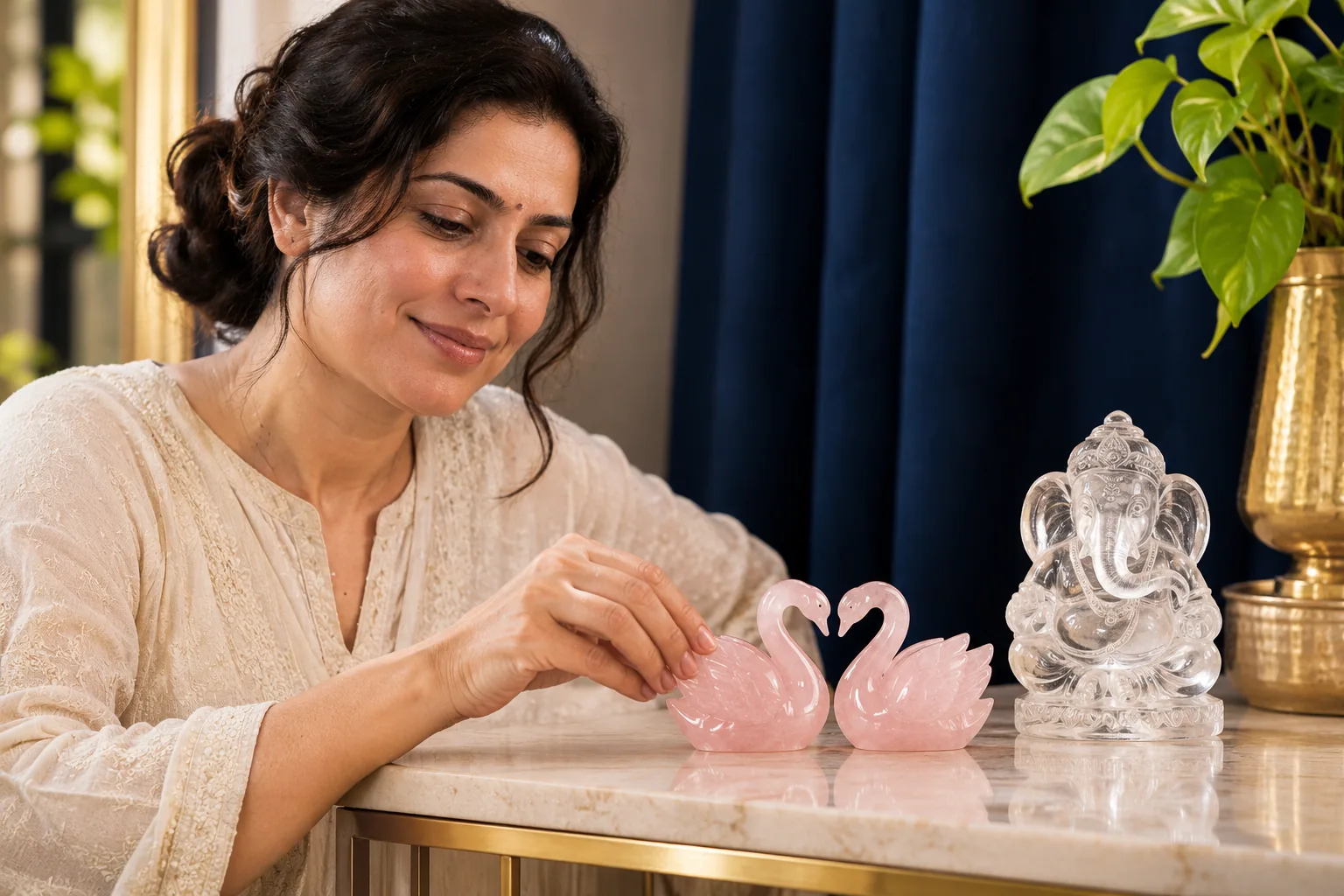
Our featured interior and Indian lifestyle portrait are original editorial illustrations. The five gallery images below are attached to actual products sold through our own storefront. They illustrate real materials and formats; always check a selected item’s weight, dimensions, finish and documentation on the relevant listing.
Seven principles for a premium, safe crystal home display
- Choose the room first: select an object that fits the actual available space and furniture.
- Do not treat Vastu and Feng Shui as interchangeable: their histories and symbolism differ.
- Check the material: Quartz, Pyrite and Malachite need different care.
- Keep heavy and pointed specimens secure: avoid shelf edges, unstable stands and busy pathways.
- Use genuine product images: an editorial arrangement is not evidence about the exact stone you receive.
- Protect children, pets and guests: keep small loose pieces, sharp edges and hot flames out of reach.
- Let symbolism remain optional: no stone placement guarantees relationships, health or income.
What is Vastu décor—and where do gemstones fit?
Indian Vastu literature addresses the built environment: site and orientation, proportional design, room arrangements and ways of understanding directions. A study of traditional Indian knowledge systems published by ICCROM describes orientation, site planning and measurement as major architectural principles. A modern suggestion to place one particular mineral at a particular corner should therefore be recognised as a contemporary interpretation, not the entire tradition.
Some households observe a preferred direction for prayer, a location for family photographs or an established custom of keeping an auspicious object near an entrance. Others simply like the natural geometry of Quartz or the pink colour of Rose Quartz. Both approaches can be respected without requiring unsupported claims about an object’s ability to change a room’s measurable energy field.
We use the phrase Vastu-inspired deliberately. A beautiful crystal on a stable table does not repair leaking walls, ventilation problems, structural issues, unsafe wiring or a stressful family situation. Good interior planning and necessary professional repairs remain practical priorities.
Our Vastu Shastra crystal placement guide explores interpretations of orientation in more detail. Here the priority is how crystal décor actually looks, fits and remains safe in everyday Indian homes.
Six rooms, six practical crystal styling approaches
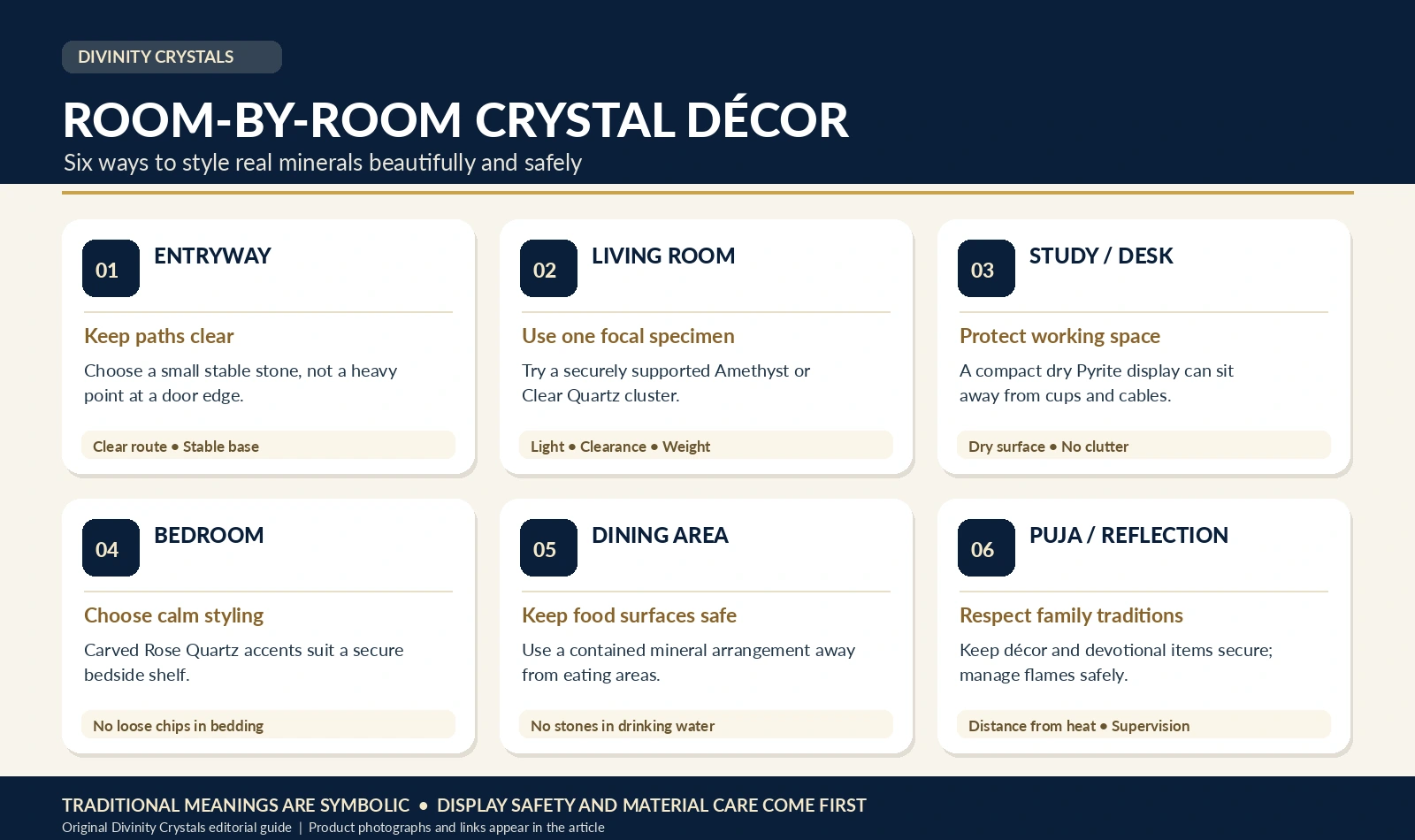
There is no required crystal for each room. Think about space, line of sight, natural light, how the room is used, and who may touch the objects. The examples below are styling ideas, not compulsory prescriptions.
A clear first impression
An entrance often has narrow ledges, moving bags, shoes and busy foot traffic. Choose a low-profile, stable mineral or a small decorative piece on a secure console rather than a sharp cluster at the edge. The most important rule is that the doorway remains unobstructed.
Material idea: a compact, contained smooth stone; avoid large loose chips and heavy points that could fall.
One natural focal point
A well-supported Amethyst or Clear Quartz cluster can add colour and natural crystal structure to a console. Place it where its points are visible but will not snag clothing, be knocked by a curtain or press against other objects. A good base matters more than having many stones.
Material idea: one accurately labelled cluster, with enough clearance and indirect light.
An uncluttered mineral accent
A small Pyrite specimen or contained tumblestones can add metallic texture without taking over the workspace. Keep them away from cups, computer vents, cables and frequent hand movements. Pyrite’s prosperity symbolism is optional; actual work habits and financial planning matter more.
Material idea: dry-stored Pyrite in a secure dish or on a padded base.
Soft colour and careful storage
Rose Quartz carvings can provide a blush-pink decorative accent on a bedside shelf. If the item is a paired bird carving, treat it as ornamental and verify its construction, weight and stability. Keep the figures away from bedding, heavy books, children and places where they can easily fall.
Material idea: a polished Rose Quartz carving or safely supported tumble.
Decorate without contaminating food
A mineral display works best on a separate shelf or sideboard, not mixed into serving dishes or drinking water. Choose a contained piece and avoid cleaners or surfaces where fragments could reach food. Malachite can offer rich green banding but deserves careful handling and should not be ground or acid-cleaned.
Material idea: one polished, correctly identified piece away from meal preparation.
Meaning with sensible safeguards
A household may choose a devotional image, family keepsake, crystal carving or simple polished stone in a personally meaningful area. Respect the customs involved and keep the surface tidy. If a diya, candle or incense is used, protect textiles, maintain ventilation and never leave flames unattended.
Material idea: one stable, easy-to-clean object that does not crowd devotional items.
For a small rented flat, you may have one shared surface rather than six separate displays. That is entirely reasonable. A clear, functional space with one stone you enjoy is more practical than trying to fill every compass direction with a different object.
Five real gemstone formats that work as decorative objects
Amethyst: a purple focal specimen
Amethyst is the purple variety of Quartz. Natural crystal points and druzy surfaces offer texture that polished decorative glass cannot reproduce exactly. Some specimens are fragile at the tips, so choose a stable base, avoid impacts and protect the colour from excessive sun or heat.
Citrine-labelled Quartz: sunlight hues
Yellow and amber quartz can bring a warm accent to a console or shelf. Citrine sold in trade may be naturally coloured or heat treated; colour alone cannot establish treatment. Display clusters securely, keep them out of excessive heat and compare the exact product photos and documentation.
Clear Quartz / Sphatik: light and geometry
Clear Quartz can appear transparent, cloudy or internally included. A cluster works well on a secure shelf, but a crystal point is not an engineering device that amplifies the energy of a house. Its value as décor is in natural growth, light and craftsmanship.
Rose Quartz: soft forms and paired figures
Rose Quartz offers pale-pink colour and can be polished or carved. Bird-pair carvings may be used as a romantic symbol, especially in Feng Shui-inspired decoration. This is not proof that placing them in a bedroom produces mutual affection or saves a relationship.
Pyrite: metallic texture for a desk
Pyrite is not gold; it is iron sulphide with a naturally metallic appearance. Tumblestones can sit in a contained bowl, while raw specimens may have sharp surfaces. Keep them relatively dry and avoid saltwater cleaning, especially for fragile material.
Malachite: strong colour in a small display
Malachite’s green banding can be beautiful in a restrained arrangement. It is a copper carbonate mineral, not a universal “healing” object. Keep finished pieces away from food, harsh acids, soaking and abrasion that could create dust.
Gemstone trees, spheres and carved figures
These shapes are often used in contemporary home styling and symbolic practice, but we recommend verifying the exact material, base, weight and stability. We do not present a standalone gemstone tree or sphere as a linked store product without a published matching listing.
Five actual Divinity Crystals home-display product photographs
Each photo is attached to a published product listing in our own store. These gallery images show the specific product format; the article’s cover and lifestyle portrait are editorial illustrations, not substitutions for the item supplied.
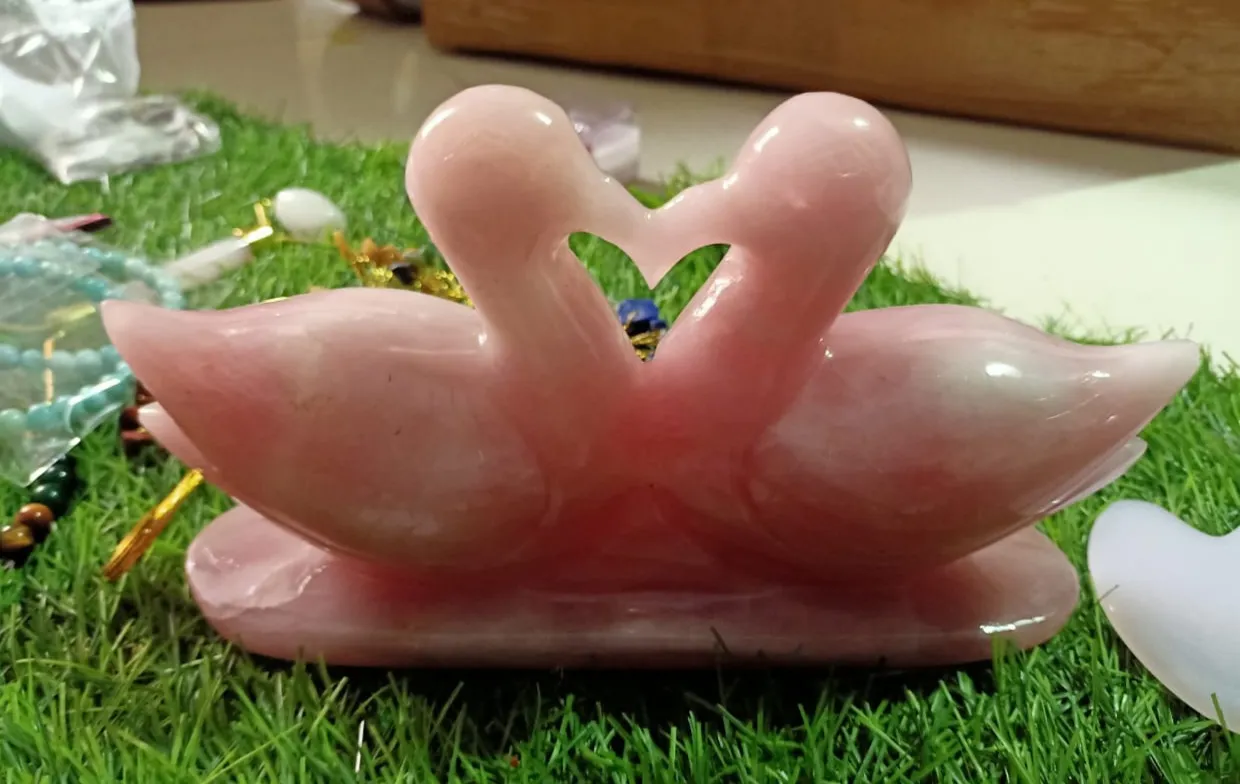
Rose Quartz Carved Bird Pair
First-party gallery view of our pale-pink carved pair. These are décor pieces associated with Feng Shui pair symbolism; confirm carving details, weight and the item supplied.
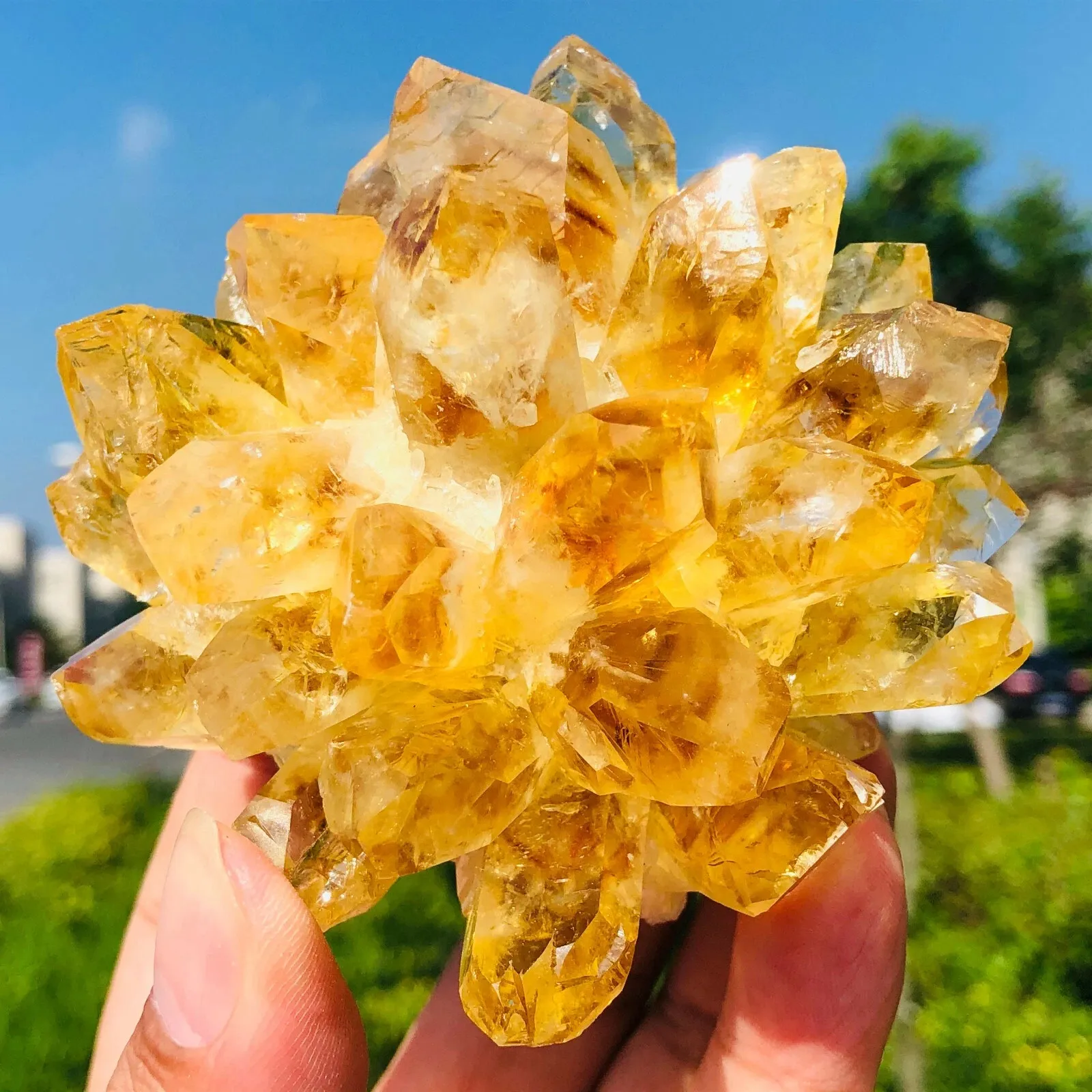
Citrine-Labelled Quartz Cluster
Our first-party Citrine-labelled quartz cluster photograph. Check the exact specimen, natural versus heat-altered colour, dimensions, and the scope of any reported certification.
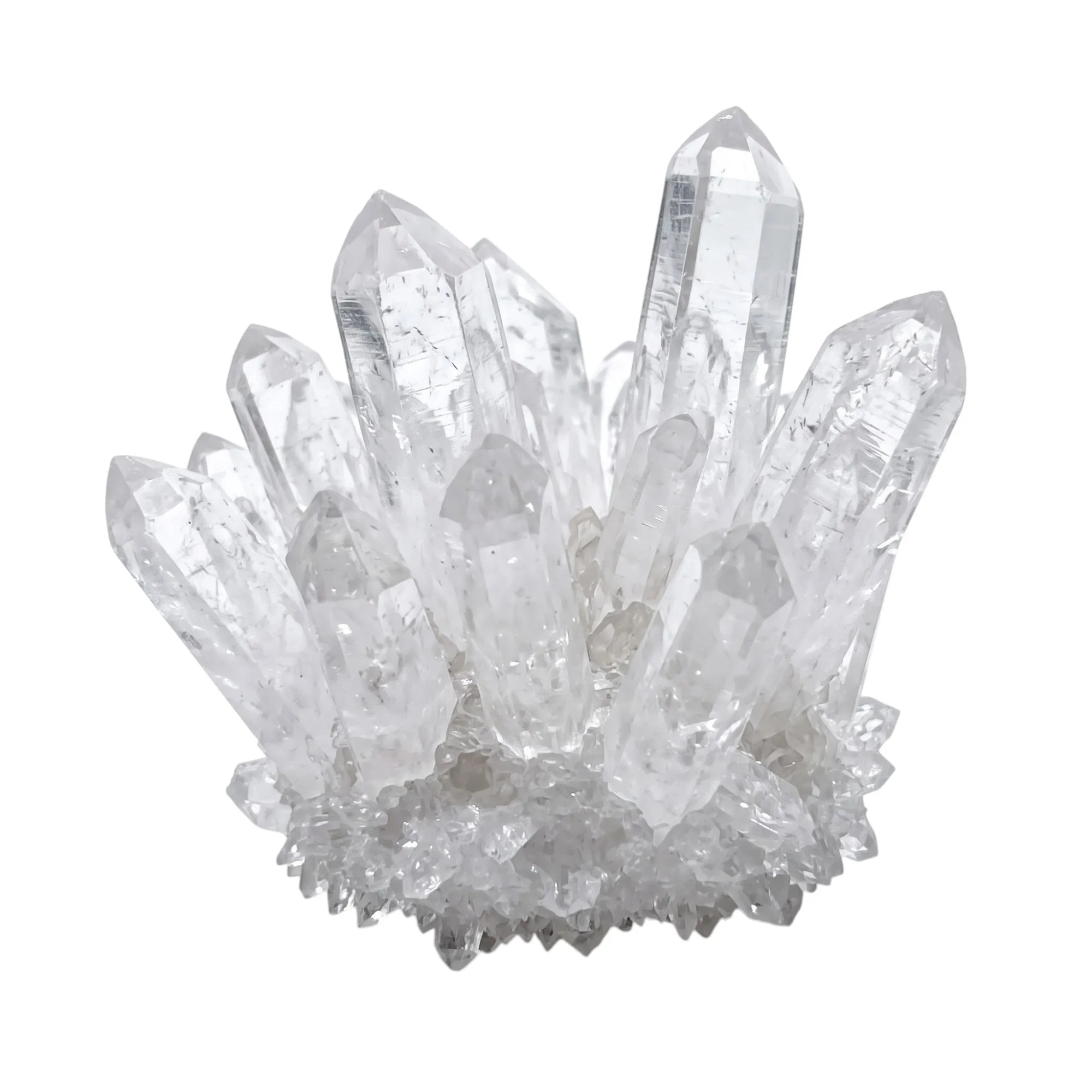
Clear Quartz Cluster
Our genuine Clear Quartz listing photo. Choose sufficient support for pointed specimens and check that the exact format matches the listing.
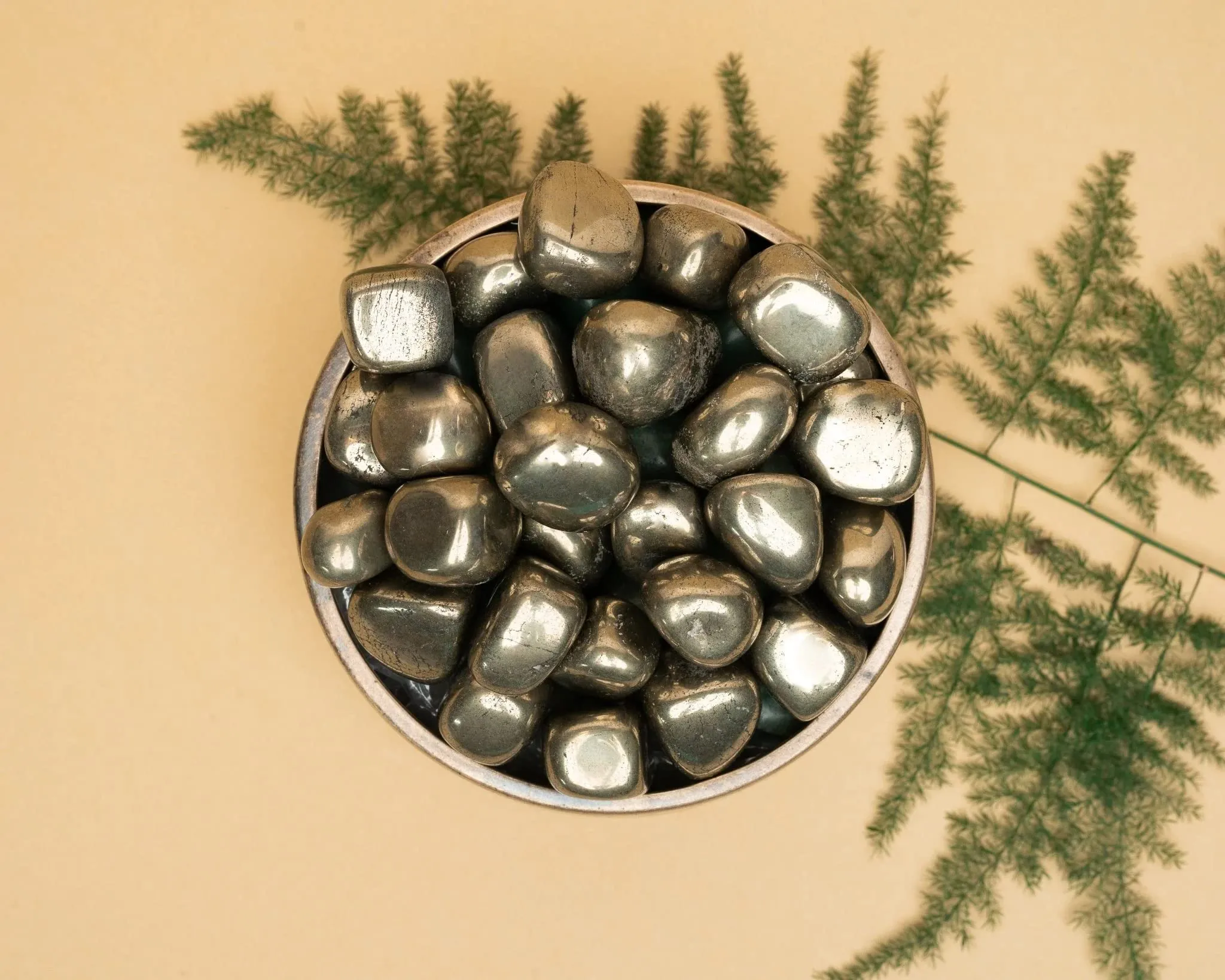
Golden Pyrite Tumblestones
Our first-party Pyrite tumble-gallery arrangement. The brassy iron sulphide adds metallic colour; use a contained dry display away from food and water.
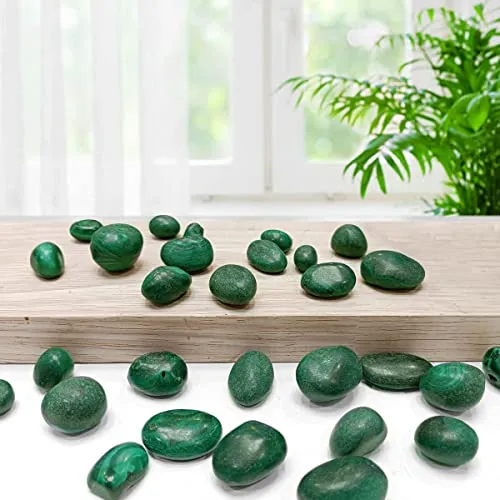
Green Malachite Tumblestones
Our green banded Malachite listing image. Display it safely, without grinding, acidic sprays, soaking or exposure to food and drinking water.
How to create a balanced, premium display without clutter
A successful crystal vignette depends on proportions and negative space. A dramatic cluster may be enough on its own; several heavy specimens arranged too close together can look crowded and be more likely to chip. The aim is a comfortable room, not a collection that takes over every surface.
Start with the surface
Measure the usable shelf or tabletop, check the load it can support, and consider how often the area is touched. Avoid balancing minerals on sloping edges, unstable stands or shelves that vibrate with a closing door.
Choose one visual focal point
A purple Amethyst cluster, pale-pink carving or clear specimen can anchor the arrangement. Keep other objects simpler and leave space around pointed or delicate edges. A smaller piece may suit a narrow shelf better than a large rock.
Match material with the environment
Keep Pyrite away from splashes and prolonged dampness, Amethyst away from excessive strong sun, and sensitive pieces away from harsh household cleaners. Do not mix loose mineral pieces into drinking water or food.
Check household safety
Secure heavy specimens and small pieces away from children and pets. Keep flames, incense and hot light sources clear of nearby textiles or any display. Recheck stability after rearranging furniture or cleaning.
Directional symbolism: keep it culturally accurate
Modern Vastu guides sometimes associate the north with prosperity, the northeast with reflection, and various other areas with particular themes. These associations are not identical across every regional or historical source. The classical subject includes site, orientation and proportion, not simply a prescription to buy a Pyrite rock or crystal sphere for a fixed corner.
A discussion of orientation in Vastu textual principles explains how directions were established within an architectural setting. Modern phone-compass and decorative placement instructions should not be confused with proof of a gemstone’s physical effect.
| Modern symbolic suggestion | What it can mean to someone | What actually matters for display |
|---|---|---|
| North / work area | Some contemporary interpretations associate it with prosperity or Kubera. | Choose a dry stable desk location, not one that blocks work or creates a spill hazard. |
| Northeast / reflection corner | Often called Ishanya and associated with contemplation in some traditions. | Comfort, clear access, appropriate lighting and safe placement for any object. |
| Southwest / stability theme | Sometimes interpreted symbolically as support or rootedness. | Heavy furniture and specimens must be properly secured regardless of compass direction. |
| Bedroom / relationships | Modern Feng Shui practice may use paired duck imagery. | Respectful symbolism does not replace consent, communication and practical relationship care. |
| Entrance / welcome | A culturally meaningful symbol may mark hospitality. | Do not obstruct movement or place sharp, heavy, unstable objects at doorways. |
To avoid mixing traditions inaccurately, note that the paired Mandarin Duck motif is prominent in Chinese art. The Metropolitan Museum of Art identifies such imagery as a historical symbol of fidelity and companionship. Our Rose Quartz carved pair belongs to contemporary decorative shopping; its physical shape should be checked on its product page rather than presumed from the trade phrase “duck/swan.”
Why original editorial imagery must be separate from actual products
Our home-decor cover brings several mineral colours together to demonstrate a premium styling concept. It is an illustrative interior composition, not a catalogue photograph of one exact arrangement available for purchase. The Indian lifestyle portrait likewise represents culturally inspired decorating rather than an exact order, a certificate or a customer endorsement.
By contrast, each gallery card above uses a photo from a specific Divinity Crystals product listing. This distinction helps avoid a common source of confusion: a page may look beautiful, but the delivered mineral must still match the description, listed size, treatment and selection method. The correct question is not only “Does this look attractive?” but also “Is this the same material and form the product page actually describes?”
We recommend checking actual item measurements, surface features, natural variation, pack count, carving weight and any available documentation before ordering. A “lab certified” phrase should correspond to a relevant real report, not a decorative image of a certificate. See our Gemstone Authentication Guide for the difference between a material claim, a treatment claim and a geographical origin claim.
How to buy crystal décor without confusing mineral types
| Buying question | Why it matters | What we should show |
|---|---|---|
| Which actual mineral? | Quartz, Pyrite and Malachite are not interchangeable and need different care. | Clear material names and treatment information, not broad “energy crystal” language alone. |
| What physical format? | Cluster, tumble, chip pack, carving and sphere have different dimensions and risk profiles. | Real product photographs, approximate size/weight and accurate shape. |
| What finish and condition? | Fractures, matrix, polishing, coatings or carving features affect appearance and durability. | Meaningful close views and honest condition notes where applicable. |
| What certification is advertised? | A report has a specific scope and may not assess every item or geographic claim. | Issuer, report details and an accurate match to the item or parcel. |
| Where will the piece be placed? | Heavy or sharp stones can harm people or furniture in unstable displays. | Realistic dimensions and practical display instructions. |
| Does the product actually exist in our catalogue? | Illustrative décor scenes may contain objects not separately available for sale. | Links only to active, verified published Divinity Crystals product listings. |
A polished green Malachite tumble is not a decorative jade sphere; a carved Rose Quartz bird is not automatically a classical Vastu remedy; and Pyrite is metallic iron sulphide rather than precious gold. Such distinctions make a page more useful than a long series of unsupported benefit statements.
Cleaning crystal décor without damaging the material
Stone care should begin with the mineral and its finish. Mohs hardness measures scratch resistance, not whether an object can be safely soaked. The easiest default for many display pieces is soft, dry dusting, followed by more specific cleaning only when the actual material, treatment and condition permit it.
Amethyst and Clear Quartz
Quartz varieties are relatively hard, around Mohs 7, but clusters can chip at pointed crystal tips. Use a soft brush and a stable hold, and avoid forcing cloth between narrow growths. Long strong sunlight or high heat may affect some Amethyst colour.
Rose Quartz carvings
Rose Quartz is also quartz, but thin beaks, wings or other carved details may be fragile. Keep the carving padded in storage and away from rough contacts. The GIA Rose Quartz care guidance discusses the mineral’s hardness and cleaning considerations.
Pyrite tumblestones
Pyrite is an iron sulphide mineral that can oxidise when environmental conditions permit. For display pieces, favour dry care and avoid routine soaking, salt baths and damp storage. Use a contained shallow bowl rather than leaving small stones rolling across a desk.
Malachite tumblestones
Malachite is a copper carbonate mineral whose green surface may be polished. Avoid acids, grinding, inhaling dust, prolonged water immersion and storing loose pieces near food. Gentle dry wiping is a conservative default.
Our Crystal Care & Cleansing Guide covers these differences in detail. A symbolic “cleansing” custom is distinct from physical cleaning and does not disinfect mineral surfaces or remove dust.
A meaningful home does not require a gemstone in every corner
Traditional or spiritual symbolism can be part of a family’s decorating choices. But a house does not become unlucky because a rock is on a different shelf, and someone facing illness, family conflict, or financial trouble has not failed by neglecting a particular crystal placement.
Air quality, light, ventilation, practical repairs, budget planning, communication and household safety are not services provided by a mineral. Crystal décor is most useful when we treat it as a beautiful, correctly described object and keep cultural claims proportionate to what they can actually establish.
We encourage customers to select only what suits their room and interests, and to appreciate real minerals for their colour, form and craftsmanship rather than repeated promises of invisible corrections.
Three sample arrangements for compact Indian homes
One low-maintenance shelf
Choose a safe wall or console surface with room for a single smooth mineral or small contained bowl. Avoid heavy raw specimens if the furniture is light. There is no need for separate north, east, south and west crystal corners.
Simple focus without clutter
Keep a small dry Pyrite display away from drinks and electronic vents. Pair it with a notebook or useful work organiser instead of surrounding the keyboard with sharp clusters. Actual customer work habits matter more than prosperity symbolism.
One specimen as a conversation piece
Place an Amethyst or Clear Quartz cluster on a solid console with ample space. A restrained arrangement can show mineral growth beautifully without creating hazards for guests, pets or children.
Meaning without pressure
Use a familiar family keepsake, a simple Rose Quartz carving or no stone at all. Keep lighting comfortable and safe. A reflection area can be meaningful without promising that a gemstone will treat distress or guarantee harmony.
Frequently asked questions: Vastu crystal décor
Clear answers about room placement, traditional symbolism, real products, authenticity and safe mineral care.
What is Vastu crystal décor?
It describes modern home styling that combines natural minerals and decorative objects with personal interpretations of Indian Vastu traditions. It is not a universal classical gemstone prescription or a proven method of changing a home’s fortune.
Is Vastu Shastra the same as Feng Shui?
No. Vastu is associated with Indian traditions of architecture and spatial organisation, while Feng Shui developed in Chinese cultural traditions. Contemporary décor may borrow from both, but they should be named accurately.
Do crystals correct Vastu dosha?
There is no reliable scientific evidence that moving a gemstone corrects architectural defects or guarantees health, prosperity or relationships. Address actual home problems through practical maintenance and suitable professional advice.
Which crystal is best for a living room?
There is no required stone. Choose a stable specimen you like, such as Amethyst or Clear Quartz, based on room size, weight, visibility, child/pet safety and care needs.
Where can I put Pyrite on a work desk?
On a dry, stable surface where it cannot fall or interfere with electronics, paperwork, cables, drinks or ventilation. Its traditional prosperity symbolism does not guarantee earnings.
Are Rose Quartz mandarin ducks a classical Vastu remedy?
Mandarin-duck pair imagery is particularly associated with Chinese art and Feng Shui. Retail décor sometimes mixes these traditions; the carvings do not guarantee fidelity or marriage.
Should I put crystals in a child’s bedroom?
Avoid loose chips, small swallowable pieces, sharp points and heavy specimens accessible to children. Secure any decorative piece out of reach and do not place stones in bedding or play areas.
How can I identify genuine decorative crystals?
Check the declared mineral, dimensions, treatments, first-party product photos and any report that actually relates to the selected item. Colour alone cannot authenticate a stone.
Can I put crystals in a bowl of drinking water?
We advise against direct mineral contact with drinking water. Material, surface treatments and hygiene are not established by appearance.
Does Pyrite need special cleaning?
Yes. Pyrite can deteriorate under certain humid conditions; avoid soaking and saltwater baths. Gently dry-dust it and store it in a suitable, relatively dry environment.
What is the most useful way to start crystal home décor?
Pick one stable, well-described item that suits your space, read its care instructions, and avoid blocking walkways or purchasing items to satisfy unrealistic promises.
Final perspective: premium décor begins with real information
Natural mineral colour, crystal growth and carefully made carvings can bring life to a space. Vastu and Feng Shui traditions can also add personal symbolism, provided we understand they are not identical systems and do not present modern gemstone placement as an established cure or guarantee.
At Divinity Crystals, we aim to combine inviting editorial design with accurate merchandise photographs, proper material names, realistic styling and safe-care guidance. Choose one well-described object that genuinely suits the room, verify its actual specifications and enjoy the beauty of the stone without needing to believe it changes the laws of the world.