


Divinity Crystals · Reflective Practice, Mineral Facts & Responsible Choices
Most days include moments we feel proud of and moments we would handle differently. Perhaps we were impatient in traffic, spoke too sharply, missed a commitment or simply noticed ourselves becoming overwhelmed. Instead of imagining that those ordinary events leave measurable “karmic dust” on the body, an evening pause can help us consider our actions, their effects and one useful choice for tomorrow.
In Hindu and Buddhist philosophical traditions, karma involves action and consequences, with different schools giving importance to intention, conduct and spiritual liberation. It is not simply an electromagnetic substance that accumulates on skin or an aura. Contemporary crystal communities sometimes associate pale Selenite with purification and purple Amethyst with inner reflection; those are spiritual or personal interpretations, not evidence that stones erase consequences, cure insomnia or guarantee financial abundance.
This focused guide offers a voluntary, practical evening routine, explains the actual minerals, and helps you select genuine Divinity Crystals products if you enjoy using a stone as a decorative reminder. The five shopping photographs below belong to published product listings, while the compact Indian lifestyle portrait is original editorial artwork.
You can begin with our published Amethyst Tumbled Stones and Selenite-labelled white tumblestones, or complete the exercise with a notebook alone. Nothing needs to be purchased or “activated” to reflect on your actions.
Six useful principles for tonight
- Karma is a religious and philosophical concept; it is not a medically diagnosed or instrument-measured energy coating.
- Personal reflection helps you identify intentions, impacts and possible repair; it does not make consequences disappear.
- A crystal may be a symbolic object, but cannot force forgiveness, prevent nightmares or attract guaranteed wealth.
- Choose one manageable issue rather than turning bedtime into an exhaustive list of mistakes.
- Selenite-labelled gypsum is soft and water-sensitive; Amethyst is harder quartz and needs different care.
- Respect rest, boundaries and professional support if guilt or repetitive worries are becoming overwhelming.
What does “clearing negative karma” mean?
The phrase is popular in devotional and gemstone marketing, but it does not have one universally shared meaning. In many Hindu interpretations, karma is tied to actions and their fruits; different traditions discuss how intention, duty, knowledge, devotion or selfless action bear on spiritual life. Buddhist teachings also pay close attention to intentional action and its consequences, although explanations differ across schools.
The Cambridge academic overview of Hindu karma and rebirth notes substantial diversity among Hindu interpretations. A Buddhist Society explanation of karma describes the role of intentional action in Buddhist thought.
In this article, an evening “clearing” practice is a metaphor for reviewing choices and acting with greater care. It is not a claim that one five-minute ceremony removes past harms or restores someone to a state of moral perfection. An apology, restitution or behavioural change cannot be replaced by a stone.
Personal symbolism
Someone may associate white Selenite with a fresh start and purple Amethyst with quiet reflection. That meaning can be part of a chosen spiritual life without requiring a mineral to contain supernatural power.
Actual ethical action
Recognise what happened, consider its impact, ask whether repair is appropriate, respect boundaries and try a better response next time. These are human behaviours, not properties documented by a gem laboratory.
Five genuine Divinity Crystals product photographs
All five pictures come from the matching published Amethyst or Selenite-related product listings. The stones are displayed as merchandise, not proof of karmic or medical effects.
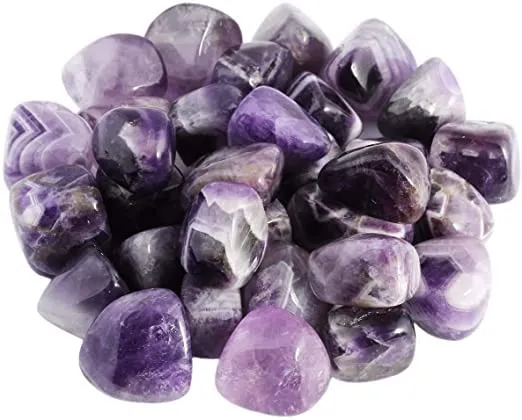
Real Amethyst tumblestones
Actual polished purple stones from the published Amethyst listing, photographed on a white background.
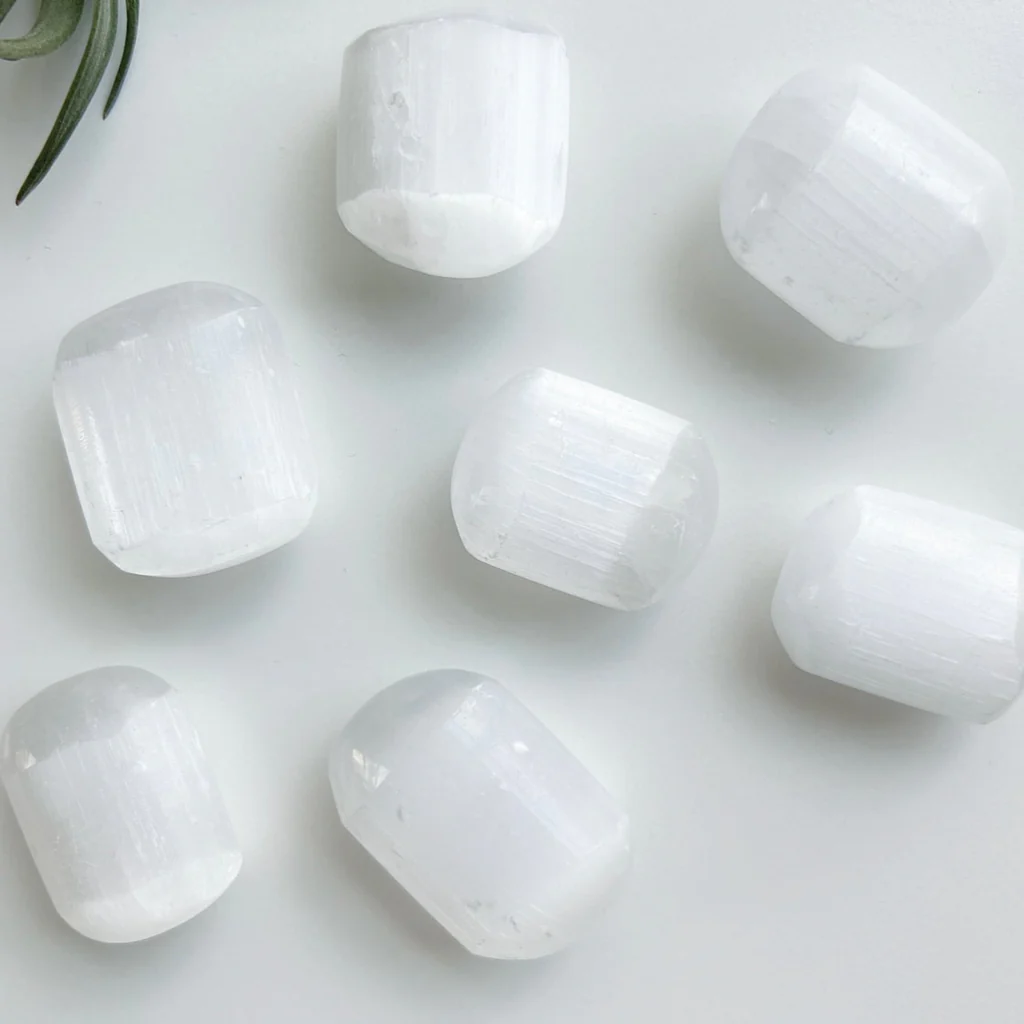
White Selenite-labelled tumblestones
First-party flat-lay showing the pearly satin-spar-style gypsum appearance. Keep it dry.
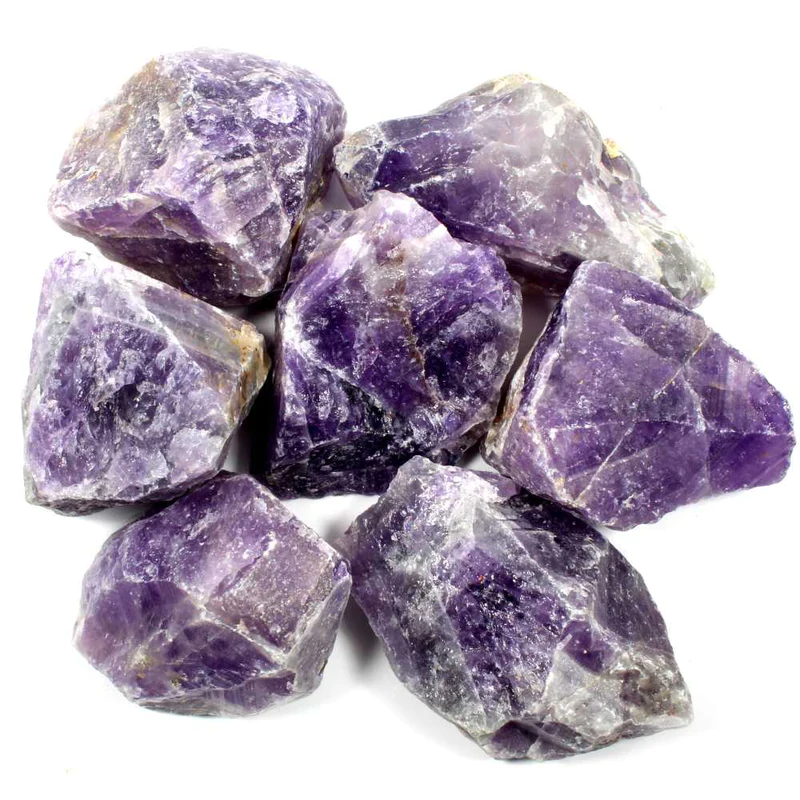
Raw Amethyst chunks
First-party image of the separately published raw Amethyst format, not a guaranteed smooth pocket stone.

White fibrous gypsum chips
Actual product image from the 50 g/100 g Selenite-labelled chips listing; the pieces are small and irregular.
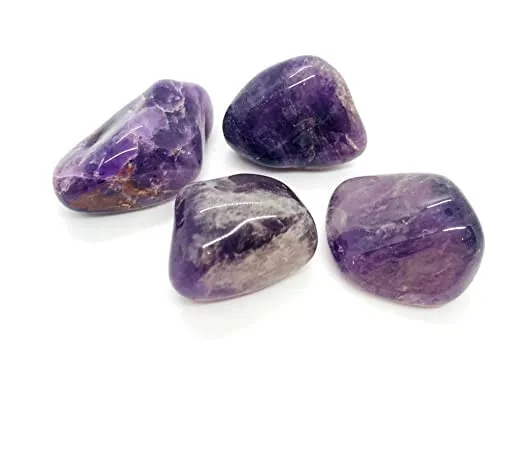
Amethyst polished-pack variation
Separate genuine image from the Amethyst tumbles gallery showing a multi-piece polished selection.
Why Amethyst and Selenite are different minerals
Amethyst is the violet variety of quartz, composed of silicon dioxide (SiO₂). It is relatively hard, around Mohs 7, and is sold in polished, carved or raw forms. Natural shades and patterns vary, and some stones may have treatments or repairs that affect cleaning.
Selenite is a clear crystalline variety of gypsum, calcium sulfate dihydrate (CaSO₄·2H₂O). Many white fibrous pieces labelled “Selenite” in shops are technically satin-spar gypsum. Gypsum is considerably softer, around Mohs 2, and is somewhat soluble in water. This means the same care routine should not be used blindly for both materials.
| Characteristic | Amethyst | Selenite / satin spar |
|---|---|---|
| Mineral family | Quartz | Gypsum |
| Typical appearance | Purple translucent to opaque stones | Clear crystals or white silky fibrous material |
| Mohs hardness | Approximately 7 | Approximately 2 |
| Care approach | Soft cloth; mild warm soapy cleaning may suit stable loose stones | Start with gentle dry dusting; avoid soaking |
| Symbolic association | Reflection, calm and spirituality in modern crystal traditions | Purity and clarity in contemporary crystal traditions |
| What neither does | Scientifically erase karma, cure insomnia or guarantee prosperity | |
See GIA Amethyst care and cleaning and the University of Minnesota gypsum mineral reference for the underlying mineral-care distinctions. Our published Selenite mineral guide has further satin-spar details.
Your optional six-step evening reflection
Five to ten minutes may be a convenient time, but there is no required duration or magical number of repetitions. Choose a comfortable time earlier in the evening if writing close to bedtime makes you more alert or worried. NHS guidance suggests a designated worry period or writing things down as one possible way to manage persistent concerns. Read the NHS worry-time guidance.
Pause without judging
Sit comfortably in a safe space for a few minutes. Your journal and crystal display are optional; you do not need candle smoke, breath-holding or a particular posture.
Recall one moment
Think of a single interaction or decision. You do not have to audit every thought, revisit trauma or list every possible moral mistake.
Name the intention and effect
Ask what you meant to do, what happened, and how another person may have experienced it. Distinguish an understandable feeling from a harmful action.
Choose an appropriate repair
If someone was hurt, consider an apology, changed behaviour or practical restitution—only when contact is wanted and safe. Respect the other person’s boundaries.
Note one good action
Write down something kind, honest or useful you did or noticed. A balanced reflection is different from punishing yourself with guilt.
Plan tomorrow’s small step
Pick one realistic action you can control, close the notebook and resume a comfortable evening routine. If reflection causes rumination, stop or move it earlier.
If you like a symbolic object, place a white fibrous gypsum piece and a purple Amethyst tumble on separate secure coasters nearby. You do not need to sweep the stone over your body, press it against your heart, close your eyes, hold your breath or perform a “karmic cleansing” motion.
ORIGINAL PRACTICAL ILLUSTRATION
From an evening thought to a useful next action
This is a reflection tool, not a way of removing karma or predicting an outcome.
A practical pattern: observation → responsibility → constructive action → rest. The sequence is optional and makes no therapeutic or spiritual guarantee.
Examples of turning reflection into real progress
If you spoke harshly
Consider a simple, specific acknowledgment: “I interrupted you and raised my voice. I am sorry. I want to speak differently next time.” Let the person decide how or whether to respond.
If you missed a commitment
Think about what you can responsibly repair: reschedule, provide an update, offer a practical solution or change how you plan. Repeated good intentions are less useful than follow-through.
If you felt jealous or resentful
Notice the feeling without assuming it marks you as morally unclean. Ask what need or insecurity lies beneath it and whether there is a constructive way to respond.
If your day was difficult
You do not have to search for something you did wrong. Rest, gratitude or asking for help may be a more useful outcome than forced confession or endless self-criticism.
For a deeper discussion of forgiveness as a personal process, see our separate Amethyst and Forgiveness guide. This article stays focused on a modest daily practice rather than repeating the full forgiveness topic.
A peaceful bedtime is not a moral test
Poor sleep, nightmares, anxious thoughts or feeling tired the next morning are not evidence of “bad karma” left in your aura. Sleep concerns can reflect routine, health, stress or many other factors. Crystal rituals cannot diagnose or treat insomnia, depression, panic attacks or trauma.
If reflection is becoming a repeated compulsion to prove that you are “clean,” stop the ritual. There is no obligation to perform more sweeping, affirmations or recharging. If guilt, shame or intrusive worries interfere with life, trusted support or qualified mental-health care is more appropriate than repeatedly attempting to neutralise them with a stone.
The NHS sleep guidance discusses ordinary bedtime routines and strategies for managing worry. You can enjoy a decorative gem without expecting guaranteed results.
How to choose genuine crystals for an evening display
These stones are physical minerals sold in different formats. A polished Amethyst tumble may be an easy-to-handle keepsake, while raw Amethyst chunks should be supported so they do not scratch surfaces. Fibrous gypsum should be kept apart from harder quartz and stored dry. There is no verified “karma-erasing” crystal pack required by this practice.
| Product format | Buying check | Practical use |
|---|---|---|
| Amethyst tumblestones | Selected pack, smoothness, size, treatments and actual product views | Small decorative item or tactile reminder |
| White Selenite-labelled tumbles | Fibrous satin-spar appearance, finish and quantity | Stable, dry tabletop display |
| Raw Amethyst | Irregular edges, weight, inclusions and safe display base | Collector specimen or secured shelf ornament |
| Selenite-labelled chips | 50 g or 100 g option, size variation and mineral identity | Dry, sealed ornamental jar; not a bath or loose bedding |
Gemstone claims such as “natural,” “untreated,” “high vibration” or “lab certified” require careful interpretation. An actual report should identify its issuer, sample and findings; one test on a sample does not prove that every item in the catalogue is independently certified. Our Gemstone Authentication Guide explains how to check those details.
ORIGINAL MINERAL-CARE ILLUSTRATION
Amethyst and Selenite-labelled gypsum: two minerals, different care
The shapes below are instructional drawings, not photos of merchandise or diagnostic identification tools.
Verify the stone and any treatment before applying cleaning advice. “Selenite” is commonly used in retail for satin-spar gypsum; gypsum is softer and sensitive to water. Both stones remain optional symbolic objects in the evening routine.
Care and storage after the evening practice
- Keep Selenite-labelled gypsum dry: use very gentle dusting and avoid prolonged water contact, wet cloths, saltwater or soaking. The soft fibrous surface scratches easily.
- Clean Amethyst appropriately: a stable loose Amethyst may be cleaned with mild warm soapy water and carefully dried. Check coatings, fillings or jewellery fittings first.
- Separate harder and softer stones: Amethyst can abrade soft gypsum. Use separate trays, pouches or padded dividers to prevent damage.
- Avoid open flames: no candle, smoke, incense or heated bowl is necessary. If you enjoy ambient light, a battery-operated lamp is a safer decorative choice.
- Secure small pieces: keep chips and tumblestones away from young children and pets and off the bed, floor or edge of a bedside table.
- Store and finish: put the notebook away, choose a comfortable wind-down routine and return to any practical amends when appropriate.
Our Crystal Cleansing Methods and Safe Care guide gives additional mineral-specific comparisons. A traditional or personal symbolic ritual is not the same as physical cleaning.
Frequently asked questions about evening karma reflection and crystals
Can crystals really clear negative karma overnight?
There is no scientific evidence that a stone erases actions, intentions or their consequences. In spiritual traditions karma is interpreted differently, and ethical change is not a guaranteed result of a purchased product.
What does karma mean?
Karma is connected with action and consequence in several Indian philosophical and religious traditions. Different Hindu, Buddhist and Jain interpretations place different emphasis on intention, conduct, rebirth and liberation.
What is the purpose of an evening reflection?
To review a manageable part of the day, recognise something that went well, notice a regretted action if any, and choose a concrete next step. It is not a compulsory confession or purification test.
Can I do the evening reflection without crystals?
Yes. A notebook, a quiet moment or no props at all is sufficient. Stones here are optional symbols, not required tools.
What if I hurt someone today?
Where safe and appropriate, acknowledge what happened, apologise without excuses, listen to the affected person and change the behaviour. Do not press for immediate forgiveness.
What should I write in an evening journal?
One thing you appreciated, one thing you learned and one reasonable action you can take. You do not need to catalog every negative thought.
Can I combine Amethyst and Selenite physically?
Yes in a contained display, but separate them with soft padding because harder quartz can scratch soft gypsum.
What is the difference between Amethyst and Selenite?
Amethyst is quartz with hardness 7; Selenite/satin-spar gypsum is much softer at about hardness 2 and is more sensitive to water.
How should I clean Selenite?
Begin with a gentle dry cloth or soft brush. Avoid prolonged water exposure, rubbing against harder stones and harsh cleaning equipment.
Are all these products independently lab certified?
Do not infer catalogue-wide testing. Check the issuer, report number, exact tested sample and findings if a particular listing advertises a certificate.
Can journaling before bed make me worry more?
It can for some people. If focusing on mistakes raises anxiety, stop, change the subject to practical next steps or move the activity earlier in the evening.
Final perspective: a thoughtful evening, one real step
Amethyst and Selenite-labelled gypsum can be beautiful objects in a quiet space. You may associate purple with reflection and white with a fresh start, while enjoying their very different mineral properties. These personal interpretations do not prove that the stones remove karma, control dreams or change physical health.
What matters is how you treat yourself and other people. Notice a difficult moment without endless self-blame, acknowledge its impact, repair what you reasonably can and make one constructive choice. Then give yourself permission to rest.