


Divinity Crystals · Focused 5-Face Rudraksha Buying & Care Guide
Pancha Mukhi Rudraksha, also written 5 Mukhi Rudraksha or Panchmukhi Rudraksha, refers to a bead traditionally classified by five natural divisions or grooves extending around its woody surface. It is a familiar form used by many devotees for prayer, japa and as a personal reminder of spiritual discipline.
In Hindu religious traditions, Pancha Mukhi is often associated with Kalagni Rudra, a form of Lord Shiva. Some interpretations also associate it with the five elements, the planet Jupiter (Guru or Brihaspati), and contemplative practice. These are devotional or astrological meanings, not laboratory measurements or medical outcomes.
This focused guide explains what a five-face bead actually is, how to examine natural grooves, which certificates and X-rays can substantiate the offered specimen, how to wear or hold one safely, and how to preserve its surface and drilled hole. It is deliberately distinct from our broader Rudraksha Mukhi Types guide, which compares many face counts.
Our confirmed published product is one 5 Mukhi Nepali Rudraksha bead with advertised laboratory and X-ray documents. It is not automatically a silver pendant or a full 108-bead mala. The three product images below come from that actual listing, while the new cover, portrait and diagrams are original educational artwork.
Key facts before buying
- A Rudraksha bead is a hard woody fruit endocarp, not a quartz crystal or mineral gemstone.
- Five Mukhi describes the claimed natural outer divisions of the individual bead.
- Kalagni Rudra and Shiva associations are devotional, not guarantees of health or supernatural protection.
- Count and origin require evidence beyond a single attractive front-facing photograph.
- Review the specimen’s actual X-ray, report issuer, ID and matching bead image when advertised.
- One individual bead is a separate format from a mounted pendant or complete prayer mala.
Five genuine Rudraksha product photographs: 5 Mukhi and comparison beads
The first three photographs are from our own published 5 Mukhi product. The last two are explicitly labelled comparison photos from our separate 4 Mukhi and 6 Mukhi listings. They must not be mistaken for five views of one bead.
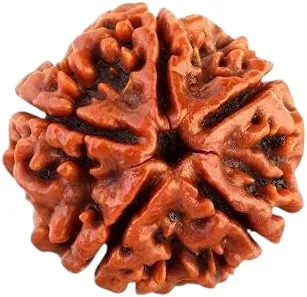
1. Actual bead texture
The existing close-up is useful for viewing natural-looking ridges and colour. Because it is a small source image, it is displayed within a compact card rather than enlarged to a full-width banner.
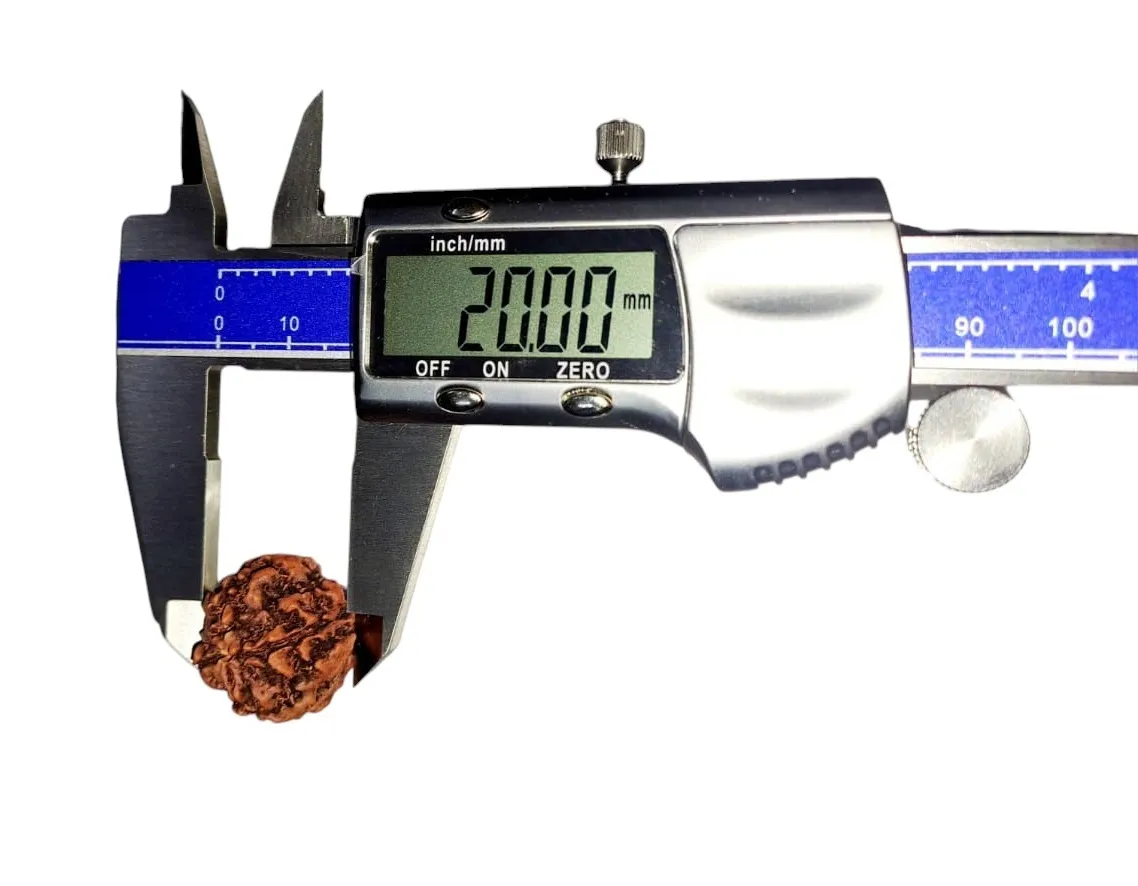
2. Additional product angle
This separate listing photograph gives more context about shape and surface. Check the measurements we publish for the currently selected bead. Photographs cannot independently establish size or weight.

3. Specimen variation view
The third first-party angle reinforces that size, colour and natural texture vary. It is not a replacement for seeing the exact item or its report.
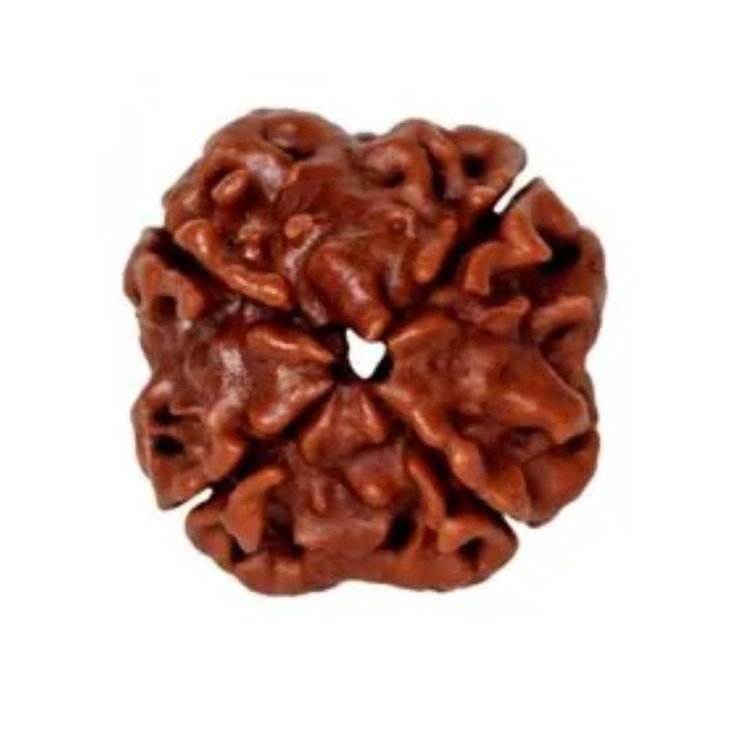
4. Compare with 4 Mukhi
This is a different 4 Mukhi product, not a 5 Mukhi specimen. Compare the exterior features while recognizing that single-angle counting is unreliable.

5. Compare with 6 Mukhi
This is a different 6 Mukhi product, not a 5 Mukhi specimen. The classification needs all-side inspection and appropriate documentation.
What is a 5 Mukhi Rudraksha botanically?
Rudraksha comes from fruits of trees in the Elaeocarpus group, including Elaeocarpus ganitrus in the trade and scientific literature. After the outer fleshy fruit tissue is removed, a highly structured, hard woody endocarp remains. This is the familiar textured object worn or held as a Rudraksha bead. Calling it simply a seed is common in retail usage, but the botanical description is more precise.
Research on Elaeocarpus ganitrus identifies a hard endocarp with strongly lignified cells and internal seed tissues. Related materials-science work studies its unusual fracture resistance. These are genuine botanical and mechanical topics, separate from marketing claims that wearing a bead acts as a capacitor or treats a disease. Read the botanical investigation and the research on endocarp fracture tolerance.
What do the five faces actually mean?
In the merchandise classification, Mukhi is a face or natural longitudinal division on the bead’s outer surface. A genuine natural structure is more complex than five grooves drawn on a photograph. One viewpoint rarely shows every division of a rounded bead. Buyers should ask for all-side views, the two poles, scale, weight and relevant examination records—especially where the price depends on a specific classification.
Do not scratch, saw, burn or cut a bead to count its internal parts. For higher-value or disputed specimens, have the examination performed by a competent laboratory or specialist who can interpret both external morphology and imaging.

Traditional symbolism and Kalagni Rudra
In many Hindu devotional interpretations, Pancha Mukhi is associated with Kalagni Rudra, one of the forms or aspects of Shiva. It may be used as an object in prayer, contemplation and repeated mantra recitation. A person who follows a particular guru or temple practice may have additional preparation, mantra or wearing customs that differ from those given in modern retail guides.
Some contemporary Jyotish accounts connect 5 Mukhi with Jupiter and spiritual learning; others connect the five divisions with the five elements. These associations are meaningful within their traditions but should not be mistaken for experiments demonstrating planetary influence or the physical balancing of the body.
What it can—and cannot—promise
The bead can serve as a tangible reminder of a chosen devotional habit. It may accompany personal prayer or meditation. But wearing it has not been established as a treatment for blood pressure, irregular heartbeat, depression, panic, insomnia or memory difficulties.
Studies of plant compounds or extracts do not demonstrate the medical effects of wearing an intact woody fruit endocarp against the skin. Healthcare concerns require appropriate clinical support, while a spiritual object may remain a personal symbolic possession.
How to identify and verify a 5 Mukhi Rudraksha
Check the natural outer grooves
Study several high-resolution photographs that show the complete bead at different angles. Natural furrows and ridges can be irregular. Be cautious if additional lines appear mechanically straight, shallow, freshly cut or different in colour and texture from the surrounding surface. These observations raise questions rather than constitute a definitive home test.
Examine both poles and possible joins
Observe where the longitudinal divisions approach the two ends of the bead and any drilled hole. Ask whether the specimen has a repaired crack, added material, filler or joined fragment. A photograph that hides one side makes confident identification more difficult.
Read the laboratory report carefully
Our published 5 Mukhi product title advertises laboratory certification and X-ray testing. The product description identifies a laboratory certificate and an X-ray report as included. The underlying documents still need to be compared with the bead itself. A useful report identifies the issuer, specimen, report number and date, measurements, methods, findings and any limitations.
Radiographs can contribute evidence about internal structures and possible manipulation; they do not by themselves authenticate an asserted Nepal origin, guarantee wearability or validate supernatural benefits. A generic online sample X-ray is not the same as the purchased bead’s specific report.

Five Mukhi authenticity: facts versus common shortcuts
| Method or claim | What it can tell you | What it cannot prove |
|---|---|---|
| Front-facing product image | Visible shape, surface, colour and some groove detail | Complete face count, natural origin or geographic source |
| All-side specimen photos | More useful continuity of ridges and signs of repair | Definitive internal structure or source provenance |
| Water float test | Behaviour in water, affected by density and trapped air | Reliable authenticity or Mukhi count |
| Copper coin test | An unreliable shop-floor demonstration | Laboratory identification or any physical power |
| X-ray with lab interpretation | Additional internal structural evidence for the submitted item | Nepal origin, general catalogue certification or spiritual effects |
| Item-matched certificate | Documented findings and scope of a specific examination | More than the laboratory actually tested or reported |
For comparison with other types, see our complete Rudraksha Mukhi identification guide. The published 4 Mukhi and 7 Mukhi listings represent distinct classifications and should never be illustrated as if they were the same 5 Mukhi item.
Published Divinity Crystals 5 Mukhi product: what is actually included?
The confirmed product is titled “5 Mukhi Nepali Rudraksha — Lab Certified & X-Ray Tested.” Its description identifies one individual bead, a laboratory certificate, an X-ray report and a care or wearing guide. The listing refers to Nepal as its stated origin. This is the origin information in our published listing; confirming the exact bead’s country of origin independently would require supporting traceability records.
The previous article mentioned a German-silver pendant and an entire 108-bead mala as if they were products available from the same listing. Those were not verified for this rebuild and are not advertised here. A photographed bowl, sacred statue, decorative tassel or model’s jewellery should not be interpreted as part of the package.
View the published 5 Mukhi Rudraksha product and its current purchase options.
How to wear or use one Pancha Mukhi bead
Single bead as a personal devotional object
You may hold an intact bead while pausing for prayer or reflection or place it in a dedicated clean pouch. A single bead is a complete object for this purpose and does not require buying an unverified accessory.
Optional threading or mounting
If you choose to wear a bead, inspect the drilled hole, select a secure and comfortable cord or suitable mounting, and avoid rough edges or weak knots. Do not assume a setting or pendant is included when the purchase listing only offers the bead itself. Remove jewellery during activities where a cord might snag, be crushed or catch in machinery.
108-bead japa mala traditions
A japa mala is a separate format often used to count repetitions of devotional mantras. A 108-bead strand is familiar in several South Asian traditions, sometimes with an additional guru bead. The exact number, thread construction, bead materials and devotional usage depend on the mala. A single five-face bead is not a complete mala and should not be presented with a fictitious mala purchase button.
Mantras and observances
Om Namah Shivaya is a widely known Shiva mantra. Some traditions prefer specific weekdays, conditioning rituals, or ways of wearing Rudraksha. These practices vary and should be learned from the person’s own chosen community or teacher, rather than advertised as compulsory steps that make a product “work.”

Gentle cleaning and care for a woody Rudraksha bead
A Rudraksha is a structured plant-derived object with grooves that can collect skin oils and dust. The string, drilled hole or any setting can need more care than the outer bead itself. Begin with gentle maintenance, not a harsh cleaning ritual applied to every piece.
- Inspect first. Check grooves, drilled openings, cracks, thread and any attached metal for wear.
- Remove loose dust gently. A soft, clean dry brush or lint-free cloth is a cautious starting method for an unknown individual bead.
- Avoid unnecessary prolonged soaking. Do not repeatedly submerge an unknown bead in water, milk or oils as a universal rule. Moisture and residues can collect in natural furrows.
- Keep food-based rituals separate from ordinary cleaning. Some lineages use ghee and milk as a particular devotional conditioning practice. That does not mean every bead requires it for physical maintenance.
- Protect the surface. Do not deepen grooves with a pin, use solvent, bleach, strong soap, hard abrasive tools or high heat.
- Dry before storage. Keep the bead and string free of lingering moisture, store in a breathable soft pouch, and protect against heavy pressure and falls.
- Handle small parts responsibly. Loose beads are not toys; cords and small objects may pose choking or entanglement hazards to young children or pets.
Devotional observances concerning sharing, meals, bathing or wearing days vary. Our physical crystal and bead care guide provides additional general handling considerations, but no gemstone-cleaning rule should be copied blindly onto plant material.

Is “Nepali” origin proven by appearance?
Trade descriptions often associate Nepal-origin beads with particular sizes or external textures, while many other sourcing regions are also represented in the market. Appearance ranges overlap. Only reliable provenance records can support a confident statement about the origin of a particular bead.
Our published product title uses “Nepali” to describe the stated origin. We should be able to support this description with traceability records for the particular bead; customers may request that evidence when origin matters to their purchase.
What gives a genuine bead value?
Value depends on natural morphology, condition, documented identity, demand, workmanship in any setting and the clarity of our item descriptions and supporting documents. Five Mukhi is a familiar common retail classification; claims that all five-face beads have special healing strength or command exceptional prices are not reliable.
Before ordering, compare the precise offered item, price, size, package contents, report and return conditions. There is no universal official “AAA” grading scale that replaces those checks.
Frequently asked questions about 5 Mukhi Rudraksha
What does Pancha Mukhi mean?
Pancha means five and Mukhi means face. The name describes a Rudraksha bead classified by five natural longitudinal divisions around its woody outer surface.
Who can wear Pancha Mukhi Rudraksha?
It is used by people of different genders and backgrounds in many devotional communities. Follow any personally chosen religious observances while ensuring the bead and threading are comfortable and safe.
How do I recognise natural five Mukhi lines?
Inspect the complete circumference, both poles and the consistency of natural surface texture. Five visible divisions are the trade criterion, but a single photograph is not a conclusive authentication test.
Does the water test prove my Rudraksha is real?
No. Float-or-sink behaviour depends on density, porosity and trapped air. It does not reliably establish natural origin or the correct Mukhi count.
Can an X-ray prove five Mukhi?
Radiography can assist in examining internal structure when interpreted by a competent examiner and connected to the exact specimen. The image alone is not a guarantee of natural origin, quality or spiritual efficacy.
What should a Rudraksha report show?
Ideally a named laboratory, unique report ID, date, specimen photographs, dimensions, assessment methods, findings and limitations that match the actual bead offered.
Does an X-ray certify Nepal origin?
No. Imaging of internal compartments does not independently prove a country or plantation of origin. Provenance needs separate traceability evidence.
What is included with the published 5 Mukhi bead?
The current product description lists one individual 5 Mukhi bead, a laboratory certificate, an X-ray report and a care/wearing guide. The decorative props in illustrations are not automatically included.
Can it cure anxiety or insomnia?
No reliable medical evidence supports wearing Pancha Mukhi as a treatment for anxiety, insomnia or depression. Seek appropriate healthcare for persistent symptoms.
What mantra is used with five Mukhi?
Om Namah Shivaya is a widely known Shiva mantra in Hindu devotional traditions. Other mantras and observances vary by teacher or community; none is an obligatory product operating instruction.
How do I clean the bead?
Begin with very gentle brushing or a clean dry cloth. Avoid harsh solvents, aggressive scraping, prolonged soaking and leaving the bead damp.
Can I leave Rudraksha with a young child?
Small beads can be a choking risk and cords can cause entanglement. Keep loose beads or necklaces out of reach of young children and pets.
Are the model and cover exact merchandise photos?
No. They are original editorials using Rudraksha-style props. The three dedicated product views come from the site’s actual published 5 Mukhi listing.
Final perspective: a meaningful devotional bead deserves accurate information
Pancha Mukhi Rudraksha has a rich place in the symbolic traditions associated with Shiva, prayer and personal discipline. Its intricate natural grooves and botanical structure are genuinely interesting—without the need to promise treatment of hypertension, guaranteed peace of mind or invisible electromagnetic shielding.
Choose the right one-bead product, inspect the actual photography, match any claimed report to the offered specimen, and care for it gently. Treat religious symbolism respectfully and medical concerns independently. That balance gives customers better information and a more confident way to buy.