
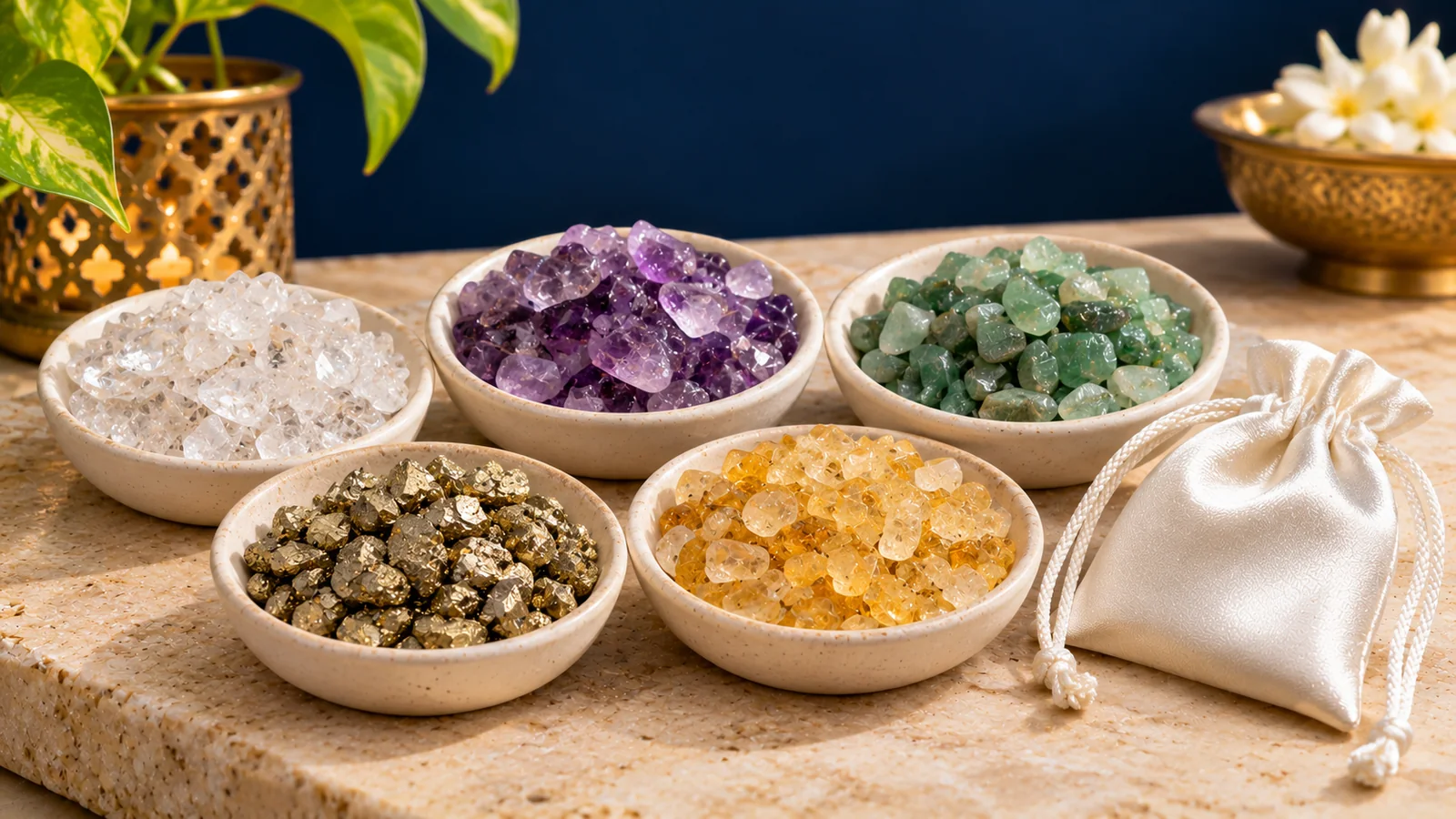

Divinity Crystals · Small Gemstone Chips & Material-Specific Guidance
Natural crystal chips are irregular, usually small fragments of a named mineral or gemstone material. Some are lightly tumbled, polished or screened for size; others are comparatively rough. They can look beautiful in dry decorative jars, carefully contained mineral displays and appropriately designed craft projects. Unlike a uniform round bead, however, a chip’s precise shape, thickness and finish vary.
Divinity Crystals currently publishes separate 50 g and 100 g chip options for materials including Green Aventurine, Citrine, Selenite-labelled gypsum, Pyrite, Clear Quartz and Malachite. These are weight-based products, not a guarantee that every pack contains the same number of equal-size pieces.
In modern crystal spirituality, some materials are associated with abundance, clarity, cleansing or grounding. Those associations may be personally meaningful, but loose chips are not medical treatments, financial instruments, water purifiers or proven electromagnetic shields. This guide focuses on real mineral identity, appropriate craft applications, reliable buying information and safe care.
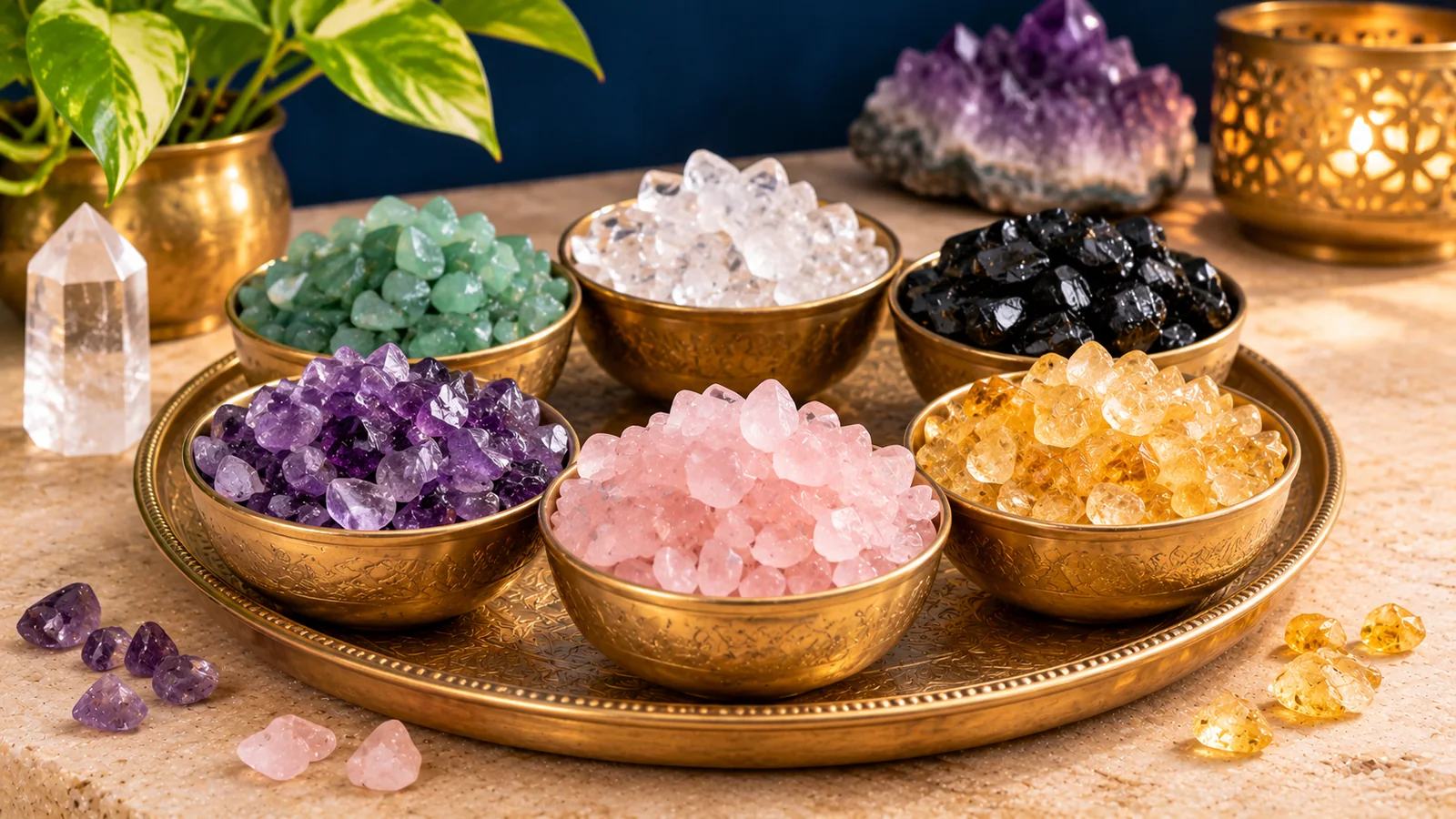
We use published first-party Divinity Crystals product photographs for the six products below. The newly generated cover and instructional graphics are original editorial illustrations. The compact Indian lifestyle portrait is a separately identified, previously created first-party Moss Agate-chip editorial, not a claim that these six products were photographed together.
Six practical takeaways
- Choose by species, finish, real photographs and pack weight—not promises of exceptional energy.
- 50 g or 100 g refers to total advertised mass; the chip count and size distribution are not automatically fixed.
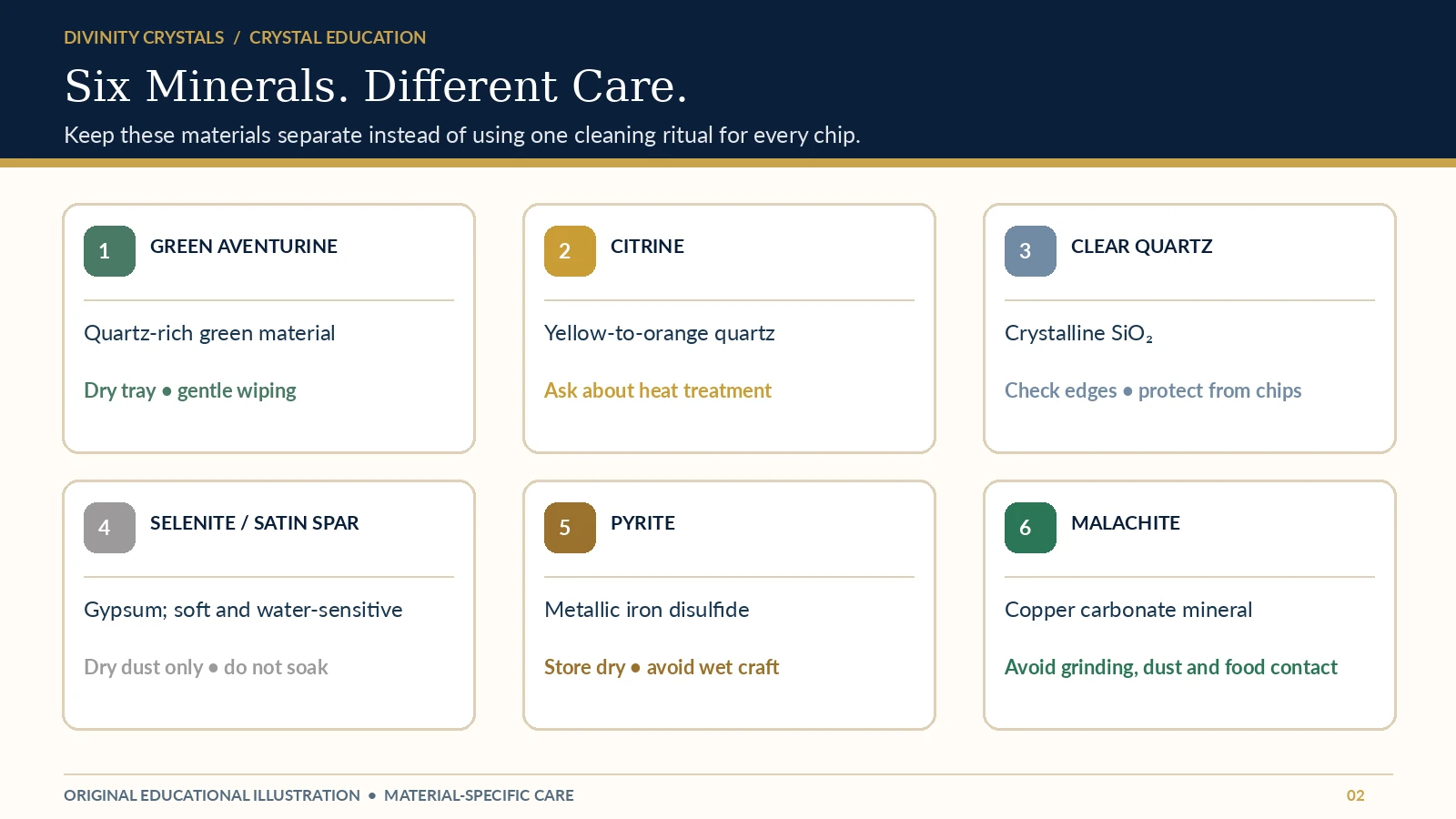
- Green Aventurine, Citrine and Clear Quartz are quartz-related; Pyrite, gypsum and Malachite need different care.
- Use secure dry trays, closed jars and carefully planned crafts rather than soaking chips or placing them directly in candles.
- Keep sharp fragments and tiny pieces away from children, pets, food and bare feet.
- Ask for item-specific laboratory evidence rather than assuming every chip pack has a separate certificate.
Six published Divinity Crystals crystal-chip products
Each card uses the image associated with its own published listing. The product names and 50 g/100 g variants come from the catalogue; exact chip appearance and supplied contents must be checked on the selected offer.

1. Green Aventurine Chips
Quartz-rich green chips used for contained dry decoration; a modern symbol of growth.

2. Selenite-Labeled Chips
White gypsum/satin-spar-like chips: soft, easily scratched and sensitive to water.

3. Citrine Chips
Golden-yellow quartz chips; colour treatments require accurate disclosure.

4. Pyrite Chips
Metallic iron-disulfide pieces that need a dry and secure display.
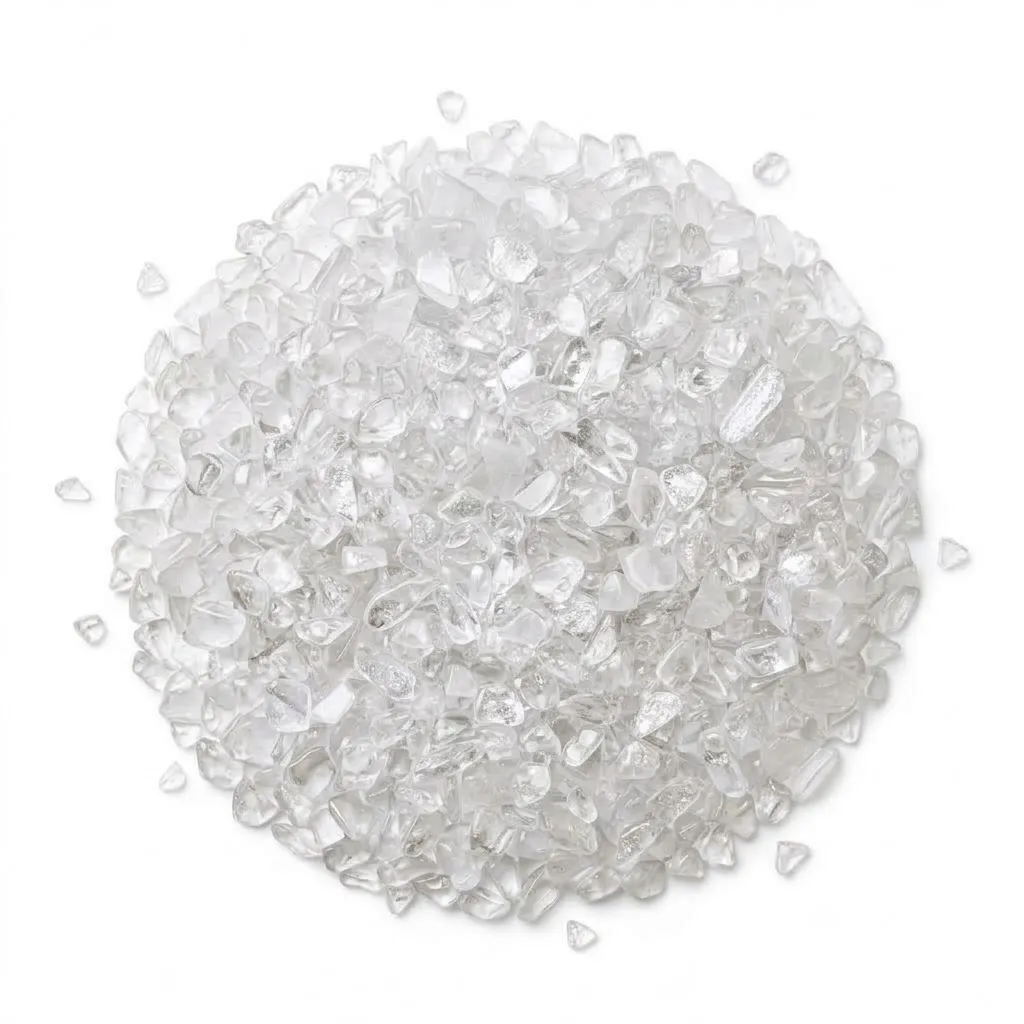
5. Clear Quartz Chips
Transparent quartz pieces for careful, contained display or craft projects.

6. Malachite Chips
Copper-carbonate mineral; avoid generating dust, wet applications or food contact.
Crystal chips versus tumblestones, beads and rough chunks
A chip is a small fragment, and may have irregular facets or edges. A tumbled stone is generally a larger, rounded object worked through abrasion and polish. A bead is typically deliberately shaped and drilled for jewellery. A raw chunk is a larger piece sold for its natural texture rather than as a prepared small fragment.
This distinction matters when buying online. A decorative photo of a palm-sized faceted stone should not be used to promise that every chip in a 50 g packet looks like a fully polished miniature gemstone. Likewise, a listing for a weight-based chip mix is not automatically equivalent to a jewellery component pack of 100 uniformly drilled pieces.
| Format | Typical appearance | Practical use |
|---|---|---|
| Small crystal chips | Irregular fragments; possible rough edges | Contained dry displays, crafts and symbolic grids |
| Tumblestones | Generally larger and smoother | Pocket collection, display, tactile objects |
| Drilled beads | Shaped with a thread hole | Bracelets, strands, secure jewellery assembly |
| Raw crystal chunks | Larger natural, often jagged surfaces | Supported mineral displays and collecting |
Browse our Tumbled Stones Collection for rounded pieces, or the Natural Crystal Chips Collection for weight-based small fragments.
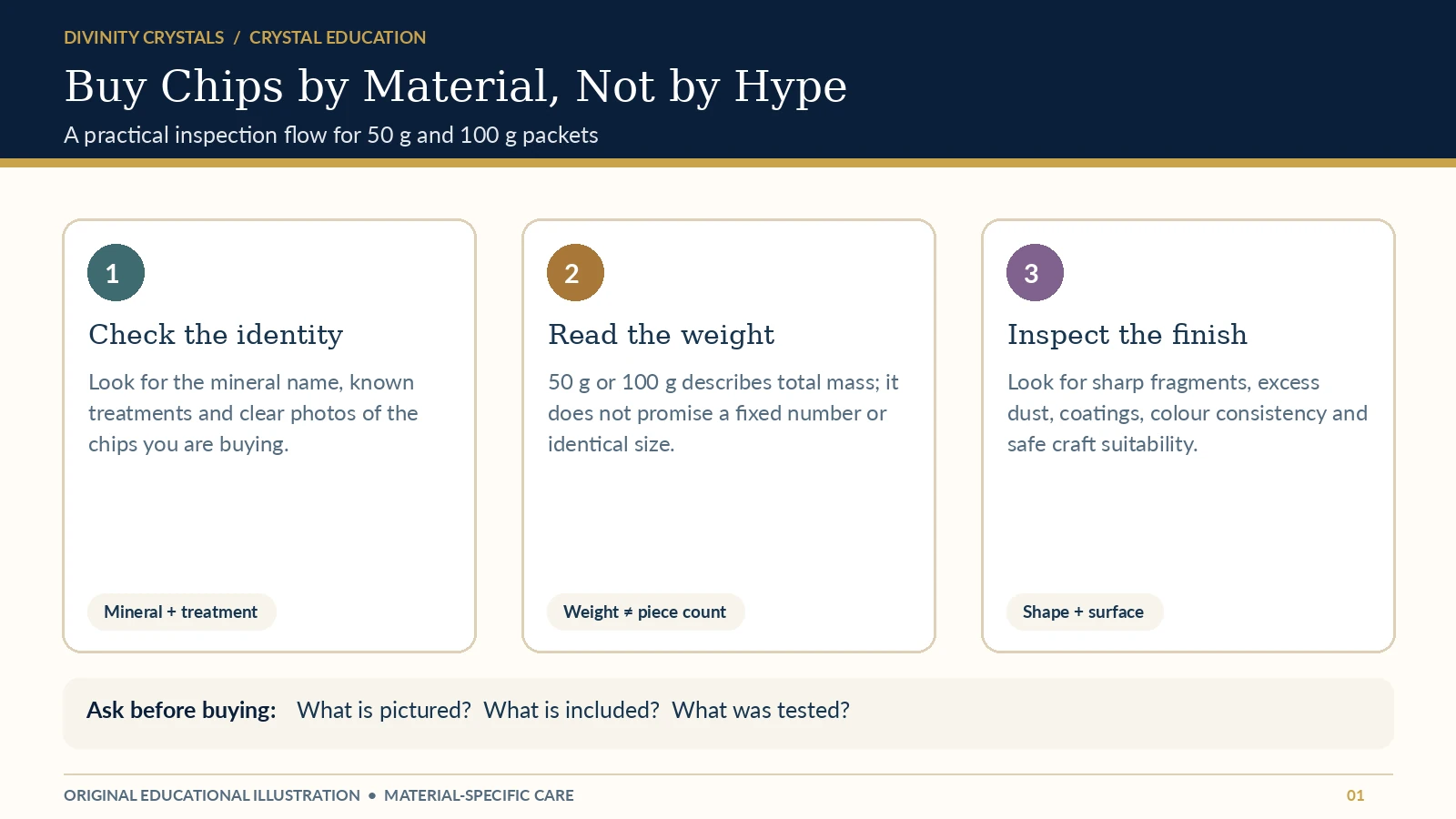
50 g versus 100 g: what can you actually expect?
The number on the bag describes mass, not a universal piece count. Two natural materials with very different density can contain different numbers of chips at the same weight. Even within one mineral, a packet of fewer large fragments may weigh as much as a packet of many tiny fragments.
For example, 50 g of Pyrite may occupy less volume than 50 g of Quartz because Pyrite is considerably denser. A 100 g pack should contain roughly twice the advertised mass of a 50 g pack of the same material, but not necessarily exactly twice as many individual chips when natural sizes vary.
Before making an intricate craft layout, check each product’s current available dimensions or size grade. If a project requires 30 similarly sized pieces or a specific drill-hole size, a general weight-based chip bag may not be the right product. Avoid assuming an advertised range such as 3–8 mm applies to all stones without a verified batch specification.
Green Aventurine chips: verdant texture
Green Aventurine is a quartz-rich decorative material with green mineral inclusions. Its colour can make a visually pleasing border in a dry display bowl or on a craft tray. Contemporary crystal guides often connect it with opportunity and the Heart Chakra, but those are symbolic interpretations, not evidence of higher income or improved plant growth.
Use a stable container rather than placing sharp fragments directly in damp potting soil. Explore our published Green Aventurine Chips.
Selenite chips: soft gypsum, dry care
Many retail items called “Selenite” are satin-spar gypsum; the mineralogical name selenite more specifically refers to clear gypsum crystals. Gypsum is soft, around Mohs 2, and somewhat soluble in water. A white collection of chips can be attractive, but avoid routine immersion, scratching them against Quartz or placing them in wet terrariums.
See the Selenite-labelled chip listing. Mineral science: University of Minnesota’s gypsum reference.
Citrine chips: treat the colour honestly
Citrine is a yellow-to-orange Quartz variety, often connected symbolically with prosperity. Its actual mineral identity and treatment history are more useful to customers than a promise of money attraction. The GIA Citrine buyer’s guide notes that much Citrine in trade is heat-treated Amethyst, which can still be genuine Quartz.
Review our Citrine Crystal Chips before ordering a colour or weight option.
Pyrite chips: metallic and moisture-sensitive
Pyrite is iron disulfide, FeS₂, prized for its brassy metallic appearance. Some Pyrite specimens can oxidise in humid conditions. Avoid long water baths, foot baths, wet soil and untested sealed wet crafts. Dry dusting and appropriate storage better preserve sensitive pieces.
See Pyrite Crystal Chips and Canadian Conservation Institute mineral conservation guidance.
Clear Quartz chips: a transparent design accent
Clear Quartz is crystalline silicon dioxide. Its relative hardness makes it useful for many decorative designs, but an irregular chip can still have a sharp edge, and Quartz can abrade softer materials stored in the same pouch.
A geometric design using transparent chips can be aesthetically pleasing without forming a physical “energy connector” circuit. See Clear Quartz Crystal Chips.
Malachite chips: avoid making dust
Malachite is a green copper-carbonate mineral, often with distinctive banded colour. Solid displayed specimens can be collected safely with appropriate care, but grinding or dry-cutting copper minerals can create undesirable dust that should not be inhaled or ingested.
Keep loose Malachite away from food, beverages and skin-soaking crafts, and do not sand it at home. See Malachite Crystal Chips and UCL mineral-pigment handling guidance.
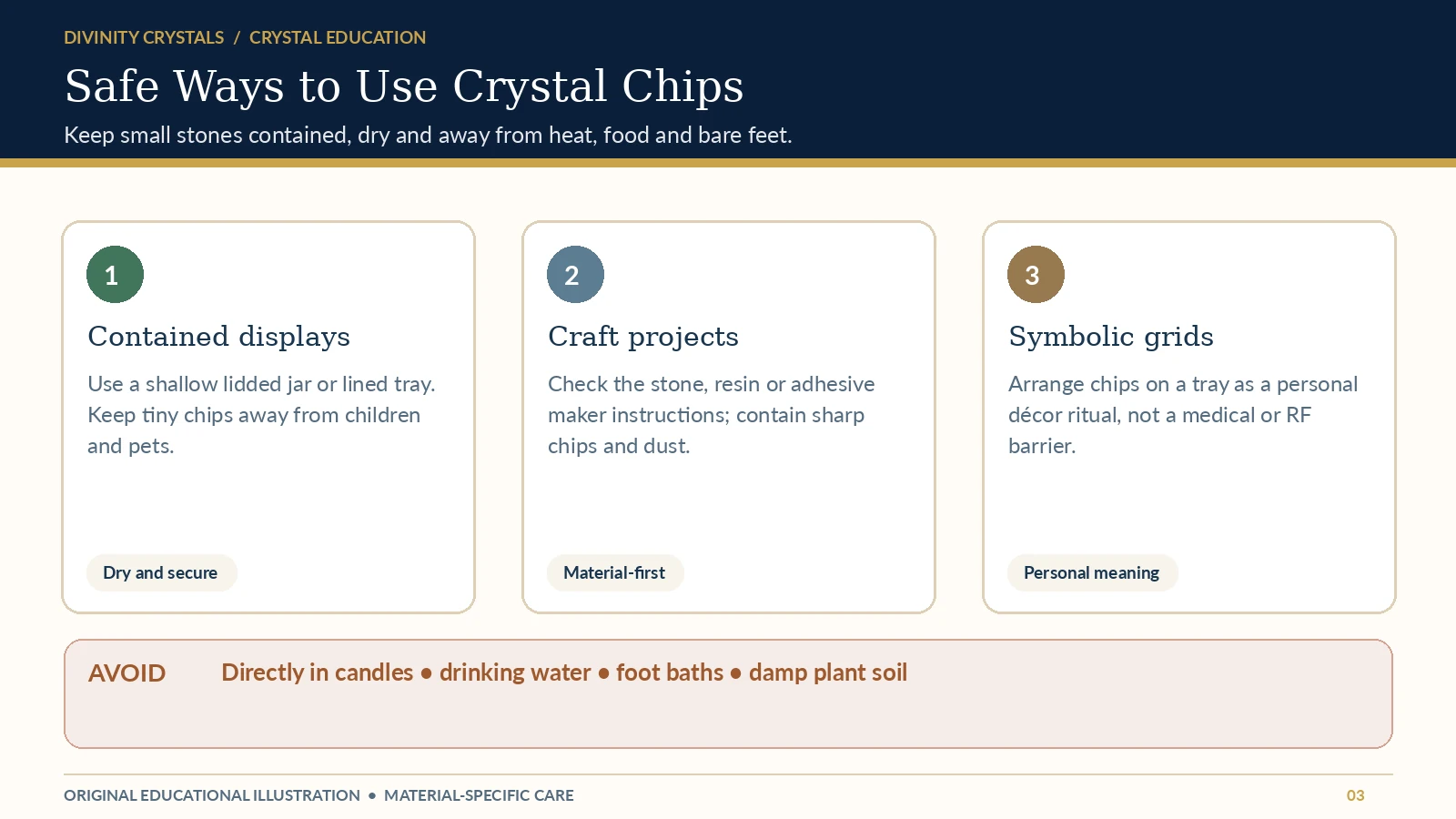
Safe ways to use crystal chips in a home
1. Dry decorative jars or mineral displays
Choose a stable lidded glass or acrylic container with a dry base, and arrange one species per compartment when possible. This helps preserve a collection and reduces the chance of accidental spills. Avoid placing the display at the edge of furniture or where a child could easily open it.
2. Carefully planned resin crafts
Some chip materials can be embedded in resin artwork when the resin manufacturer’s specific instructions, ventilation, curing and protective equipment are followed. Use a container designed for the project and ensure no untested mineral dust is released. Embedding a mineral does not make a finished resin object food-safe, heat-safe or suitable for jewellery that contacts injured skin.
3. Symbolic crystal-grid arrangements
Contemporary spiritual practice sometimes assigns specific colours or positions to stones. A geometric design may serve as a creative activity or a reminder of a chosen personal goal. It does not produce a proven healing barrier or strengthen a crystal’s documented physical properties. Our beginner crystal-grid tutorial and advanced arrangement guide show how to build stable dry patterns.
4. Labelled material-study collections
A collection of separate Clear Quartz, Citrine, Pyrite, Malachite and other specimens can be useful for comparing colour, surface and density. Use a clean magnifier rather than scratching or breaking samples. Label each bag with the retail name, date and any disclosed treatments, while avoiding unsupported certainty about source.
What we do not recommend with loose mineral chips
Do not place chips directly in burning candles, drinking water, foot baths or wet plant soil as a generic practice. Small fragments can be sharp, some stones deteriorate when wet, and unidentified minerals or coatings are not food-contact materials. Candle-making also introduces heat, wick and fire behaviour that loose embedded fragments can complicate.
Neither Malachite nor Pyrite belongs in a drinking-water elixir. Gypsum should not be repeatedly soaked. Putting chips under bare feet risks cuts and slips, and scattered chips can be swallowed by small children or pets. These are practical material risks; they do not depend on whether someone attributes spiritual meaning to the stones.
A chip collection cannot remove heavy metals from water, cleanse air, cure illness or guarantee prosperity. For safe hydration read our Crystal Water Bottle Safety guide. For home décor ideas, consult our Vastu Crystal Placement guide without treating its directional symbolism as a replacement for physical safety.
How to inspect authenticity, colour and certification
| Question | What to verify | Why it matters |
|---|---|---|
| What mineral is sold? | Specific material name and actual chip photos | Some commercial names cover more than one mineral form |
| Is it coloured or treated? | Known heating, dye, coating, filling or composite construction | Appearance alone does not establish untreated status |
| Which size will arrive? | Available size grade, variance and pack format | Small chips are not uniform jewellery beads |
| What does 50 g/100 g cover? | Selected weight variation and packaging details | Mass does not provide a guaranteed fragment count |
| Does a lab report exist? | Laboratory, report ID, tested item or batch and findings | A sample certificate cannot automatically authenticate every chip in the catalogue |
| What use is suitable? | Dry décor, craft system or jewellery construction | Not all materials tolerate moisture, abrasion, heat or skin contact |
Relevant technical references include GIA’s Gem Treatment Guide and our Gemstone Authentication Guide. Where a laboratory report is important for a special or high-value material, its actual scope should be requested before purchase rather than assumed from a marketing badge.
Cleaning and storing chips without damage
Loose chips can retain ordinary dust, but their surfaces vary greatly. For unknown finishes or fragile items, start with a soft, dry cleaning method. Separate materials before cleaning; do not tip a mixed box of gypsum, Pyrite and Quartz into the same bowl of soapy water.
- Sort by material: keep each species separate before choosing a method.
- Inspect edges and surface: identify fragile, dusty, sharp or coated fragments.
- Use conservative dry care first: gently remove loose dust without grinding or abrasive scraping.
- Follow mineral-specific cleaning: stable loose Quartz can sometimes tolerate mild water cleaning; gypsum and moisture-sensitive Pyrite should be kept dry, while Malachite dust must be avoided.
- Dry and label: do not store damp chips in sealed packs. Use clean, soft-lined compartments and readable labels.
- Keep collections out of reach: store in secure containers, not loose in drawers shared with small children or pets.
For additional material-specific guidance see our Crystal Cleansing and Safe Care guide. No scientific maintenance rule requires a monthly moonlight or smoke “recharge”; meaningful personal rituals are separate from physical cleaning.
Frequently asked questions about natural crystal chips
What are natural crystal chips?
They are small fragments of rocks or minerals, sometimes polished or lightly tumbled, sold by material and often by total pack weight. Their shapes and size distributions vary.
Are crystal chips the same as tumbled stones?
Not always. A tumblestone is typically a larger rounded piece, while chips can be smaller, uneven or sharp. Do not assume every chip is smooth.
What is included in a 50 g pack?
The stated mass is approximately 50 grams of the selected product, subject to its actual listing details and tolerances. It does not promise a specific number of pieces or a fixed chip diameter.
Can I choose a specific chip size?
Only when the individual product listing explicitly offers that variation. Do not assume a uniform size from a styled photograph.
Are all Divinity Crystals chips independently certified?
No catalogue-wide assertion should be made without records. Where a product advertises a report, check the tested sample and report scope.
Can Selenite chips get wet?
Avoid routine soaking. Gypsum is soft, Mohs hardness about 2, and is somewhat soluble in water; dry dusting is a conservative approach.
Are heat-treated Citrine chips fake?
Not necessarily. Heat-treated Amethyst remains genuine quartz. The important issue is whether the treatment and product identity are described accurately.
Is Pyrite safe to soak?
No routine soaking is recommended. Some Pyrite specimens oxidise and deteriorate in moisture, so dry storage and dusting are preferable.
Can Malachite chips go in a foot bath?
No. Copper-bearing mineral chips should not be put in foot baths or water treatments, and small sharp pieces also pose injury risks.
Can I put mineral chips inside a candle?
Avoid embedding loose stones near or in a burning candle. The stones and fragments can interfere with combustion, wick safety or hot wax; use a separate nonflammable tray instead.
Should crystal chips be put in drinking water?
No. Decorative mineral packs are not certified as food-contact or water-treatment devices, and mineral labels do not establish absence of coatings or soluble compounds.
How should I clean mixed crystal chips?
Separate them by mineral. For unknown finishes, start with a soft dry method. Treat Pyrite, gypsum and Malachite more cautiously than stable quartz.
Are these chips safe for children?
They are not toys. Loose small mineral pieces can be swallowed or cause choking; store them securely away from young children and pets.
Final perspective: real minerals, useful formats and honest expectations
Natural crystal chips are practical because they come in small pieces that can add colour and texture to contained displays and carefully designed crafts. Green Aventurine, Citrine, Pyrite, Clear Quartz, Selenite-labelled gypsum and Malachite have different material properties—and should never be represented as interchangeable medical or spiritual devices.
We recommend checking exact listings, weight variations, actual photos, mineral treatments and safe handling before buying. The beauty of genuine crystal chips lies in the natural variation and thoughtful use of the material, not promises that a handful of fragments will guarantee wellbeing or financial success.