
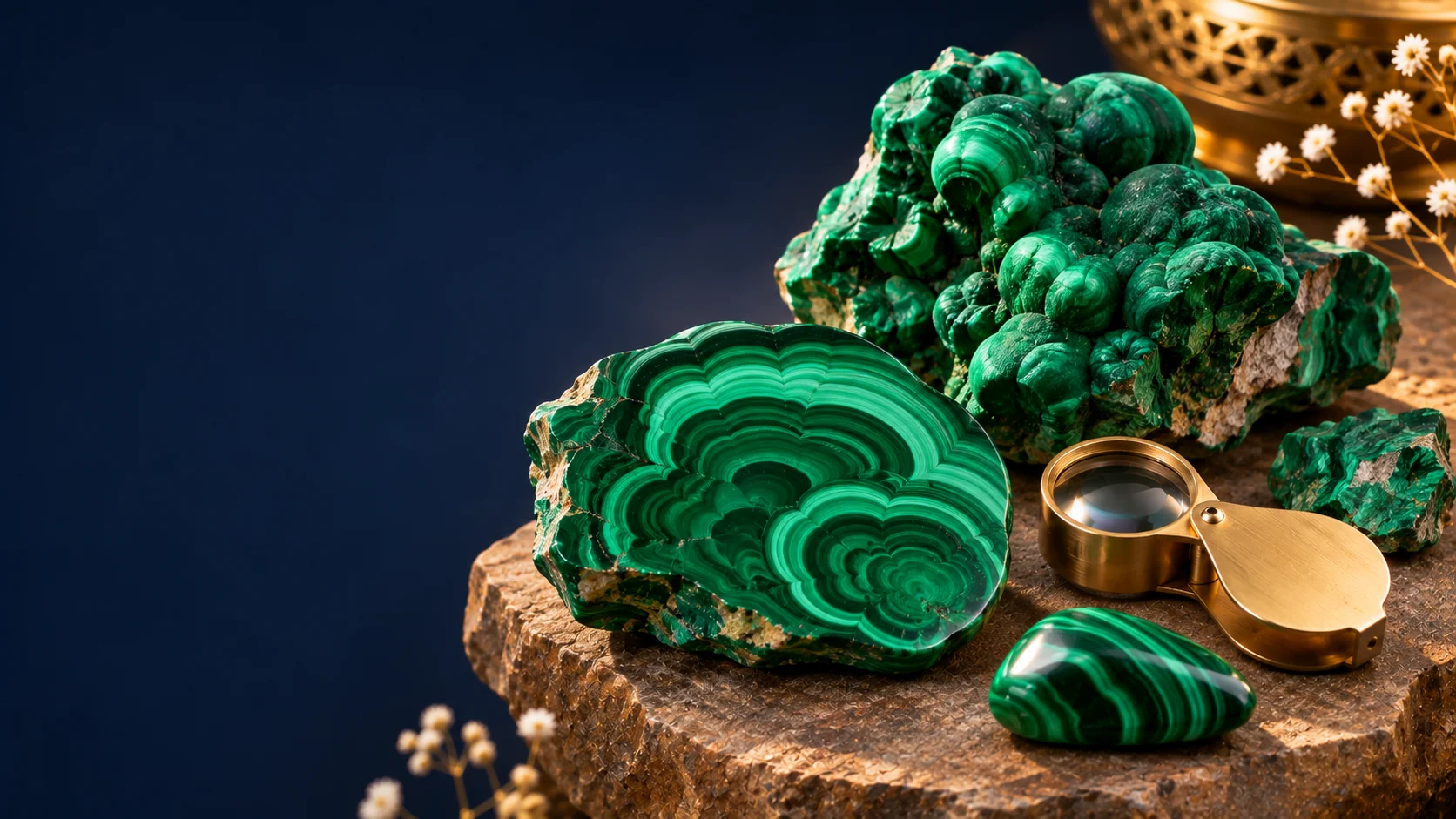
THE DIVINITY JOURNAL · MALACHITE MINERAL & GEMSTONE BUYING GUIDE
Malachite is one of the most recognisable green minerals, famous for its swirling emerald-green bands and polished surfaces. It appears as decorative tumbles, beaded jewellery, small irregular chips and striking rough mineral formations, each with different buying and handling considerations.
Malachite is copper carbonate hydroxide, Cu₂CO₃(OH)₂. Its hardness is around Mohs 3.5–4, making it substantially softer than quartz. Natural banding can be beautiful, but visual patterns and an appealing photograph cannot independently prove material authenticity, origin or whether the piece has been coated or stabilised.
This guide uses a new Indian lifestyle portrait visibly holding a vivid green-banded stone, five genuine Divinity Crystals product photos, a natural-versus-imitation comparison and practical instructions for Malachite jewellery, polished stones and small chips. Transformation and heart-chakra meanings are personal symbolism, not medical claims.

FIVE VERIFIED FIRST-PARTY MALACHITE PRODUCT PHOTOGRAPHS
Real Malachite Tumbles, Green-Threaded Bracelet, Chips & Mixed Jewellery
Each gallery photograph comes from the original Divinity Crystals catalogue. The mixed-stone bracelet is labelled separately so that visitors are not shown another mineral as pure Malachite stock.

Polished Malachite Tumbled Stones
Genuine first-party photo of polished green-banded Malachite tumbles on a white backdrop; compare selected size and pack count.

Natural Malachite Tumble — Hand Scale
Different actual catalogue view with a smooth Malachite stone held in a hand, helping explain scale and green band variation.

Green-Threaded Double-Row Bracelet
Real Malachite double-layered 38-bead bracelet with green thread. Check exact bead pattern, finished fit and laboratory report.
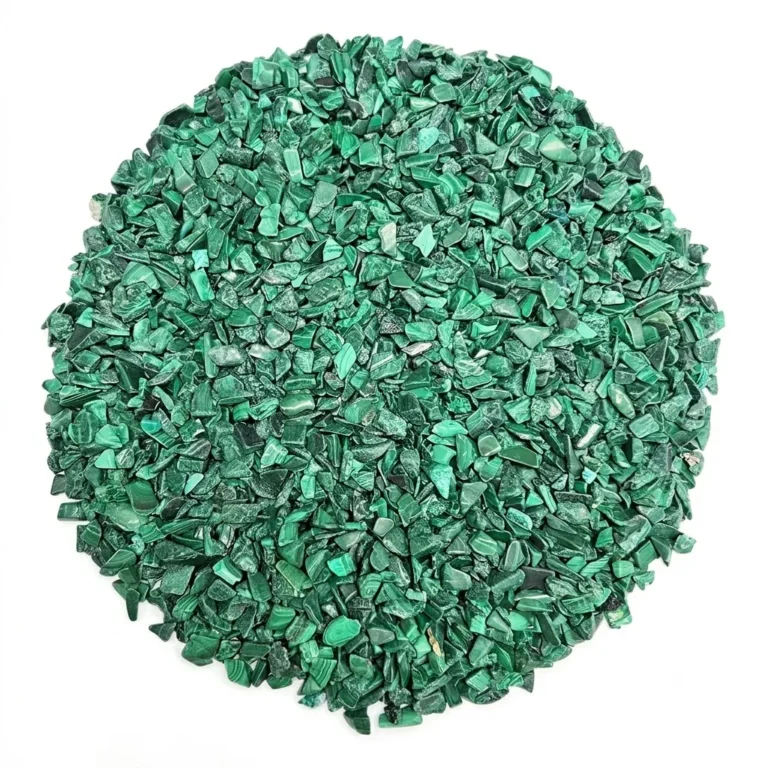
Small Malachite Crystal Chips
Actual Malachite chip photograph; small, uneven fragments are different from polished tumblestones and require careful containment.
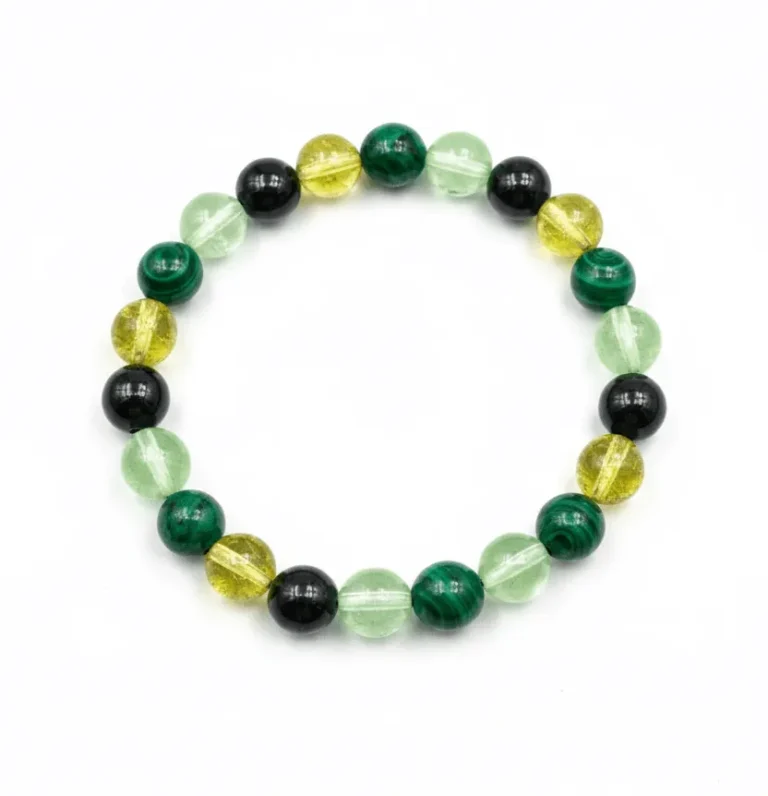
Number 5 Mixed-Stone Bracelet
Actual mixed-material bracelet with Malachite, Green Fluorite, Peridot and Jade. It is not a Malachite-only bracelet.
GREEN GEMSTONE IDENTITY · LOOKALIKE COMPARISON
Natural Bands vs Imitation Stripes
Colourful stripes are a useful feature to inspect, but neither regularity nor irregularity alone proves that a specimen is natural.
Natural Banded Malachite
Bright and deep green wavy, curved or concentric mineral bands; actual patterns vary widely.
Striped Resin Imitation
Manufactured materials may mimic dark and light green lines. Do not treat perfect-looking stripes as definitive proof either way.
Chrysocolla & Other Green Minerals
Other copper minerals can be green or blue-green, but have different chemistry and physical properties.
Original colour diagrams are illustrations only; qualified material identification may be necessary for high-value specimens.
Malachite Mineral Facts, Treatments & Care
| Feature | What buyers should know |
|---|---|
| Mineral identity | Malachite is green copper carbonate hydroxide, Cu₂CO₃(OH)₂, often forming near weathered copper deposits. |
| Signature appearance | Bright to deep green curved, concentric, wavy or irregular bands; matte rough material and polished material look different. |
| Mohs hardness | Typically about 3.5–4; significantly softer than quartz and easily scratched by abrasive cleaners. |
| Density | Often around 3.6–4.0 g/cm³, but density, colour and banding alone are not reliable proof of treatment or origin. |
| Natural formations | Massive banded pieces, botryoidal or rounded crusts, polished stones, beads, carved shapes and small irregular chips. |
| Imitations | Painted or striped resin, polymer composites, reconstructed material and other green stones may imitate the look. |
| Treatments | Waxing, resin stabilisation, polishing, repairs or coatings can affect appearance and cleaning suitability; ask for item disclosures. |
| Verified product forms | Natural Malachite tumblestones, green-threaded double-layer bracelet, loose small chips and a separately labelled mixed-stone bracelet. |
| Handling precautions | Intact polished material differs from loose dust. Avoid grinding, sanding, ingestion and drinking-water immersion; contain small chips. |
| Care | Keep away from acids, abrasives, steam and ultrasonic cleaning. Prefer dry soft wiping or carefully controlled damp wiping where suitable. |
| Traditional symbolism | Transformation, courage and heart-chakra associations are personal or cultural meanings rather than proven health or wealth outcomes. |
For gemological background, see Mindat Malachite mineral record, International Gem Society’s Malachite guide and Geology.com mineral notes.
MALACHITE · GEMSTONE IDENTIFICATION, REAL PRODUCTS & GENTLE CARE
Read the Green Bands · Choose Real Formats · Keep Malachite Safe
Three gemstone-specific buying checks for a soft copper carbonate mineral, based on the actual Divinity Crystals range.
COPPER CARBONATE · MOHS 3.5–4 · NATURAL GREEN BANDS
Choose by the real mineral, selected format and suitable handling
Examine the Green Banding
Look at light and dark curved layers, polish and natural variation. Compare each item with resin or other green mineral lookalikes.
Pattern alone does not certify authenticity or treatment.
Match the Actual Product
Compare polished tumblestones, green-threaded 38-bead bracelet, small mineral chips and the mixed-stone Number 5 bracelet.
Check real photos, size, quantity, bead fit and the exact mix.
Care for the Copper Mineral
Keep Malachite away from acids, abrasive scrubbing, steam and ultrasonics. Avoid grinding or inhaling dust and keep loose chips out of drinks.
Use soft wiping and protect any coatings or thread.
Explore genuine Malachite listings: Polished Tumbles · Green-Threaded Bracelet · Malachite Chips · Number 5 Mixed-Stone Bracelet
Malachite contains copper, but an intact polished jewellery piece should not be confused with powdery workshop material. Avoid dust-producing work, ingestion and gemstone-infused drinking water, while enjoying finished stones with normal care.
Before Buying Malachite
- Review the actual product photo and compare dark-and-light green bands.
- Confirm the selected tumble count, chip pack weight or finished bracelet circumference.
- Check surface polish, cracks, filled areas, coatings and signs of repair.
- For the double-row bracelet, inspect green thread, bead count and actual fit.
- Ask for details of wax, resin stabilisation or any other treatment.
- Review the actual laboratory report and tested sample if certification is claimed.
Malachite Cleaning and Handling
- Use a soft dry cloth first on finished polished pieces.
- A barely damp cloth may be suitable for some intact stable finishes, followed by immediate drying.
- Keep away from vinegar, acids, harsh cleaners and abrasive materials.
- Avoid steam, ultrasonic machines and prolonged soaking of jewellery.
- Do not sand, grind, crush or deliberately brush friable raw pieces into airborne dust.
- Keep small chips away from children, pets, food and drinking water.
What Is Malachite? The Green Copper Mineral
Malachite is a natural copper carbonate hydroxide mineral with the formula Cu₂CO₃(OH)₂. It is an important secondary mineral associated with the weathering of copper-bearing deposits, and often forms masses, crusts, layered bands or rounded botryoidal surfaces.
Its characteristic vivid green colour comes from its copper chemistry. Some polished pieces show dramatic concentric or wavy bands, while rough specimens can feature textured, dull or fibrous surfaces. A polished surface usually reveals patterns more clearly than a rough exterior.
Mineralogical references, including Mindat, describe the mineral’s relatively low hardness and range of forms. For more context on raw mineral varieties, see our Raw Crystals and Rough Stones Guide.
How to Tell Real Malachite from Imitation
Imitations can use resins, polymer-based materials or printed finishes. Extremely regular stripes and an artificial-looking surface can invite further investigation, but neither those signs nor attractive natural-looking bands are conclusive on their own.
Do not use destructive scratch, acid, hot-needle or solvent tests on valuable jewellery. A qualified gemologist or laboratory can examine materials more reliably, and documentation should identify the exact piece or tested sample. Origin statements and blanket “lab-certified” descriptions require supporting evidence.
For related shopping guidance, read How to Spot Fake Crystals and our Crystal Cleaning & Safe Care Guide.
Is Malachite Toxic? Understanding Real Handling Risks
Because Malachite contains copper, it should not be ingested, deliberately pulverized or used to make gemstone-infused drinking water. Loose powder and friable material present greater handling concerns than intact, finished pieces, particularly if dust could be inhaled or swallowed.
Normal contact with cool water does not cause Malachite to emit toxic copper fumes. The more relevant considerations are improper cleaning, wet mineral residue, potential leaching into liquids intended for consumption and damage to waxes, repairs or other treatments. Children and pets should not have access to small loose specimens.
For a powdery, damaged or uncertain specimen, avoid forceful dry brushing and consult an experienced mineral conservator. Polishing, grinding, drilling and other dust-producing workshop work require specialized controls and appropriate protective measures.
Malachite Cleaning and Jewellery Care
At approximately 3.5–4 on the Mohs scale, Malachite is relatively soft. Acidic products can attack the mineral, while harsh abrasives can mar a polished surface. Steam and ultrasonic cleaners should be avoided; GIA’s jewellery care guidance includes Malachite among stones vulnerable to such cleaning systems.
If an intact polished piece has a known stable finish, light wiping with a soft cloth may be sufficient. For some suitable pieces, a minimally damp cloth may be used carefully and dried promptly, but the safest approach depends on coatings, wax, resin stabilization, metal settings and any underlying cracks.
Do not soak unknown pieces in saltwater or acidic baths, bury delicate jewellery in gritty soil, or assume smoke removes dirt. Browse the Crystal Cleansing Methods Guide for broader physical-care principles.
Malachite Meaning, Transformation & Heart Chakra
Some modern gemstone traditions associate Malachite with the heart chakra, reflection, boundary setting and emotional change. A polished piece on a desk or a securely finished bracelet may serve as a personally meaningful reminder to journal, reflect or practise a goal.
These are symbolic associations, not scientific proof that Malachite resolves trauma, improves relationships, absorbs negative emotions, prevents bad habits or shields a person from electromagnetic fields. For anxiety, distress or other health concerns, use appropriate medical or mental-health support rather than relying on stones.
A meaningful ritual can be as simple as a moment of quiet reflection and ordinary physical cleaning. Neither smoke nor a “charging plate” is required to maintain the mineral.
Compare Malachite with Other Divinity Crystals Collections
Explore our Love & Harmony Crystals collection for symbolic gifting themes, or Crystal Bracelets for different jewellery styles. Product availability, dimensions and any certification vary by individual listing.
For mineral comparison, the Pyrite Guide discusses another mineral with distinctive metallic appearance and its own storage requirements. Check gemstone photographs, the precise material offered and complete documentation before deciding on a purchase.
Do not assume that every green-banded commercial item is natural Malachite or that any advertised locality or independent testing applies to all items of a category.
Frequently Asked Questions
What is Malachite made of?
Malachite is a copper carbonate hydroxide mineral, Cu₂CO₃(OH)₂, with a distinctive green colour and frequently dramatic natural banding.
Does natural Malachite always have circular bands?
No. Natural Malachite may have swirls, stripes, irregular bands, massive textures or rounded botryoidal growth. Pattern varies by piece.
How can I distinguish real Malachite from imitation?
Examine the exact item photos, pattern, material descriptions and treatment disclosures. Painted resins and composites can resemble natural bands. Valuable pieces may need professional identification.
Is Malachite jewellery safe to wear?
Intact, well-finished Malachite jewellery can be worn with normal care. Avoid damaged friable surfaces, dust-generating work, licking stones or letting children mouth loose pieces.
Is Malachite toxic if touched?
Normal contact with an intact polished stone is different from inhaling or ingesting mineral dust. Do not deliberately grind, sand, chew or consume Malachite.
Can Malachite go in drinking water?
Do not place Malachite stones or chips into drinking water; mineral contaminants, copper-containing material and finishes are not established food-contact safe.
Can I clean Malachite with vinegar or an acid?
No. Malachite is carbonate-rich and sensitive to acids. Avoid vinegar, acid-based cleaners, harsh solvents and abrasive scrubbing.
Is Malachite safe in an ultrasonic cleaner?
Ultrasonic and steam cleaning are not recommended for Malachite because it is soft, somewhat brittle and sensitive to damage.
Is the Number 5 bracelet all Malachite?
No. The verified Number 5 design includes Malachite, Green Fluorite, Peridot and Jade, so it is a mixed-stone product.
How can I care for a Malachite beaded bracelet?
Use a soft cloth and avoid scrubbing. Preserve the green thread, bead holes, knots, coatings and any metal fittings; do not soak or steam-clean.
Can Malachite help with emotional transformation?
Transformation and heart-chakra meanings are spiritual symbolism. A stone has not been shown to treat trauma, anxiety or other health conditions.
Does ‘lab certified’ mean every Malachite bead was examined?
Not necessarily. Review the specific report, issuing lab, tested sample and findings to know what the certificate actually covers.
Choose Malachite for Its Genuine Green-Banded Mineral Beauty
Malachite’s distinctive curves and deep emerald tones reward careful inspection. The strongest product decision comes from real first-party photos, clear sizing and treatments, sensible handling and an understanding of how its softer copper mineral surface differs from quartz.
Its transformation and heart-chakra symbolism can remain a personal tradition, separate from medical or physical claims.