

Divinity Crystals · The Mineral Journal
Garnet is not a single red mineral. It is a family of related silicate minerals that can appear in deep wine-red, orange, green, pink, brown and other colours. Many collectors know the dark red material used in tumbled stones and rough specimens, while jewellery buyers may also encounter brilliant green Tsavorite or Demantoid and vibrant orange Spessartine.
Garnet has a long history in decorative jewellery and is widely recognised as a January birthstone. In many modern crystal traditions, red Garnet symbolises passion, perseverance, groundedness and personal resilience, and it is often linked with the Root Chakra. These meanings can be enjoyed as culture or personal ritual, but they are not evidence that a stone cures exhaustion, changes physiology or guarantees romantic results.
Here, we separate mineral facts from symbolism and explain how to inspect Garnet, appreciate different varieties, choose between tumbled stones, raw chunks and crystal chips, and use safe material-specific cleaning and storage.
Explore Divinity Crystals Garnet Tumbled Stones alongside our real-product gallery below.

Key takeaways
- Garnet is a group of related silicate minerals, not only one red gemstone.
- Common Garnet mineral species and mixtures vary in colour, hardness and value.
- GIA gives a general Mohs hardness range of 6.5–7.5 depending on type.
- Look for exact-item photos, weight, dimensions, species, treatments and report scope.
- Root and Sacral Chakra meanings are traditions, not scientifically verified medical effects.
- Warm soapy water is normally suitable for Garnet itself, but matrix, fractures and jewellery need extra care.
Five original Divinity Crystals Garnet product views
These are five different first-party merchandise photographs: polished tumbles, rough fragments from multiple angles and Garnet chips. They are not AI-imagined stock, and photographs alone do not establish species or certification.
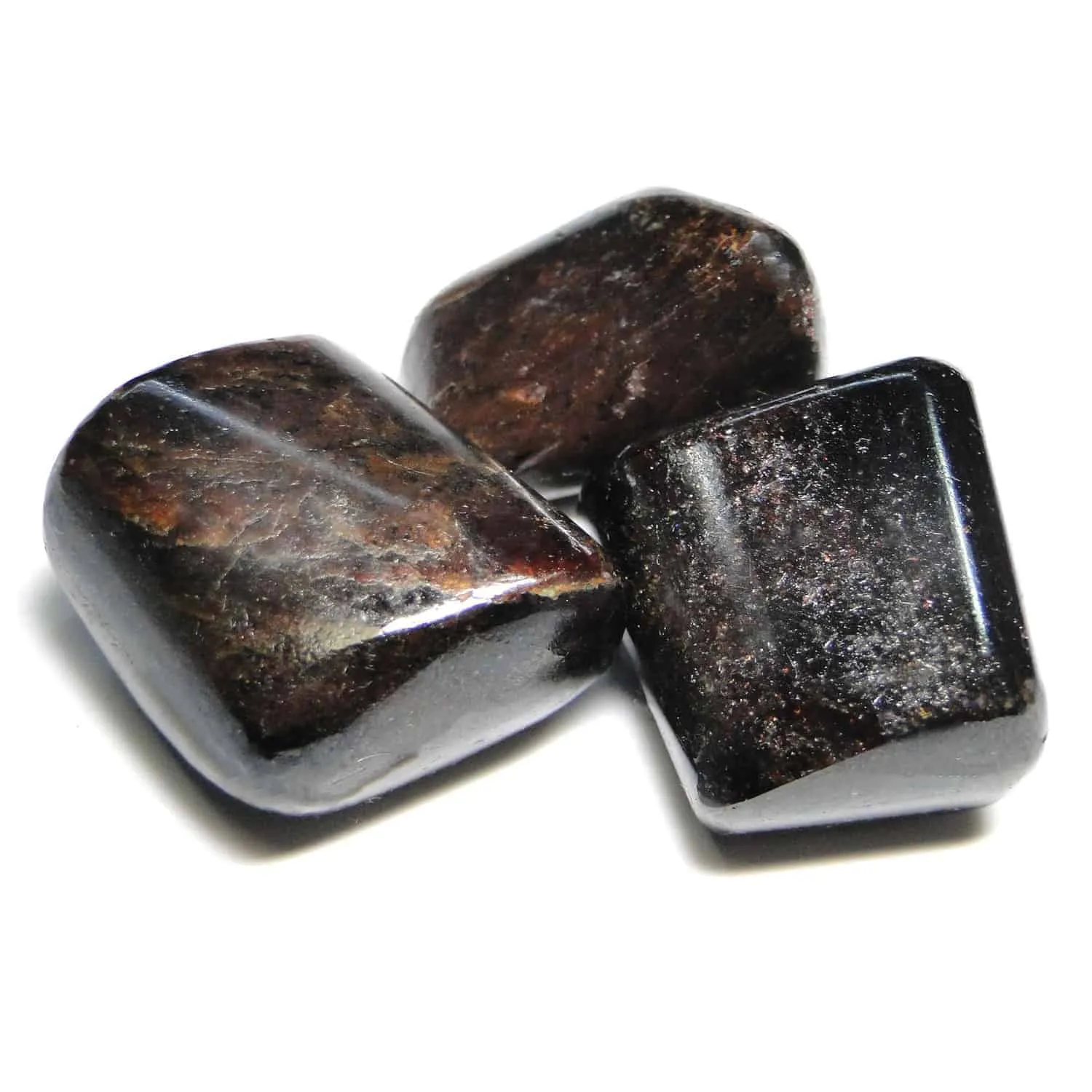
1. Garnet tumbled stones
Original first-party photograph showing three rounded dark-red stones; compare the listing’s actual pack, dimensions and colour.
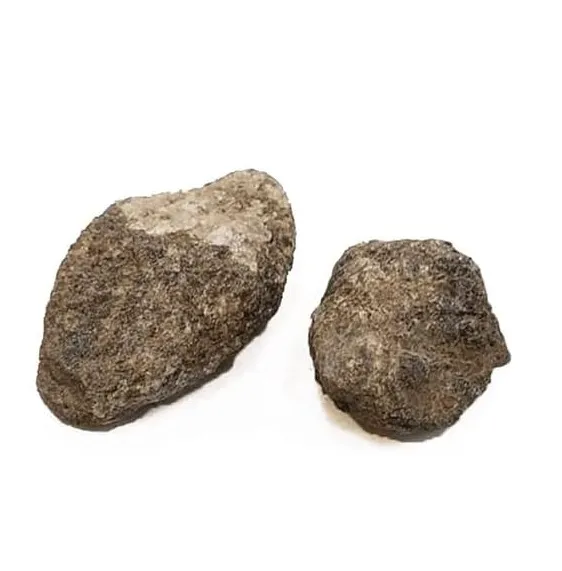
2. Raw Garnet chunks
An original merchandise image of irregular rough Garnet pieces with different surfaces and mineral shapes.
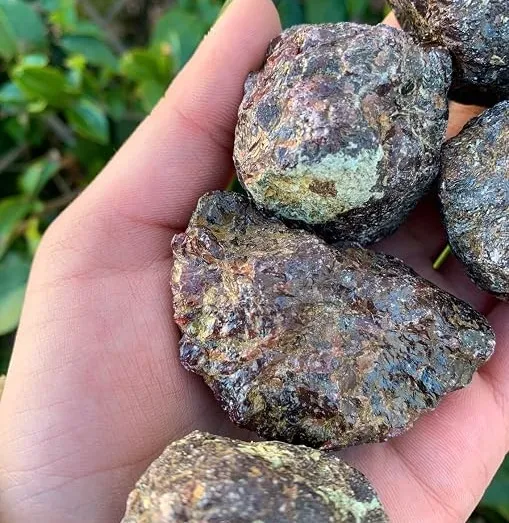
3. Raw stones in hand
A hand-held original product view helps illustrate the real-world scale of the rough material.
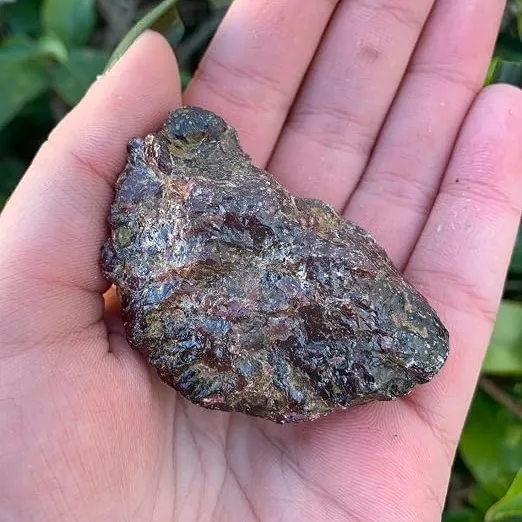
4. Outdoor single specimen
The single rough specimen shows surface detail in natural light; appearances may vary across different pieces.
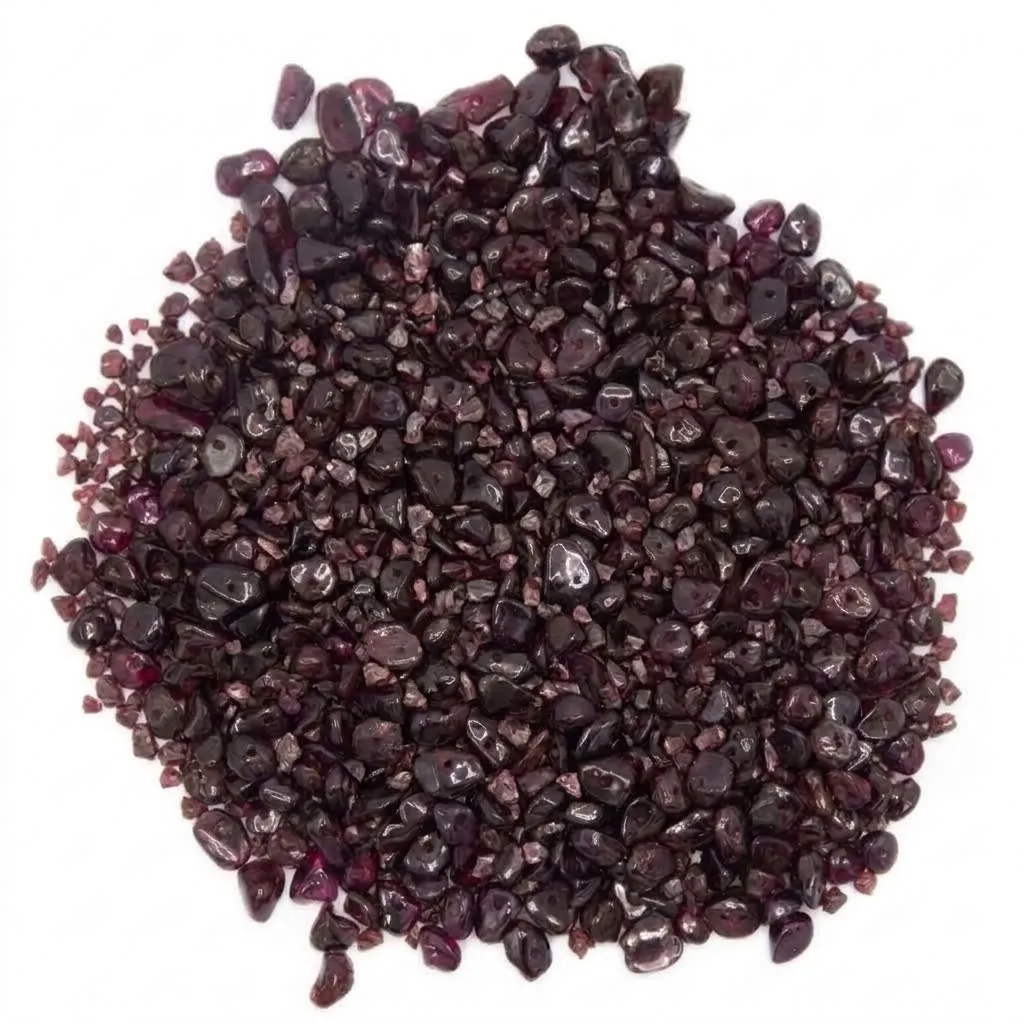
5. Garnet crystal chips
Original product photograph of small deep-red mineral fragments for decorative crafts and symbolic grids.
What is Garnet? Understanding the mineral group
The mineral-group name Garnet covers multiple closely related silicates rather than one fixed formula. Different elements occupy positions in the crystal structure, producing several end-member species and intermediate compositions. A seller may correctly call a stone Garnet without knowing whether its chemistry is closer to almandine, pyrope or a mixture; a precise species statement requires the right supporting evidence.
Six familiar end members are Almandine, Pyrope, Spessartine, Grossular, Andradite and Uvarovite. Many attractive varieties occur as natural mixtures or trade colour names. The garnet group includes reddish purple, orange, yellow, green and brown gemstones, so a buying guide that only describes “ruby-red Garnet” misses much of the mineral story.
For independent mineral information, consult GIA’s Garnet mineral-group overview and GIA’s Garnet buyer’s guide.
Six Garnet species and well-known varieties
| Mineral / variety | Typical appearance | Important buying distinction |
|---|---|---|
| Almandine | Often dark wine-red or reddish brown | Frequently associated with common red rough and jewellery Garnet; colour alone does not prove it. |
| Pyrope | Red to purplish red | May occur as mixtures; species or blend should be reported carefully. |
| Spessartine | Orange through reddish-orange | Orange colours and clarity can change the market value substantially. |
| Grossular | Colourless, yellow, orange or green | Includes green Tsavorite and orange-to-reddish Hessonite. |
| Andradite | Yellow, brown or green | Includes Demantoid, a green variety with different optical and durability properties. |
| Uvarovite | Green, usually small crystals | Often encountered in mineral specimens rather than large faceted jewellery stones. |
The exact assortment available at Divinity Crystals may be narrower than the full Garnet group. The images in this guide show the existing red Garnet merchandise; the species table is educational and does not imply we stock all six Garnet minerals.
Garnet at a glance
| Property | What buyers should know |
|---|---|
| Family | Group of related silicate minerals |
| Colours | Red, purple-red, orange, yellow, green, brown and others |
| Hardness | Approximately 6.5–7.5 Mohs, varying by species |
| Durability | Suitable for many jewellery styles with care; vulnerable to hard impacts |
| Form | Rough crystals, polished stones, chips and faceted gemstones |
| Cleaning | Garnet usually tolerates gentle warm soapy water; verify matrix, fractures and attachments |
| Authentication | Gemological identification, original specimen photos, verifiable report where appropriate |
Before purchasing Garnet online
- Confirm whether you are buying one specimen, multiple tumbles or a weight-based chip pack.
- Review actual product photography, not just an editorial illustration.
- Check the mineral description and ask if a specific Garnet species is identified.
- Assess chips, surface cracks, natural matrix, colour and any polishing limitations.
- Check dimensions, mass, quantity and scale against real photographs.
- When a report is promised, verify the laboratory, report ID, sample and conclusions.
A seller’s adjective such as “AAA” does not replace a universally standardised Garnet grading report; GIA notes that retailer grade labels vary.

Confirm the mineral group and, where needed, the species. Check actual photographs and documentation rather than relying on colour alone.
Enjoy Garnet as a collector object or symbol of perseverance and grounding. Personal tradition is not medical treatment.
Keep stones away from knocks; clean known stable material gently and store separate from hard or sharp objects.
Garnet vs Ruby, glass and other red stones
Red Garnet can resemble Ruby, red spinel, red glass or dyed material in a photograph. Ruby is a red variety of corundum, with a different chemistry and physical properties; spinel and Garnet are also distinct minerals. A striking wine-red colour is not sufficient to identify any of them.
A qualified gemologist may use refractive index, optical character, spectroscopy, specific gravity and microscopy to help determine a stone’s identity. Appropriate testing depends on whether the specimen is polished, loose or mounted. Internet colour charts and at-home scratch or destructive tests cannot reliably replace expert examination, especially where resale value or certification matters.
How to assess rough red Garnet
Look at natural crystal faces, any matrix, translucency at thin edges and surface condition. Natural Garnet crystals may show geometric forms such as dodecahedral faces, but rough stones can also be irregular or broken. Refrain from assuming that a well-shaped crystal or particular red hue guarantees the species, treatment or origin.
How to assess tumbled Garnet
Check finish, size, colour under different lighting and whether the item has surface pits or fractures. Some dense dark-red tumbled pieces may appear opaque in ordinary light but show red transmission at thin edges. That can be an observation, not a stand-alone authenticity test.
Root Chakra, passion and the meaning of “vitality”
Garnet is often associated with the Root Chakra (Muladhara) and sometimes the Sacral Chakra (Svadhisthana) in modern gemstone traditions. It may symbolise determination, protection, sensuality, commitment and steady progress. Those interpretations can be meaningful within personal rituals and culture, but Garnet does not have proven effects on blood circulation, hormone levels, chronic fatigue, depression, anxiety or physical stamina.
A person may use a stone as a reminder to journal, practise a comfortable breathing exercise, set a practical goal or express care toward someone. These activities are choices independent of any scientifically demonstrated mineral “frequency”. For persistent exhaustion or emotional distress, seek appropriate professional support rather than treating a crystal as medicine.
For more on traditional associations, see our Root Chakra Crystals guide.
How to use Garnet in everyday life
1. Tumbled Garnet: a pocket-sized collector stone
Polished stones can be displayed on a small tray, inspected in indirect light or carried as personal decorative objects. They do not deliver a measurable boost of stamina, but their colour and weight may be appreciated as part of a quiet ritual.
See the Natural Garnet Tumbled Stones listing for actual available formats, pack size and photographs.
2. Raw Garnet: appreciate its structure
Rough Garnet chunks are useful for examining mineral texture, crystal form and matrix. Larger stones should rest on stable padded surfaces; raw edges and attached minerals may need more delicate cleaning than an unmounted polished gem.
Explore the Garnet Raw Crystal Chunk listing and examine the documented photographs.
3. Garnet chips: crafts and decorative grids
Small fragments work for craft displays and optional symbolic patterns, provided package weights and natural variation are understood. Small chips can be choking hazards and should never be used as unverified drinking-water ingredients.
4. Garnet jewellery: consider the whole construction
Garnet can be worn in rings, pendants and bracelets, but durability depends on species, stone condition, setting, cords and metals. The current Garnet-specific product set verified for this article includes tumbles, rough material and chips; this section is educational and does not advertise a non-verified Garnet bracelet.
Follow the exact item’s finish and jewellery-maker instructions when cleaning.
Vastu and home placement: tradition without overpromising
Some contemporary Vastu and crystal-décor approaches associate red Garnet with the south, personal grounding or motivated action. Directions and meanings vary among practitioners and are not backed by experiments showing a stone changes room energy, cures low mood or improves romantic relationships.
For an attractive display, use a level shelf away from edges and high-traffic zones. Protect sharp rough specimens from falling; keep small stones away from children and pets. You can enjoy a decorative arrangement for what it is: natural material displayed thoughtfully.
How to clean Garnet without damaging the specimen
GIA recommends warm soapy water for Garnet, and notes that Garnet hardness varies by species and that hard blows should be avoided. The cleaning method for a stable polished Garnet gemstone is not necessarily suitable for raw matrix, fracture-filled material, glued jewellery or unknown finishes. Check the actual piece before applying any method.
For a stable polished, unmounted Garnet
- Inspect for visible fractures, surface treatments or loose inclusions.
- Remove loose dust using a very soft brush or clean dry cloth.
- If the known stone is stable, gently clean with mild warm soapy water and a soft brush or cloth.
- Rinse carefully where appropriate and dry completely before storage.
- Keep individual stones padded and separate from hard, sharp objects.
For rough chunks, chip packs and jewellery
Raw matrix can contain additional minerals that do not tolerate water in the same way as the Garnet itself. Where material is friable or identification is uncertain, start with minimal gentle dry dusting. Avoid vigorous scrubbing, soaking chip packs or washing unknown glue, elastic, dyed string or plated findings.
GIA says ultrasonic cleaning may be acceptable for some Garnet but is unsuitable when stones have fractures; steam cleaning is not recommended. Fracture-filled stones should only be cleaned carefully using warm soapy water. For a valuable or unusual specimen, seek professional advice.
Do not use soil burial, saltwater baths, abrasive powders or strong acids as standard care. Physical cleaning removes dirt; symbolic “charging” is a separate optional practice and does not repair mineral damage.
Read GIA Garnet Care and Cleaning and our Crystal Cleansing Methods — How to Clean Stones Safely.
Storage, display and long-term care
Keep rough pieces in padded trays or specimen boxes where they cannot roll or collide. Polished Garnets may be stored separately in a lined compartment. Avoid high shelves, hard impacts and exposure to harsh household chemicals. Small chips belong in a secured, labelled container away from pets, children and food.
A safe environment and careful handling matter more than claims that the stone must absorb or discharge a spiritual energy.
Lab reports, treatment and responsible buying
Where a retailer describes Garnet as natural, untreated, certified or of a particular species, request supporting evidence specific to the actual product. A certificate should identify who issued it, what was tested and which conclusions were reached. A report for one specimen cannot automatically validate every piece in a weight-based pack.
Our Gemstone Authentication Guide explains useful buying questions for natural and imitation stones.
Frequently asked questions about Garnet
What is Garnet made of?
Garnet is a group of related silicate minerals with different chemical compositions. Common species include almandine, pyrope, spessartine, grossular, andradite and uvarovite. A trade label reading Garnet alone does not identify the precise species.
Is Garnet always red?
No. Garnet occurs in red, pink, orange, yellow, green, brown and other colours. Red material is common in consumer jewellery, but green tsavorite and demantoid and orange varieties are also important.
What is the difference between almandine and pyrope Garnet?
Both can be red. Almandine is iron-rich and pyrope is magnesium-rich; many commercial gems have intermediate compositions. Colour alone may not distinguish them reliably.
What is Rhodolite Garnet?
Rhodolite is a trade variety name usually used for purplish-red to pink garnet in the pyrope–almandine compositional range. It is not proof of a particular origin.
What is Hessonite Garnet?
Hessonite is typically an orange to reddish-orange variety of grossular Garnet. It is traditionally called Gomed in some Indian gemstone markets; verify identity and treatment before buying.
How hard is Garnet?
Depending on its species, Garnet generally ranges from about 6.5 to 7.5 on the Mohs scratch-hardness scale. It can still chip or break after an impact.
Does red Garnet look like Ruby?
Some Garnet shades can resemble Ruby or red glass, but Ruby is corundum, not Garnet. Colour and price alone cannot establish the mineral species.
How do I identify natural Garnet at home?
Inspect the real stone, colour, surface, matrix and seller documentation, but avoid destructive scratch tests. A competent gemologist can use refractive index, spectroscopy and other methods suited to the specimen.
Can Garnet be lab-created or imitated?
Imitations such as glass exist, and some manufactured garnet-structured materials are used industrially. Natural origin should be supported by testing and reliable product records, especially for high-value pieces.
Is every Garnet specimen untreated?
Garnet is often sold without treatment, but some stones may have undergone processes such as fracture filling. No universal untreated claim should be made for an assortment without evidence.
Can Garnet be certified?
Yes, suitable gemological laboratories can identify the mineral and report observations. Check the issuing body, report number, described specimen and the actual conclusions rather than relying on the word certified.
Can Garnet increase stamina?
There is no reliable clinical evidence that holding or wearing Garnet treats chronic fatigue, increases physical endurance, or changes bodily energy. Those are traditional symbolic claims, not medical effects.
How do I clean a polished Garnet stone?
GIA recommends warm soapy water for Garnet. For a stable loose polished stone, use a soft brush or cloth and dry thoroughly. More fragile or mixed-material pieces need individual assessment.
Which Garnet format should I choose?
Choose based on your intended use: tumbled stones for handling or collecting, rough chunks for mineral display, and small chips for crafts. Assess actual quantity, dimensions, and surface condition.
Can I verify Garnet origin from a photograph?
No. Source locality or a named mine cannot normally be established from a retail photograph alone. Seek credible provenance documentation where origin is commercially important.
Choose Garnet for natural mineral beauty and informed trust
Garnet rewards careful observation: its related minerals offer a remarkable range of colours, geological forms and jewellery styles. A dark-red tumbled stone and a raw Garnet chunk have different buying and care considerations, while a Garnet chip pack requires attention to quantity and small-piece handling.
Enjoy historical and chakra symbolism as cultural meaning, and rely on reliable information for mineral identification, certification, safety and care. The best choice is an accurately described stone with transparent details and realistic expectations.