
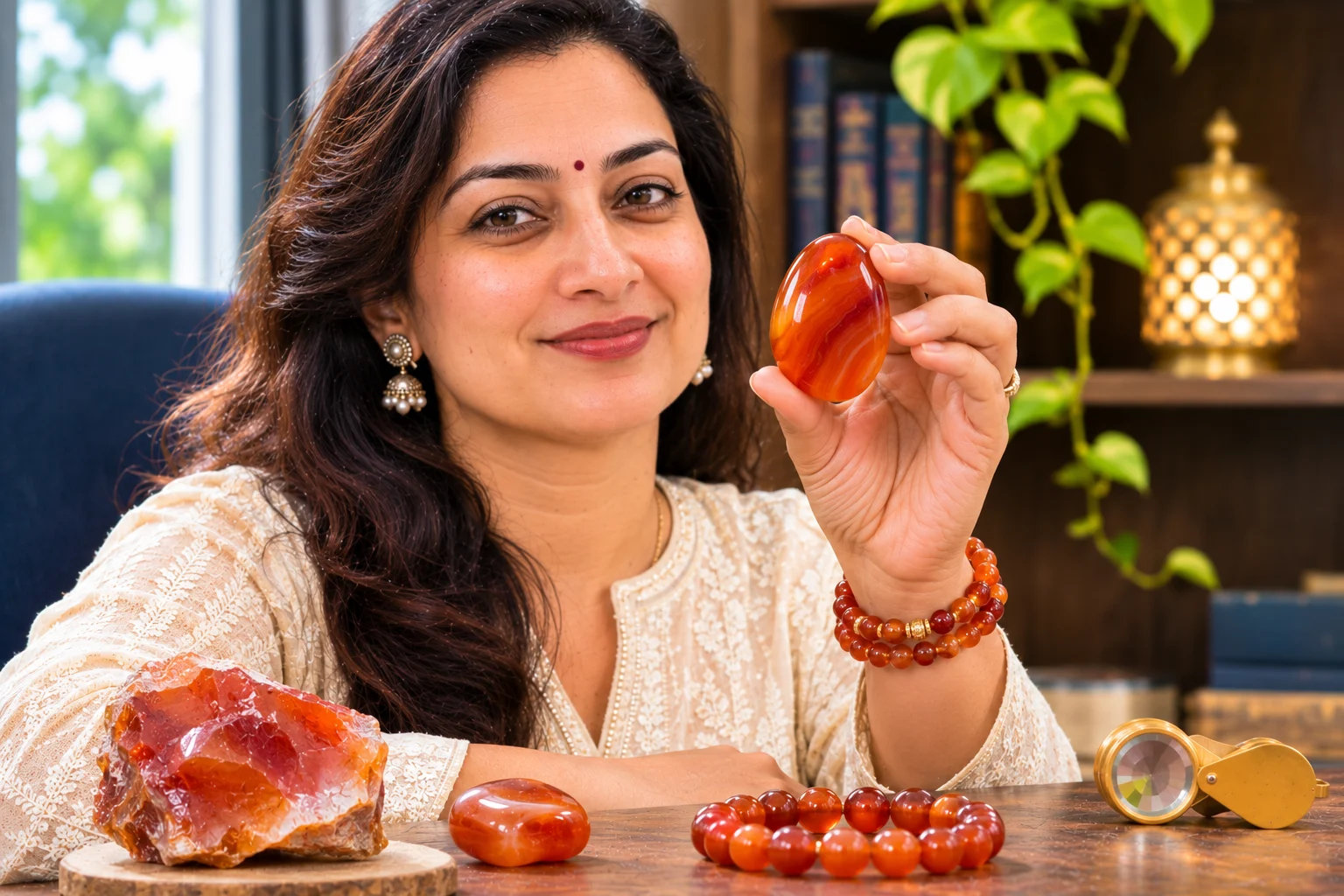
THE DIVINITY JOURNAL · CARNELIAN MINERAL & BUYING GUIDE
Carnelian has long been admired for its warm orange, red-orange and rich reddish-brown shades. It is familiar in rough mineral collections, smooth polished cabochons and bracelets, with its distinctive colour linked to iron in fine-grained quartz-family material.
Carnelian is a chalcedony variety made mainly of SiO₂, with Mohs hardness approximately 6.5–7. Both natural colour and enhancement are found in the market. Heat treatment is historically common, but a highly coloured photograph cannot establish whether a specific stone was treated.
Explore five genuine Divinity Crystals product photographs, a distinct Indian portrait holding a visibly orange-red polished stone, an original Carnelian-specific featured cover, and a buyer’s guide covering natural-looking colour, enhancement, real bracelet construction and careful cleaning. Motivation and creativity associations are personal traditions, not guaranteed outcomes.

FIVE DISTINCT FIRST-PARTY CARNELIAN PRODUCT PHOTOGRAPHS
Real Carnelian: Four Rough-Stone Views and a Red-Threaded Bracelet
These are actual Divinity Crystals catalogue images. The first four show different views of the listed raw Carnelian range, while the fifth shows the actual red-threaded double-layer bead bracelet. The photographed colour may vary across genuine specimens.

Natural Orange-Red Carnelian Raw Stones
First-party image of the actual Carnelian rough-stone product; orange and warm reddish tones differ naturally between pieces.
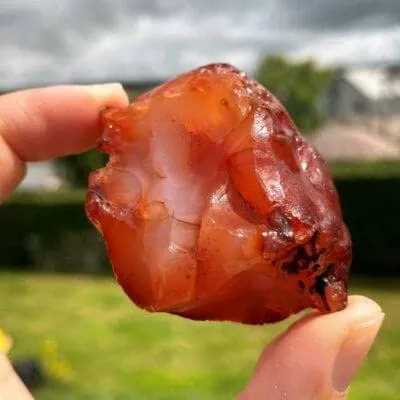
Translucent Carnelian Rough Crystal
Original catalogue image of a rough Carnelian-like specimen illustrating light transmission and the irregular raw finish.

Deep Red Raw Carnelian Pieces
Separate real raw Carnelian product image showing darker orange-red stones. Depth of colour does not independently establish heating.
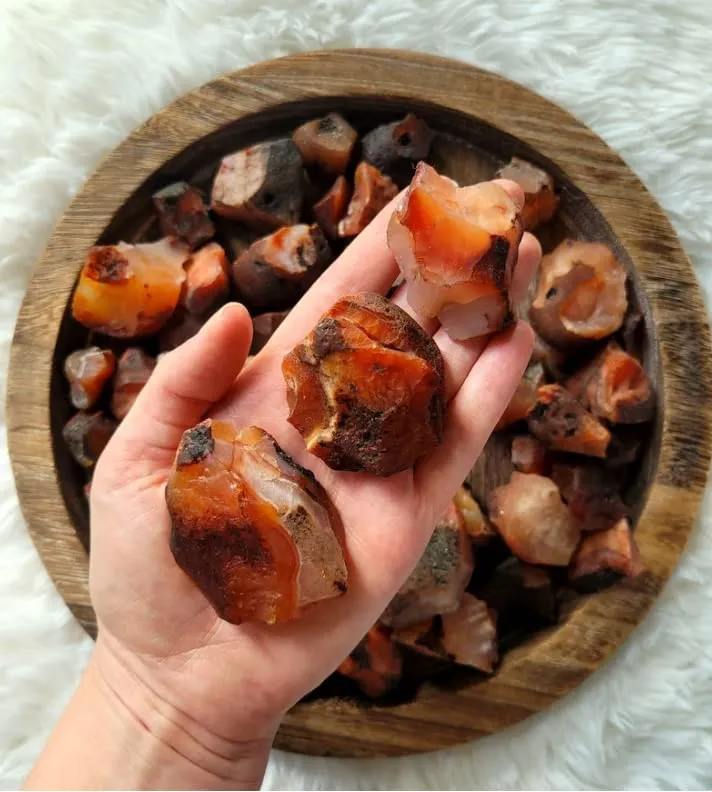
Collection of Carnelian in a Bowl
Genuine first-party photograph of a group of Carnelian raw chunks displayed in a wooden bowl, showing pack-style variation.
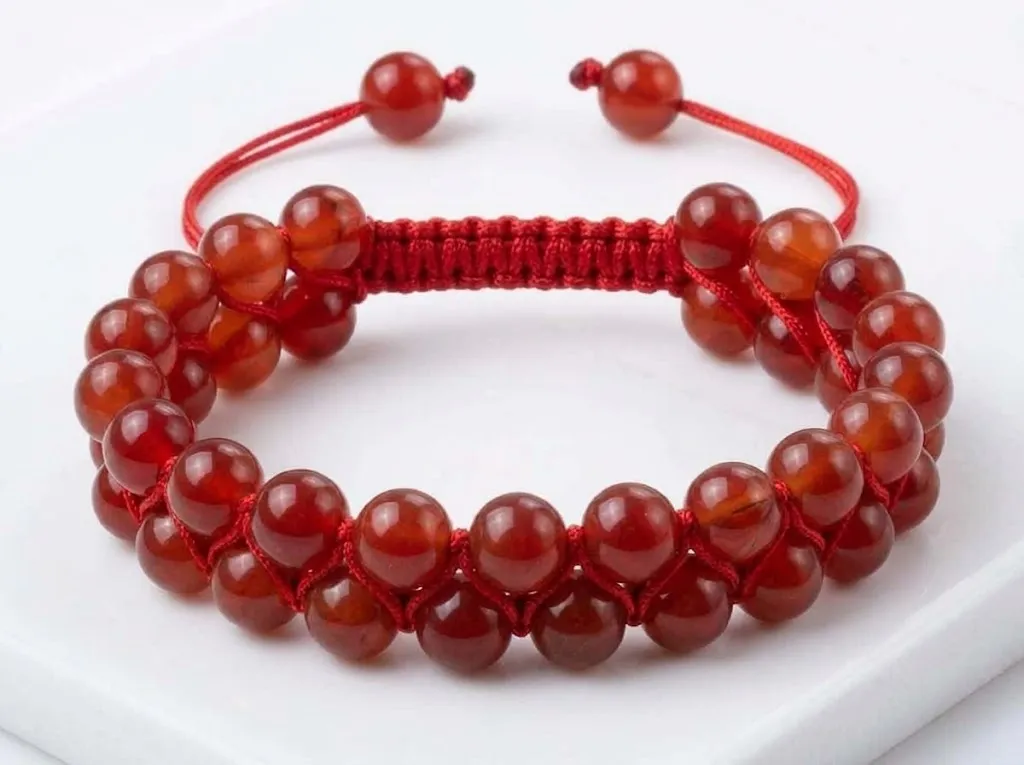
Red-Threaded Double-Row Carnelian Bracelet
Real jewellery product image of the listed 38-bead Carnelian double-row bracelet with red thread, distinct from rough stones.
CHALCEDONY COLOUR · BUYING & TREATMENT COMPARISON
Natural Carnelian vs Enhanced Chalcedony
A photograph of orange or red chalcedony rarely establishes exactly how its colour developed. Treatment needs proper disclosure and, where material, a relevant evaluation.
Naturally Coloured Carnelian
Warm orange-to-red iron-related colour in chalcedony; opacity and saturation naturally vary between pieces.
Heat-Enhanced or Dyed Chalcedony
Natural silica altered to intensify colour; it should be described accurately rather than automatically called fake.
Orange Glass or Other Imitations
A different manufactured or composite material can imitate an orange polished gemstone but is not natural Carnelian.
Original educational colour swatches are not material-identification tests and are not extra products for sale.
Carnelian Mineral Identity, Treatments & Buyer Facts
| Property | What buyers should know |
|---|---|
| Mineral identity | Carnelian is orange to reddish-brown iron-coloured chalcedony, a microcrystalline silica material (SiO₂) in the quartz family. |
| Typical shades | Light orange, orange-red and reddish-brown. Translucency and local colour concentration vary by specimen. |
| Mohs hardness | Approximately 6.5–7. Chalcedony offers reasonable scratch resistance but beads, fractures and stringing still need care. |
| Orange-red colour | Iron-bearing particles or oxides contribute to warm colours. Colour is a description, not proof of untreated material. |
| Treatment history | Heat treatment of chalcedony to deepen reddish shades is well documented. Dyes can also affect commercial stones. |
| Raw vs polished | Irregular rough Carnelian has fractured natural surfaces; finished beads are polished, drilled and set into jewellery. |
| Sard and agate | Sard often describes browner or darker translucent chalcedony; agate refers to banded chalcedony. Trade boundaries can overlap. |
| Imitation risk | Coloured glass, dyed other materials and reconstructed products can imitate some Carnelian appearances. |
| Verified stock | Four first-party raw-stone images from one listing and a genuine red-threaded Carnelian double-row bracelet; mixed Carnelian combinations are separate products. |
| Care | Use a soft cloth first; limited mild-soap washing can suit sound compatible pieces. Protect dyes, adhesives, elastic and metal fittings. |
| Traditional symbolism | Motivation, courage, creativity and sacral-chakra associations are cultural or personal meanings, not clinical effects. |
Gemological references: International Gem Society Carnelian Guide, Chalcedony Information and GIA Gem Treatments.
CARNELIAN · GEMSTONE IDENTITY, REAL PRODUCTS & CARE
Examine Orange Chalcedony · Ask About Heat · Check Real Jewellery
Three Carnelian-specific buyer checks based on mineral chemistry, real store formats and physical care.
ORANGE-RED CHALCEDONY · MOHS 6.5–7 · GENUINE CARNELIAN STOCK
Choose by actual material, transparent enhancements and the right product format
Inspect the Quartz Family
Carnelian is fine-grained chalcedony with orange-to-red iron-related colour. Translucence varies across naturally formed specimens.
A colour photograph cannot certify treatment or origin.
Ask About Colour Enhancement
Heat treatment can deepen red-orange colours, and dyes are possible in commercial chalcedony. Request clear, accurate disclosures.
Heated natural quartz-family stone does not automatically become glass.
Choose Actual Stone or Bracelet
Compare rough chunks and the red-threaded double-row 38-bead bracelet; check bead dimensions, inner fit, finishes and condition.
Protect stringing, drilled beads and treated surfaces when cleaning.
Explore authentic Carnelian listings: Carnelian Raw Chunks · Red-Threaded Carnelian Double-Layer Bracelet · Number 9 Mixed-Stone Bracelet · Number 1 Mixed-Stone Bracelet
Three Appearance Clues Worth Checking
Natural-looking orange-red colour
Compare several actual photographs in neutral light. Neither uniform orange nor scattered cloudy areas independently determines treatment status.
Translucence and internal texture
View rough surfaces and polished beads from different angles. Natural chalcedony can appear cloudy or translucent, but glass can also mimic a clear orange hue.
Seller evidence and report scope
Ask for accurate material description, dimensions, treatment disclosures and the actual document if certification is claimed.
Visual features are useful when comparing photographed items, but they do not confirm untreated origin or laboratory results. Avoid acid, flame, scratch and boiling-water authenticity experiments.
Before Buying Carnelian
- Identify the material as Carnelian chalcedony, not just an “orange lucky stone.”
- Check actual product images for rough surface, colour, translucence and dimensions.
- Confirm pack count or individual dimensions on raw stone listings.
- For a bracelet, review red-threaded double-row construction, claimed bead count and finished wrist fit.
- Ask whether heating, dyeing or other colour treatments are disclosed.
- Read any original laboratory report for the actual sample and tested properties.
Safe Carnelian Cleaning & Storage
- Remove loose grit using a soft dry brush or lint-free cloth before wiping.
- For stable compatible natural material, a brief gentle mild-soap wash may be suitable.
- Keep uncertain dyes, repaired fractures, elastic and red thread away from extended soaking.
- Avoid aggressive solvents, very hot water, ultrasonics and harsh scrubbing.
- Store away from sharp metal edges, hard stones and heavy objects.
- Do not put unknown stones or jewellery into drinking water.
What Is Carnelian? Mineral Identity and Colour
Carnelian is a variety of chalcedony, a finely crystalline silica material within the quartz family. Small amounts of iron-bearing material produce its familiar warm appearance. Gemstone colour descriptions include orange, red-orange and brownish red; the boundaries with darker sard and agate trade names are sometimes gradual.
A piece may appear slightly cloudy, almost opaque or translucent when held to an appropriate light source. Surface texture differs substantially between a rough specimen, a polished tumble and a drilled bead. These traits can help you describe the stone to a seller, but they are not definitive authentication tests.
Read more about different specimen forms in our Raw Crystals and Rough Stones Guide and our Natural vs Fake Crystals Guide.
Natural Carnelian vs Heated or Dyed Chalcedony
Enhancing chalcedony’s orange-red shades by heating is historically well known and common in the gemstone trade. Dyed chalcedony also exists. A heat-treated stone may still be real chalcedony; the more useful question is whether the treatment is disclosed and whether the seller’s description reflects the actual item.
Neither intensely saturated colour nor pale colour guarantees treatment history. Claims such as “100% natural untreated,” “always lab-certified” or a particular percentage of fake material sold online require evidence for the relevant products and should not be assumed from an image or marketing label.
For a technical overview of Carnelian, its common heating and its approximate 6.5–7 Mohs hardness, see the International Gem Society. Where a certificate is promised, request the issuing laboratory, report number, tested sample and stated conclusions.
Carnelian Meaning, Creativity & the Sacral Chakra
In modern crystal traditions Carnelian is often linked with courage, motivation, confident expression, creativity and the sacral chakra. People may carry a tumbled stone, wear a bead bracelet, place a raw piece on a work desk or incorporate it into a reflective routine.
These associations belong to personal or cultural practices. There is no scientifically established mechanism by which a Carnelian specimen eliminates procrastination, increases libido, restores “prana,” improves public speaking or changes sleep physiology. If a stone serves as a visual prompt to begin a task, that is a personal habit rather than a gemstone’s verified physical property.
Three practical ways to enjoy Carnelian
- Desk display: Keep a stable tumble or raw piece on a small tray as a decorative reminder of a project or intention.
- Bracelet: Wear polished beads for their colour and style; remove the piece when doing activities that could strain the elastic or scratch the stones.
- Home arrangement: Add orange Carnelian to an aesthetic Vastu- or chakra-inspired setup without presenting location or direction as a scientifically proven source of outcomes.
How to Clean Carnelian Without Damaging It
Although chalcedony is relatively durable, cleaning advice must consider treatments, cracks, inclusions, jewellery fittings and any adhesives. For an unidentified or fragile specimen, begin with a soft dry brush or cloth. When an item is sound and confirmed compatible with moisture, limited cleaning with a damp soft cloth and mild soap can be appropriate, followed by complete drying.
Avoid universal claims that all Carnelian is “perfectly water-safe,” that prolonged sunlight charges it, or that a stone must be set in direct sun for a particular time. Heating, daylight, and humidity can affect some treated stones or their mountings. Keep cleansing rituals conceptually separate from physical care.
See the Crystal Cleansing Methods Guide for mineral-specific principles and precautions.
Shopping Carnelian at Divinity Crystals
For an example of a current development-store listing, review Carnelian Crystal Raw Chunk. Product titles, stock, gemstone weight and any treatment or certificate information should be checked on the individual listing rather than inferred from photographs.
Compare categories such as Raw Crystals and Tumbled Stones for different formats. If you need material identification for a significant purchase, request documents for the exact specimen or lot.
Frequently Asked Questions
What is Carnelian stone?
Carnelian is an orange to reddish-brown variety of chalcedony, composed mainly of microscopic crystalline silica in the quartz family.
Why is Carnelian orange or red?
Iron-bearing impurities or oxides produce a range of yellow-orange, orange-red and deeper red-brown shades, with varying translucency.
Is Carnelian the same as red agate?
These chalcedony trade names can overlap. Carnelian mainly describes colour, while agate commonly refers to layered or banded chalcedony.
Is all red Carnelian heat-treated?
No absolute claim can be made for a photographed individual item. Heating is common and may enhance the red colour, but the specific treatment history must be checked.
Does heat-treated Carnelian count as fake?
No. Heating natural chalcedony changes its appearance but not the underlying identity as chalcedony. Disclose treatment accurately.
Can Carnelian be dyed?
Yes. Dyed commercial chalcedony or other materials can resemble Carnelian, so source and treatment disclosures are important.
How can I spot Carnelian imitation at home?
Inspect seller claims, current product photos, unusual joins and any treatment details without scratching. An independent gemologist is preferable for costly or disputed material.
Does Divinity Crystals sell raw Carnelian?
Yes. The verified catalogue includes a Carnelian Crystal Raw Chunk listing with several different original photographs.
Does Divinity Crystals have a Carnelian bracelet?
Yes. The verified catalogue also lists a red-threaded double-layered Carnelian beaded bracelet advertised as 38 beads. Check actual dimensions and report coverage.
Is the Numerology Number 9 bracelet entirely Carnelian?
No. The listed Number 9 bracelet includes red Carnelian with Green Jade, Red Jasper and Rhodochrosite, so it is a mixed-stone product.
How do I clean raw Carnelian?
First remove surface dust with a soft brush. For sound untreated compatible material, a brief mild-soap wash may be suitable, followed by complete drying.
How should I care for a Carnelian bead bracelet?
Avoid rough physical activities, prolonged soaking and exposure to harsh chemicals. Protect drilling, elastic, red thread, metal fittings and any coatings.
Is Carnelian safe in drinking water?
Do not immerse untested loose gemstones or jewellery directly in drinking water. Food-contact suitability depends on more than a mineral name.
What does lab-certified Carnelian mean?
A meaningful certificate should identify the issuing lab, sample, report number and findings; a title alone cannot prove that every bead was individually tested.
Choose Carnelian for Its Real Orange-Red Chalcedony Beauty
Carnelian rewards close attention to its rich warm colour, translucent or cloudy surfaces, natural-looking texture and polished finish. Choose the exact product format using authentic photographs and dimensions, and ask for accurate colour-treatment disclosures and relevant evidence rather than relying on “real or fake” shortcuts.
Its symbolism of energy and creativity can complement a personal practice without being presented as proven medical or financial effects.