

THE DIVINITY JOURNAL · BLUE LACE AGATE BUYER GUIDE
Blue Lace Agate stands out for its delicate sky-blue colour and rippling white bands. These distinctive patterns belong to a variety of banded chalcedony, a microcrystalline form of quartz, rather than a different chemical species of mineral.
Blue Lace Agate is chiefly silica (SiO₂), with Mohs hardness about 6.5–7. Natural material can show soft blue layers, while commercial dyed agate also exists. Colour and bands may provide clues, but do not establish mine origin or treatment status by themselves.
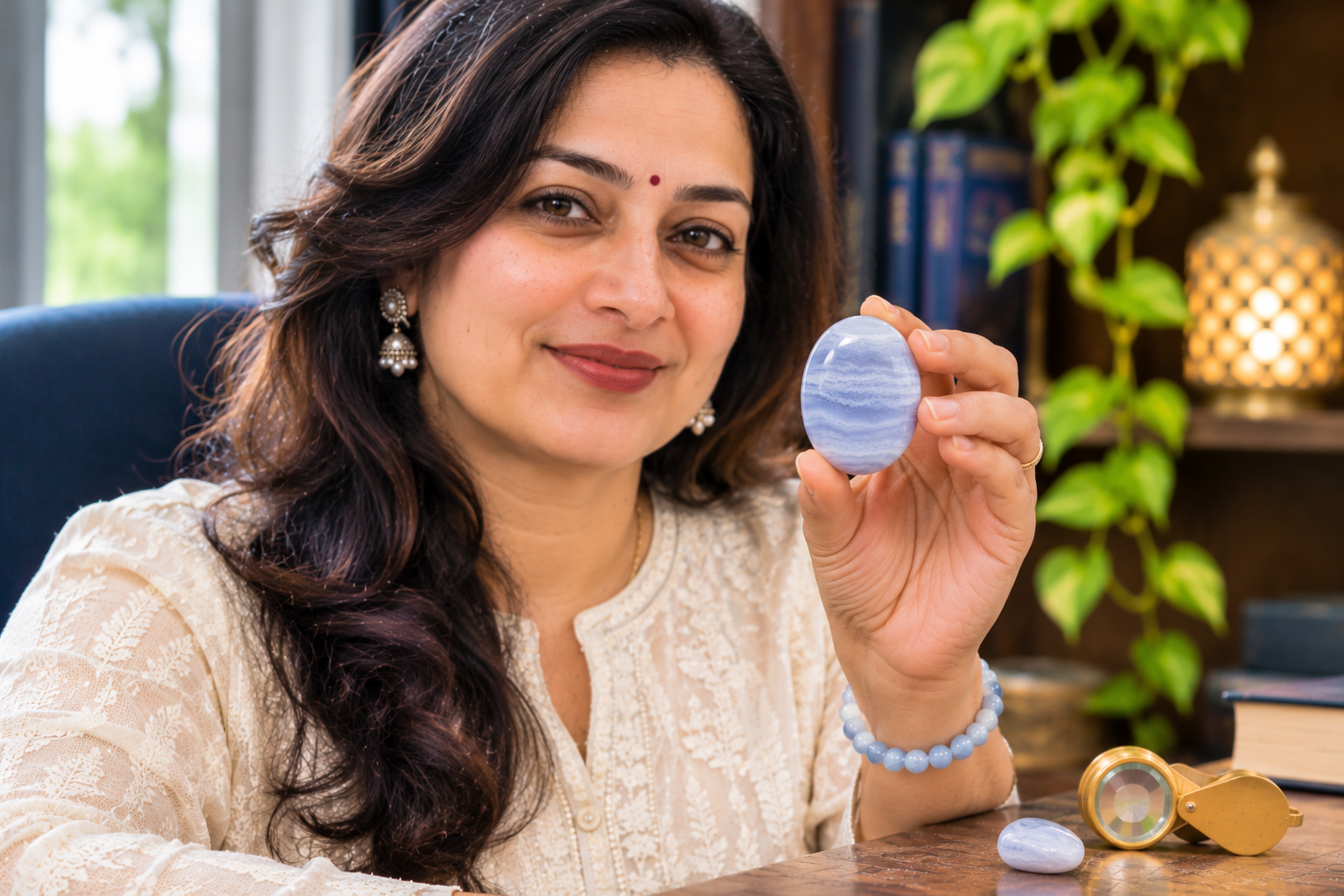
This guide pairs an original Indian portrait holding the blue-and-white stone with our verified 9 mm Blue Lace Agate bracelet, four distinct mineral and care illustrations, a dye-treatment comparison, and practical care guidance. The separate Blue Lace Agate calm-communication article explores a different reflective topic.
ONE GENUINE CATALOGUE PHOTO · FOUR ORIGINAL EDUCATIONAL VISUALS
Blue Lace Agate: Real Bracelet and Unique Mineral Views
Examine an authentic 9 mm bracelet photograph alongside four different original views illustrating fine agate bands, polish, rough texture and cleaning.
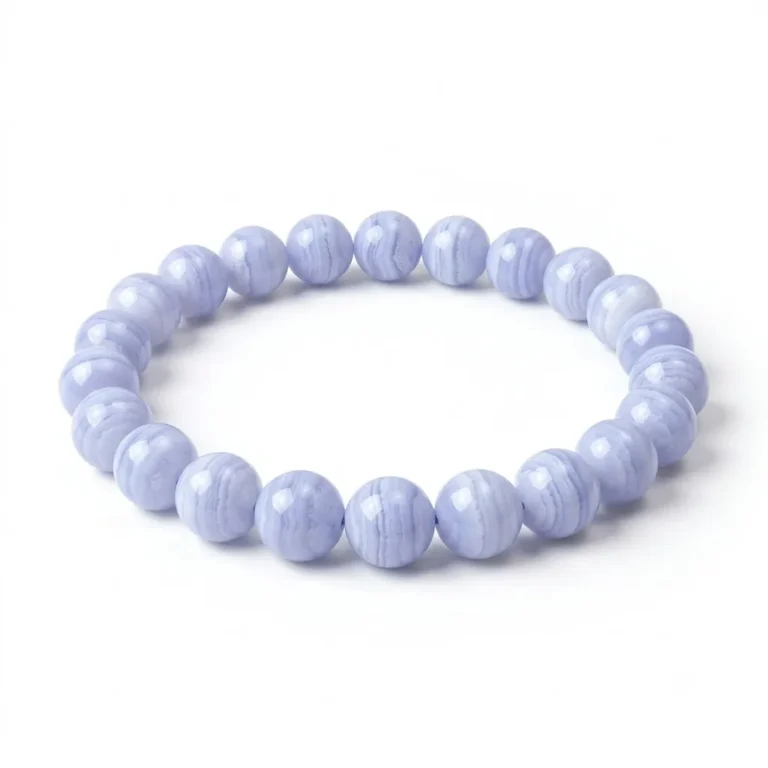
Natural Blue Lace Agate 9 mm Bracelet
Real catalogue photograph of the Blue Lace Agate 9 mm bracelet; check the actual bead finish, size and fit.
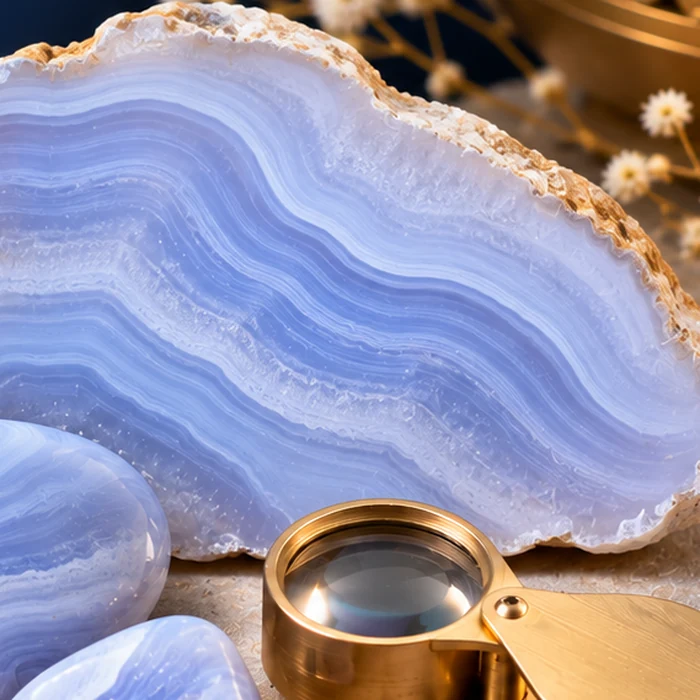
Blue-and-White Lace Banding
Distinct original editorial showing the fine wavy white bands within pale-blue agate-like silica; not stock.
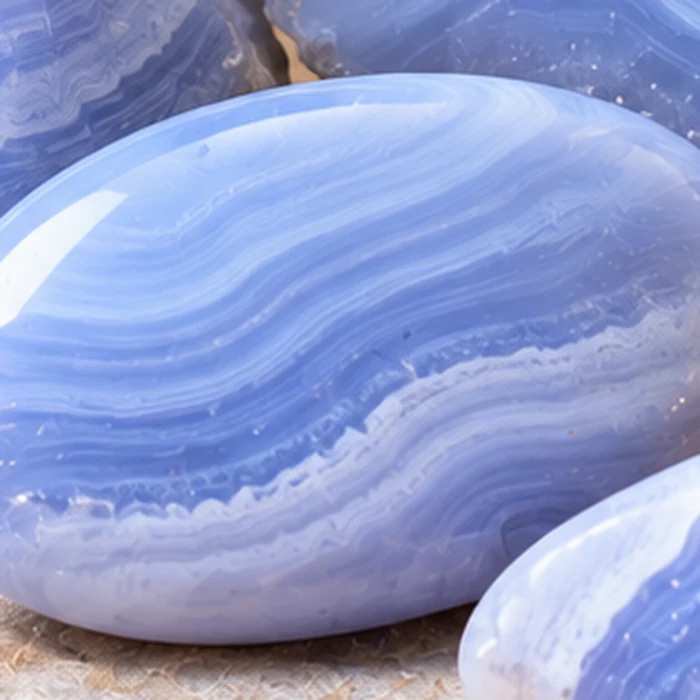
Polished Chalcedony Study
Original mineral editorial showing gentle polish, blue translucency and flowing white bands.
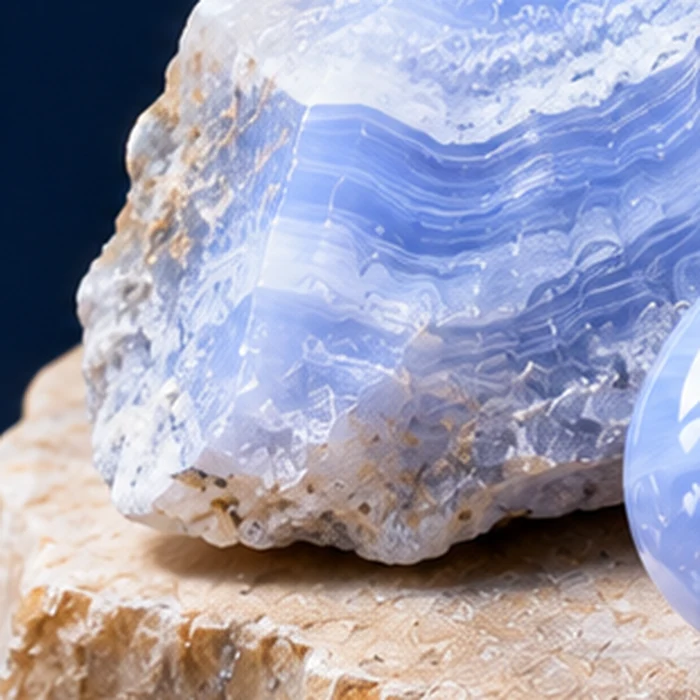
Rough Blue Agate Texture
Original rough mineral-style educational illustration showing an unfinished pale-blue banded surface; not retail inventory.
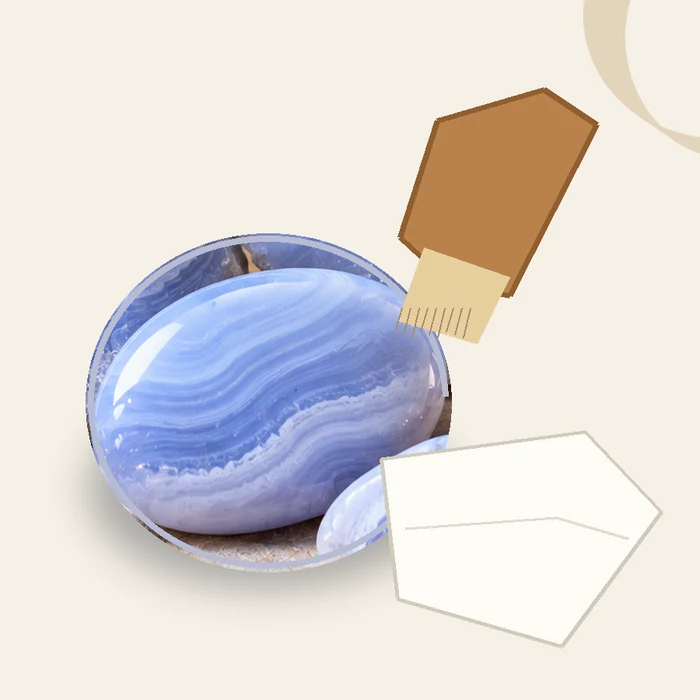
Safe Blue Agate Cleaning
Separate original care illustration showing a soft cloth, brush and a pale blue-banded agate-like piece.
PALE BLUE CHALCEDONY · COLOUR TREATMENTS
Natural Lace Bands or Dyed Blue?
Similar blues can occur in different material. Use trustworthy item descriptions instead of a colour-only test.
Natural Blue Lace Agate
Fine blue-white curved silica bands in a softly coloured chalcedony material.
Dyed Blue Chalcedony
Dye can intensify blue colour; look for accurate disclosures rather than guessing from saturation alone.
Aquamarine Blue Beryl
A separate silicate mineral with a different chemical structure, even when its sky-blue colour looks similar.
These are original illustrative swatches, not proof of authenticity, colour treatment or origin.
Blue Lace Agate Mineral Facts and Buying Checks
| Property | Buyer guidance |
|---|---|
| Mineral family | Blue Lace Agate is finely banded chalcedony, a microcrystalline form of silica (SiO₂) in the quartz family. |
| Appearance | Pale sky blue or grey blue with thin wavy white bands. The density and contrast of bands vary naturally. |
| Hardness | Around Mohs 6.5–7. Drilled beads, any cracks, polishing and bracelet construction still affect durability. |
| Colour treatments | Natural pale-blue bands exist, but blue dyes and other colour enhancements may be used in commercial agate. |
| Imitations | Dyed chalcedony, other blue agates, glass and blue gemstones can look similar. Visual colour is not conclusive identity. |
| Origin | Namibia, including the Ysterputs locality, is a historic source; do not claim an exact origin from appearance alone. |
| Available product | The verified listings is a Natural Blue Lace Agate 9 mm Bracelet; the other gallery artworks are educational. |
| Cleaning | Soft cloth or gentle mild-soap cleaning for compatible sound stones; protect dyes, metal findings and elastic from harsh chemicals and prolonged soaking. |
| Traditional meanings | Peaceful communication and throat-chakra symbolism are personal traditions, not medically established effects. |
For mineral background, consult IGS Chalcedony Information and the seller’s item-specific material descriptions.
BLUE LACE AGATE · MINERAL & JEWELLERY GUIDE
Inspect the Lace Bands · Check the 9 mm Bracelet · Care Gently
A real gemstone-specific guide to wavy banding, actual wrist fit and suitable cleaning.
BLUE-AND-WHITE CHALCEDONY · MOHS 6.5–7 · REAL BRACELET
Choose the actual stone and finished jewellery, not simply a pretty blue photograph
Recognise the Bands
Agate develops fine white and pale-blue wavy layers. Compare actual patterned surfaces and transparency.
Appearance cannot prove natural untreated colour.
Check Bracelet Construction
Look at the actual listed 9 mm beaded Blue Lace Agate bracelet. Confirm bead count, inside circumference, quality and stringing.
Bead diameter is different from wrist size.
Protect Dye and Settings
Start with a soft cloth. Use brief mild cleaning only when compatible with coatings, dye, adhesive and the bracelet’s construction.
Avoid harsh solvents, long soaks and damaging tests.
Verified product: Natural Blue Lace Agate 9 mm Bracelet · Blue Lace Agate Reflection Guide · Aquamarine Mineral Comparison
Only the bracelet has been verified as an available Blue Lace Agate product here; the four other gallery images are distinct original editorial illustrations.
Before Buying Blue Lace Agate
- Check the mineral name, actual item photo and blue-white band appearance.
- Ask whether the stone has been dyed, coated or otherwise treated.
- Verify 9 mm bead diameter and finished bracelet circumference separately.
- Examine drill-hole condition, surface cracks, elastic and closure.
- Review any certificate for the tested sample and actual identification.
- Do not infer Namibian origin from blue colour or marketing text alone.
Gentle Agate Care
- Start with a soft cloth or gentle soft brush.
- Use brief mild soapy cleaning only for compatible sound stones.
- Protect uncertain dye, adhesives, stringing and metal parts from immersion.
- Skip harsh chemical cleaners and destructive scratch tests.
- Store apart from sharp or harder minerals and avoid stretching threads.
- Keep loose beads and small stones away from children and drinking water.
What Is Blue Lace Agate? Chalcedony and Its Bands
Blue Lace Agate is a variety of agate made mainly of fine-grained silica (SiO₂). Agate is within the broader chalcedony family, itself a form of microcrystalline quartz. The visual hallmark is pale blue colouring with fine, wavy or lacy white bands formed during successive mineral deposition.
The mineral typically has hardness about 6.5–7 Mohs. That makes it suitable for many decorative and jewellery uses, though finished surfaces, fractures, drilling and adjacent materials still determine durability in practice.
References: Mindat for mineral classification; IGS for the chalcedony family.
Natural Blue Lace Agate vs Dyed Chalcedony
The pale-blue and white banded appearance of Blue Lace Agate occurs naturally. Commercial chalcedony can also be dyed, including blue shades, and dyeing in the agate trade is not unusual. Particularly even or intensely saturated colour may justify further questions, but visual colour is not a definitive test.
A Journal of Gemmology study on blue chalcedony describes ways gemologists evaluate dyed material and lookalikes. Do not attempt acid, acetone, torch or scratch tests on jewellery at home; they can damage treated surfaces or components.
For purchases where authenticity or treatment status matters, request a trustworthy report and check exactly which sample was tested, what conclusions were made and which treatments the laboratory assessed.
Blue Lace Agate Meaning and the Throat Chakra
In modern crystal-healing traditions, Blue Lace Agate is often associated with composure, gentle communication, confidence when speaking and the throat chakra. These are symbolic beliefs rather than established mineral effects on emotion, heart rate, speech or nerve function.
Some people like to keep an attractive bracelet or stone nearby as a prompt to prepare a conversation or pause before reacting. Such a personal routine may be meaningful without attributing scientifically unproven powers to the gemstone.
Three practical ways to enjoy the stone
- Bracelet: Wear finished beads for colour, craftsmanship and a personal reminder to communicate thoughtfully.
- Desk display: Place a stable polished piece on a soft pad to decorate a work or writing area.
- Personal reflection: Use a stone as part of journaling or intentional pauses, not as a medical substitute for anxiety care.
How to Clean Blue Lace Agate Safely
As with other chalcedony varieties, a stable untreated piece can often be cleaned with warm water, a little mild soap and a soft brush or cloth. The practical complication is not simply the mineral’s Mohs hardness: dye treatments, cracks, settings, cords, adhesives and metal findings change what the complete object can tolerate.
Begin by removing dust gently. Avoid harsh chemicals and prolonged soaking, especially where treatment is unknown. Rinse briefly only if the item is appropriate for water and dry well. Displaying it by moonlight is a personal symbolic practice, not a scientifically demonstrated way to disinfect or recharge a mineral.
For other mineral-specific precautions, see our Crystal Cleansing Methods and Safe Care Guide.
Where Does Blue Lace Agate Come From?
A well-known source of classic Blue Lace Agate is the Ysterputs locality in southern Namibia, where blue and white bands occur in agate-bearing veins. Other localities and comparable banded chalcedony have been documented; the location on an untested retail item cannot be established from blue colour alone.
Use the Mindat locality information as a mineral reference, but ask for provenance details and sample-specific records before repeating a particular mine or country as a commercial claim.
Blue Lace Agate Bracelets at Divinity Crystals
View the Natural Blue Lace Agate 9mm Bracelet listing in our development catalogue. Check the actual item photographs, approximate bead size, length or fit, current price, availability, treatment disclosure and any certificate before ordering.
You can also explore Crystal Bracelets and Tumbled Stones for other formats. Do not assume that every item in a collection has identical mineral origin, laboratory documentation or quality grade.
Frequently Asked Questions
Is Blue Lace Agate a real gemstone?
Yes. Natural Blue Lace Agate is a pale-blue and white banded form of chalcedony, primarily silica, within the quartz mineral family.
Why does Blue Lace Agate have white wavy bands?
Alternating silica-rich mineral layers form fine blue and white lace-like bands. Pattern and spacing differ between individual pieces.
Is Blue Lace Agate the same as Blue Chalcedony?
They are closely related forms of chalcedony. Blue Lace Agate usually has distinct wavy white and pale-blue banding; not all Blue Chalcedony is banded.
Is natural Blue Lace Agate always pale blue?
The classic material is softly coloured, but hue varies. Deep blue alone is not proof of dye, and pale blue alone does not prove untreated colour.
Can Blue Lace Agate be dyed?
Yes. Commercial agate and chalcedony can be dyed. Ask the seller for item-specific treatment disclosure rather than relying only on photographs.
Does Divinity Crystals sell Blue Lace Agate bracelets?
Yes. The verified catalogue has the Natural Blue Lace Agate 9 mm Bracelet. Check current price, size, fit and availability on that listing.
What does 9 mm mean on the bracelet?
It usually means the bead diameter. Bracelet inner circumference and elastic or clasp design must also be checked for wrist fit.
Are the four mineral-study images actual stock?
No. They are four distinct original educational illustrations demonstrating banding, polish, rough material and safe care; the bracelet photo is real merchandise.
How do I clean Blue Lace Agate safely?
For sound compatible pieces, gently use a soft cloth and brief warm mild-soap cleaning where suitable. Protect dyes, coatings, cords, elastic and adhesives from immersion.
Can I use Blue Lace Agate in drinking water?
Do not immerse untested minerals or assembled bracelets directly in drinking water. Gemstone identity does not establish food-contact safety.
Can Blue Lace Agate treat anxiety or throat conditions?
There is no reliable evidence that Blue Lace Agate treats anxiety, panic or speech problems. Its calm-communication associations are symbolic.
Does a certificate prove every bracelet bead is untreated?
Not necessarily. Read the laboratory, report number, tested sample, methods and findings; the report may not address every bead or treatment.
Choose Authentic Banded Beauty and Care for It Well
Blue Lace Agate is valued for subtle pale-blue banding and a gentle white pattern. Match your expectations to genuine product photographs, accurate colour-treatment descriptions, good fit and sensible physical care. Personal communication symbolism is separate from gemological proof.