

THE DIVINITY JOURNAL · AQUAMARINE GEMSTONE GUIDE
Aquamarine’s pale sea-blue colour and elegant crystal growth make it a favourite for jewellery and mineral displays. The gemstone belongs to the beryl family, like emerald, but its blue-to-greenish-blue colour reflects a different appearance and set of buying considerations.
Aquamarine is beryl (Be₃Al₂Si₆O₁₈), with a Mohs hardness of about 7.5–8. It is associated with calm communication and courage in modern crystal traditions, but such meanings are personal rather than evidence of emotional or medical effects.
Here you can examine actual Divinity Crystals Aquamarine product images, learn about heat treatment and common lookalikes, compare jewellery with natural-looking clusters, and see a gemstone-specific selection and care guide.

FOUR REAL AQUAMARINE PRODUCT PHOTOS · ONE ORIGINAL MINERAL STUDY
Aquamarine Product Views: Genuine Bracelet & Crystal Clusters
One photographed bracelet and three original cluster views correspond to real store products. A fifth image is an original mineral study for education, not an invented retail SKU.
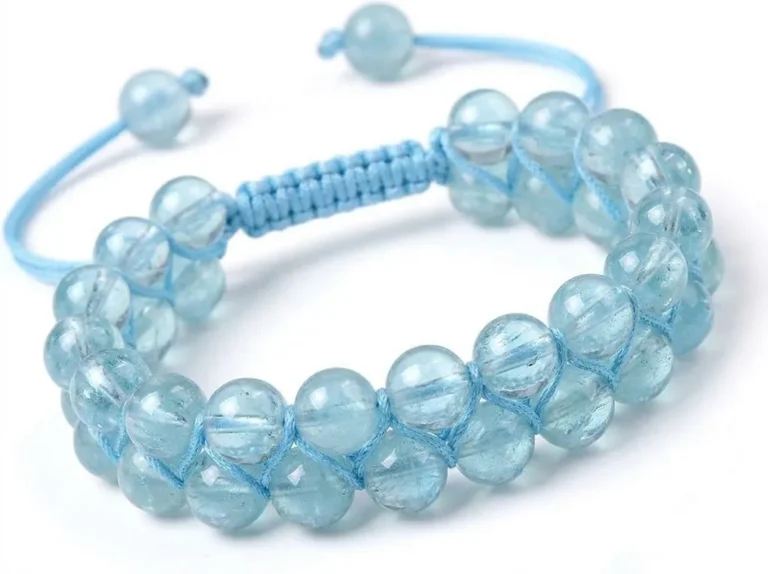
Aquamarine Blue-Threaded Bracelet
First-party photo of the real two-row Aquamarine bead bracelet with blue thread. Confirm bead count, fit and laboratory report for the selected product.

Aquamarine Phantom Cluster
Actual catalogue view of the listed Aquamarine cluster, showing crystal habit and natural-looking form. Check size, condition and report.
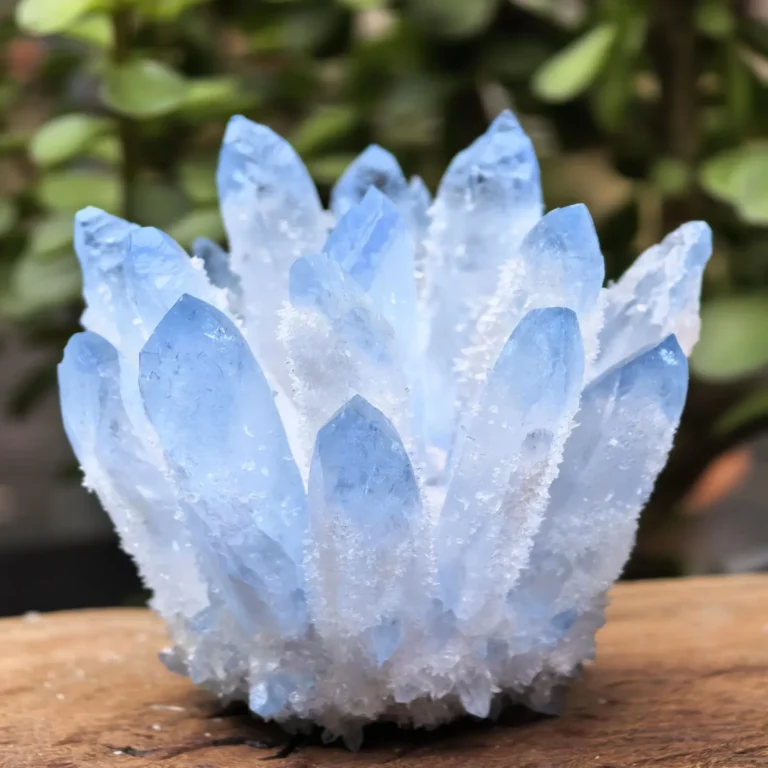
Aquamarine Cluster on Wood
Another authentic first-party product angle, demonstrating a displayed cluster’s proportions and the need for a stable display.
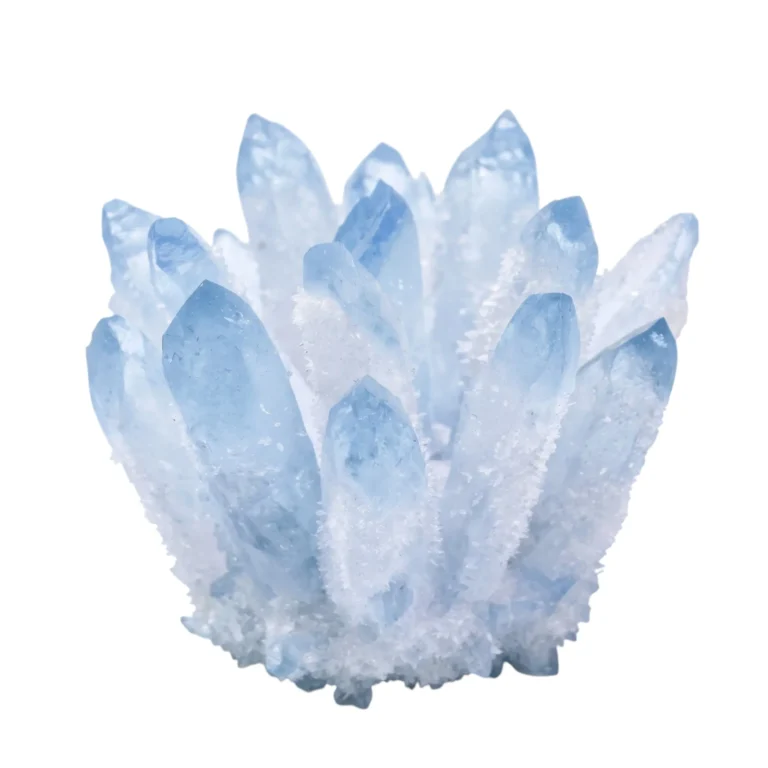
Premium Aquamarine Cluster
Third genuine cluster photo from the product media library. Visible shapes do not independently verify internal phantom growth features.
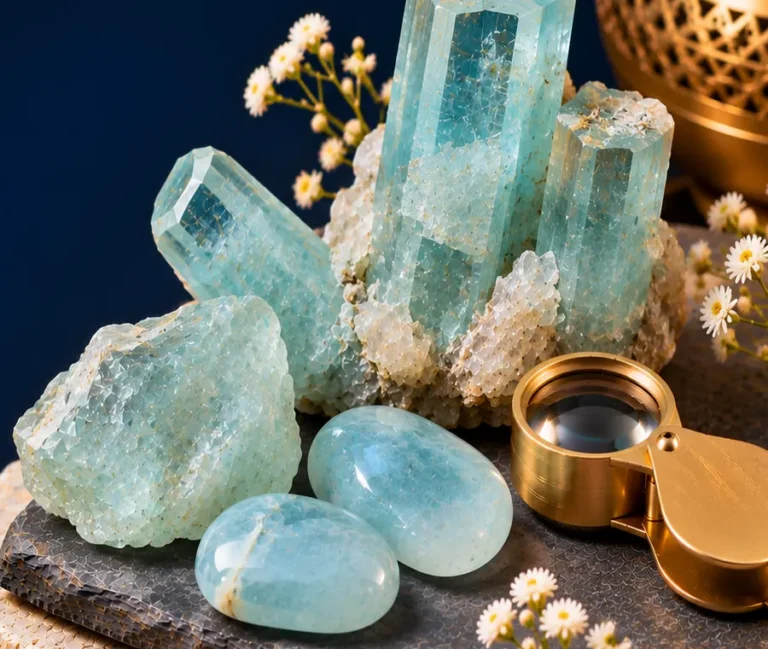
Beryl Crystal Texture — Editorial
Original mineral editorial illustrating sea-blue Aquamarine-like crystal surfaces and internal clarity; not a fifth retail item.
GEMSTONE IDENTITY · APPEARANCE IS NOT PROOF
Aquamarine, Emerald & Blue Glass
Aquamarine
Blue to greenish-blue beryl (Be₃Al₂Si₆O₁₈). Mohs 7.5–8.
Emerald
Green beryl, within the same mineral family but with different colour, typical inclusion and value characteristics.
Blue Glass Lookalikes
May resemble blue beryl in photos but do not have beryl’s crystal structure. Identification needs suitable evidence.
Colour swatches are illustrative only, not a gemological authenticity test.
Aquamarine Mineral Facts and Buying Checks
| Property | What to know |
|---|---|
| Mineral identity | Aquamarine is blue or greenish-blue beryl, a beryllium aluminium silicate with formula Be₃Al₂Si₆O₁₈. |
| Family relationship | Emerald is another beryl variety. Sharing a mineral group does not mean that a green emerald and blue Aquamarine have the same colour or value. |
| Colour & clarity | Iron is associated with blue colour. Tone ranges from pale sea-blue to stronger blue or greenish-blue, with inclusions and crystal clarity varying. |
| Mohs hardness | About 7.5–8. Crystal tips, fractures and jewellery settings can still chip or break under impact. |
| Common treatment | Heat treatment can reduce the green component; a properly disclosed heated Aquamarine remains Aquamarine rather than a fake gem. |
| Imitations | Blue glass, other pale-blue minerals and some synthetics may look similar; pictures and home scratch tests are insufficient proof. |
| Actual store formats | The verified catalogue includes a blue-threaded double-row bead bracelet and a labelled phantom crystal cluster. |
| Traditional meanings | Courage, calm communication and throat-chakra connections are cultural or personal associations, not clinically demonstrated gemstone effects. |
| Care | Start with gentle soft cleaning. For sound compatible untreated items, mild soapy water is generally appropriate; avoid excessive heat and handle fractured or filled material conservatively. |
Gemological references: GIA Aquamarine overview and GIA Aquamarine Care & Cleaning.
AQUAMARINE · MINERAL IDENTIFICATION & VERIFIED BUYING GUIDE
Recognise Blue Beryl · Compare Store Forms · Verify Treatments
Understand mineral identity, actual product formats and responsible selection before relying on symbolic meanings.
BLUE BERYL · MOHS 7.5–8 · REAL AQUAMARINE PRODUCTS
How to select the stone, examine genuine product details and care for it
Recognise Aquamarine
True Aquamarine is blue-to-greenish-blue beryl, often transparent or translucent. Colour and clarity vary naturally.
Photos alone do not identify all glass lookalikes or confirm origin.
Compare Actual Products
Choose between a blue-threaded double-row Aquamarine bracelet and a listed collector-style cluster. Check physical size, bead count, growth points and condition.
Match every purchase to the exact listing and tested specimen.
Check Treatments & Care
Ask about heat treatment, fractures, fillings and certificates. Use conservative gentle cleaning for unknown conditions, and protect crystal points.
Heat-treated Aquamarine remains Aquamarine when correctly described.
Explore the two verified Aquamarine formats: Blue-Threaded Aquamarine Double-Row Bracelet · Aquamarine Phantom Crystal Cluster
Before Buying Aquamarine
- Review the exact listing photographs under natural and studio lighting.
- Check hue, clarity, inclusions, dimensions and visible cracks.
- For bracelet jewellery, verify the blue-threaded two-row construction and finished fit.
- For clusters, inspect tips, stability, condition and the individual piece’s measurements.
- Ask about heat treatment, filling and other disclosed enhancements.
- Match any laboratory report to the tested sample and specific retail item.
Aquamarine Care and Storage
- Use a soft cloth or soft brush first; clean with mild soap when compatible.
- Avoid high heat, strong knocks and sudden temperature changes.
- Protect fragile tips and fractures of collector specimens.
- Check adhesives, threads, elastic, metal fittings and any fillings before immersion.
- Skip ultrasonic and steam cleaning when condition or treatment is uncertain.
- Store securely away from harder stones, sharp objects and prolonged unnecessary soaking.
What Is Aquamarine? Understanding Blue Beryl
Aquamarine is the blue to slightly greenish-blue variety of the mineral beryl. Its chemical formula is Be₃Al₂Si₆O₁₈, and its blue appearance is related to trace iron in the crystal structure. Emerald is a different, green colour variety of beryl, so the gems share a mineral species without sharing every feature of colour or typical inclusion pattern.
Aquamarine can develop well-formed, six-sided prismatic crystals in pegmatite environments. Faceted material is valued for transparency and colour; rough specimens are often collected for crystal form and overall condition. GIA records its hardness as approximately 7.5–8 Mohs. See the GIA Aquamarine overview for composition, colour and material facts.
Colour, Clarity and What Determines Aquamarine Quality
Aquamarine ranges from delicate pastel blue-green to richer blue. GIA notes that more saturated, attractive blue colours can be desirable, but the effect of cutting, clarity, tone and size must also be considered. Smaller stones may look paler than larger crystals cut from similarly coloured material.
Unlike emerald, fine faceted aquamarine is often relatively transparent with few eye-visible inclusions. A rough or ornamental specimen, however, should be assessed for its particular intended use: texture, stable crystal structure, shape, matrix and authenticity may matter more than the standards of a faceted gemstone.
Consult GIA’s Aquamarine Quality Factors. Marketing labels such as AAA are seller-specific and not a universal gemological grading system.
What are ‘phantom’ clusters?
Some ornamental mineral listings use the word phantom for visible internal outlines or growth-related zoning. That description should be supported by the actual piece; do not assume every pale-blue cluster automatically contains an independently verified phantom growth feature.
Natural Aquamarine, Heat Treatment and Lookalikes
Heat treatment is common in aquamarine because it can lessen the greenish component and produce a more strongly blue appearance. Properly described heat-treated aquamarine is still aquamarine—it is not automatically counterfeit. However, a seller should not advertise a heated stone as untreated without evidence.
Colour alone cannot reliably identify treatment. Similar-looking products may include blue glass, other blue gemstones, synthetic beryl or coated material. Home scratch, flame and solvent tests can damage finished stones; a competent gemological laboratory may be necessary for meaningful identification questions.
GIA’s Aquamarine buyer’s guide describes identification reports, and the International Gem Society discusses treatment and imitation considerations. Check which specimen or lot a certificate actually covers.
Aquamarine Meaning, Courage and Communication Traditions
Because its name refers to seawater, Aquamarine has appeared in stories about sailors and safe travel. In modern crystal traditions it is associated with calm, courage, communication and the throat chakra. Someone may enjoy it as decorative jewellery or as an optional reminder to prepare for a conversation.
These interpretations are cultural and personal, not proof that the stone regulates emotions, treats panic, cools anger or creates better communication skills through a physical mechanism. Preparing what to say, listening carefully and practising clear boundaries are practical ways to improve conversations.
Three ways to enjoy Aquamarine without medical promises
- Jewellery styling: Choose a suitable bracelet for its pale blue colour and construction.
- Mineral collecting: Display a stable specimen on a secure stand where it will not be knocked over.
- Reflection routine: Keep a polished decorative stone next to notes for an upcoming conversation, without attributing clinical effects to it.
How to Clean Aquamarine and What to Avoid
GIA describes Aquamarine as durable for normal jewellery wear, with a Mohs hardness of about 7.5–8. For most intact items, warm water with mild soap and a soft brush is the recommended cleaning method. Aquamarine’s colour is generally stable against light exposure; exposure to high heat is not recommended.
GIA explains that ultrasonic and steam cleaning can be suitable for some sound untreated aquamarine, but they should not be used for stones with liquid inclusions, fractures or fracture filling. Where a specimen’s condition or treatment is unknown, conservative hand cleaning is simpler and safer. Check glued settings, threads, elastics and metal findings.
Avoid saltwater soaking as a ritual cleaning requirement; salt residue can complicate cleaning of some jewellery components. Never place unknown stones into beverages. Moonlight cleansing can be a personal symbolic practice, but it does not disinfect the stone or recharge a measurable mineral ‘frequency’. Read GIA’s Aquamarine Care and Cleaning Guide and our Crystal Cleansing Methods Guide.
Shop Aquamarine at Divinity Crystals
Our staging catalogue offers an Aquamarine-Listed Double-Layered Threaded Bracelet and an Aquamarine-Listed Phantom Crystal Cluster. Both titles have been corrected to avoid unsupported laboratory certification claims. These are real catalogue listings, but listing titles alone do not independently establish treatment, mineral identification or laboratory report scope.
For each item, review the actual photographs, number of beads, dimensions, condition, treatment disclosure, current inventory and original documentation where a certificate is advertised. A cluster may be a collector’s piece rather than an ideal everyday jewellery material.
For different formats explore Crystal Bracelets and Raw Crystals. Verify current product availability rather than assuming every format is in stock.
Frequently Asked Questions
What is an Aquamarine stone?
Aquamarine is a blue to greenish-blue variety of beryl, with formula Be₃Al₂Si₆O₁₈. It belongs to the same mineral family as emerald but is a distinct colour variety.
Why is Aquamarine blue?
Its colour is associated with iron in the beryl crystal structure. Colour saturation varies from light sea-blue to stronger tones and may be affected by heat treatment.
Is Aquamarine the same as blue topaz?
No. Blue topaz and Aquamarine are different minerals, despite some similar blue appearances. Check reliable identification rather than relying on a colour photograph.
Does Aquamarine cure anxiety or improve communication?
No reliable clinical evidence establishes these gemstone effects. Its courage, protection or throat-chakra associations are traditional and personal beliefs.
What is an Aquamarine phantom crystal cluster?
The term is used for a cluster with claimed internal outlines or growth features. Confirm the actual specimen, photographs and the precise meaning and scope of any mineral report.
Is heated Aquamarine fake?
No. Heat treatment is common in the trade and can change greenish-blue material toward blue. Disclosure matters, but heated material remains Aquamarine if correctly identified.
How do I distinguish Aquamarine from blue glass?
Visual appearance alone is not definitive. For valuable or disputed material, seek professional identification and check actual origin, treatment and any laboratory report.
Does Divinity Crystals have an Aquamarine bracelet?
Yes. The published staging listing is Aquamarine-Listed Double-Layered Threaded Bracelet — 38 Beads. Its genuine catalogue photograph shows blue woven thread; independent identification and certification of its beads have not been established from the available media.
What should I check before buying the bracelet?
Compare the actual blue-threaded two-row construction, bead count, measurements, finished fit, disclosed treatments and the details of any claimed laboratory report.
What should I check before buying an Aquamarine cluster?
Confirm the exact pictured specimen, overall dimensions, display stability, crystal tips, condition and which sample a laboratory report covered.
Can I clean Aquamarine with soapy water?
For intact sound stones, warm water with mild soap is a standard choice; consider inclusions, fillings, metal and thread construction and avoid aggressive methods if uncertain.
Can I use Aquamarine in drinking water?
Do not immerse untested mineral specimens, adhesive-backed jewellery or unknown treated stones in drinking water. A gemstone’s identity does not confirm food-contact safety.
Choose Aquamarine by Its True Mineral Qualities
Aquamarine is admired for its watery blue beryl colour, crystal form and versatile jewellery. Good buying decisions come from original product photographs, an accurate material description, clear treatment disclosures, sensible care and specimen-specific documentation.
Its historical and modern courage symbolism can be a meaningful personal tradition without turning it into a health or life-outcome guarantee.