

THE DIVINITY JOURNAL · PYRITE MINERAL & BUYING GUIDE
Pyrite is one of the most recognisable natural metallic minerals, admired for its brassy golden sheen and striking cubic crystal faces. Called “fool’s gold” for its resemblance to native gold, it is in fact an iron-disulfide mineral with a completely different chemical composition and physical behaviour.
Pyrite is FeS₂, with Mohs hardness around 6–6.5. Beautiful intergrown cubes, polished stones, beaded bracelets and large collector specimens all require different buying and handling checks. Moisture-sensitive material also needs careful storage to protect its finish and structure.
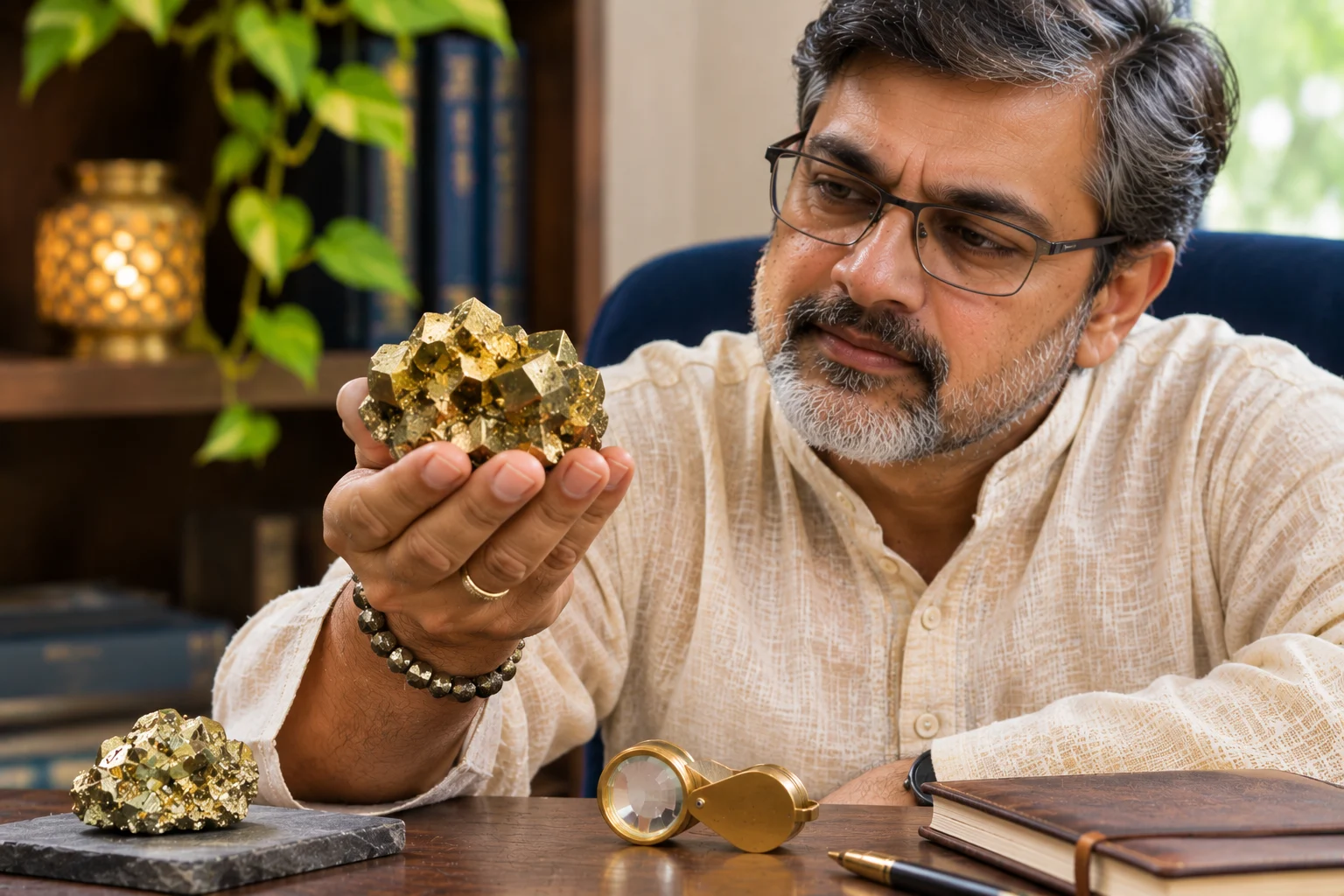
Explore five original Divinity Crystals product photographs, a new Indian lifestyle portrait holding a visible golden crystal cluster, identification facts, a Pyrite-versus-Gold comparison and practical dry-care guidance. Wealth and solar-plexus meanings are traditional symbolism rather than guaranteed effects.
FIVE DISTINCT FIRST-PARTY PYRITE PRODUCT PHOTOGRAPHS
Real Pyrite: Raw Clusters, Cubic Faces, Bracelets & Tumbles
Compare our own three published cluster listings (30+ g, 100+ g and 200+ g), 10 mm diamond-cut bracelet and polished tumbled stones. Each first-party image opens the exact associated product; these photographs are not independent evidence of origin or certification.
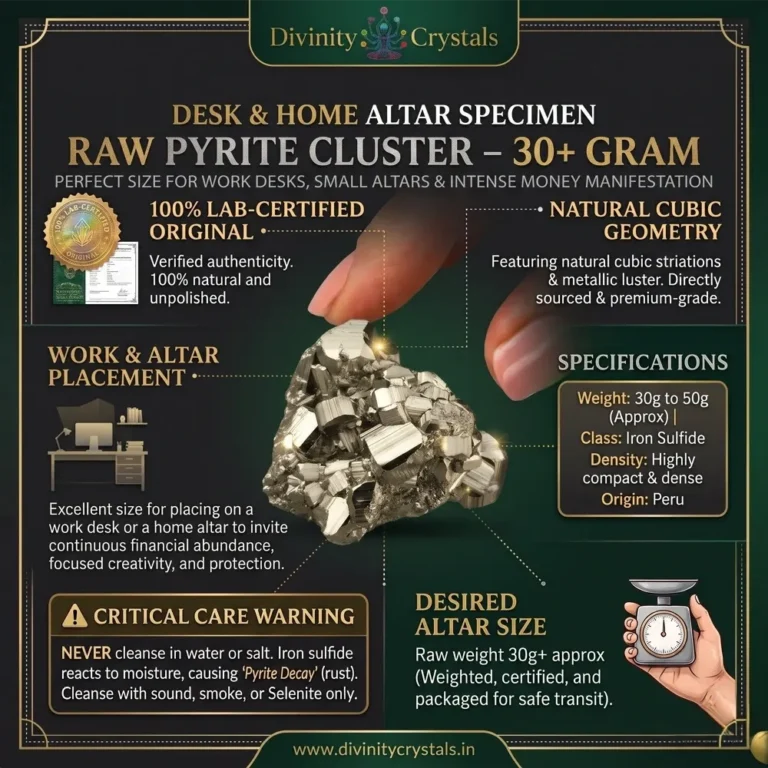
Raw Pyrite Cluster — 30+ g
Actual first-party product photograph of our published 30+ gram raw cluster. Inspect physical texture, reflective faces and the weight option.

Crystalline Pyrite Cluster — 100+ g
Distinct first-party photo attached to the 100+ gram crystalline Pyrite listing. A file name or certificate claim is not proof of testing without the report.
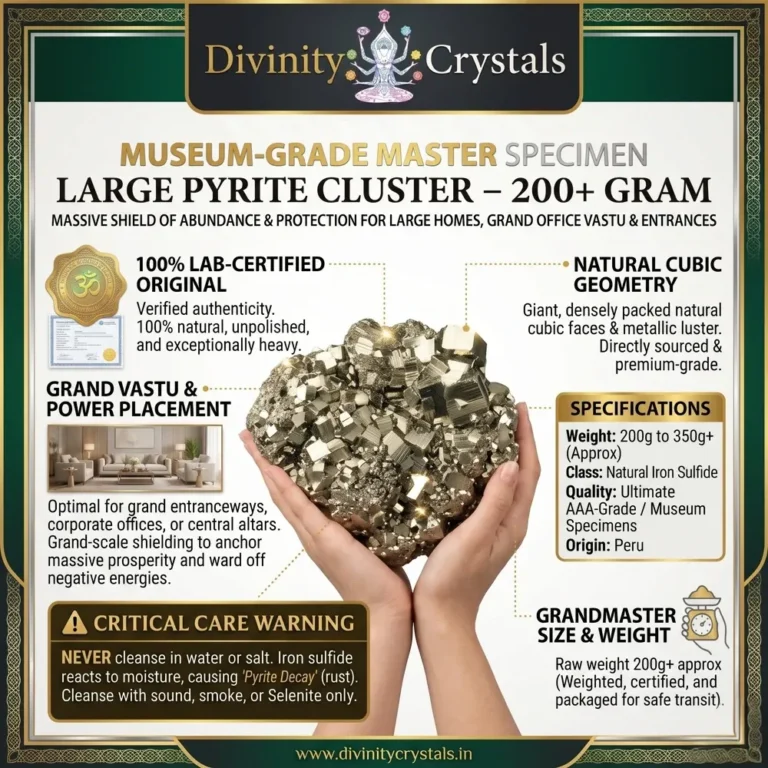
Large Pyrite Cluster — 200+ g
Original large-cluster product image. Compare size reference, stability and the exact piece offered for sale.
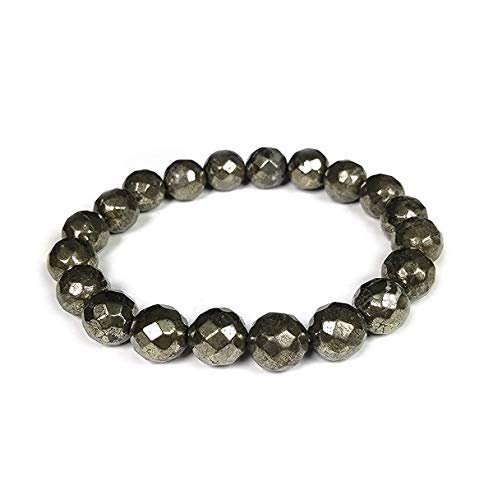
10 mm Diamond-Cut Pyrite Bracelet
Actual catalogue photograph showing the faceted Pyrite bead finish. The diameter and wrist fit differ from cluster measurements.
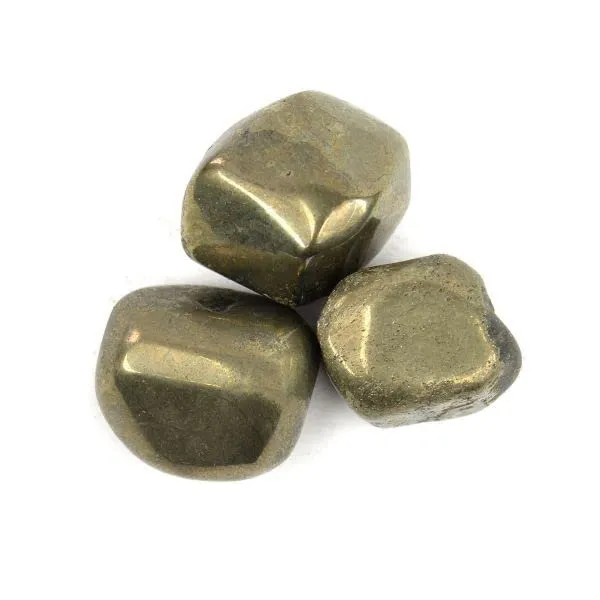
Three Polished Pyrite Tumbled Stones
Genuine rounded-stone photograph, distinct from rough clusters and bead jewellery. Check selected pack count and finish.
GEMSTONE IDENTITY · COLOUR IS NOT PROOF
Pyrite, Gold & Chalcopyrite
Three golden-looking materials have distinct mineral identities. Colour swatches illustrate appearance only.
Pyrite · FeS₂
Brassy metallic iron disulfide; commonly brittle cubic crystals, approximately Mohs 6–6.5.
Native Gold · Au
Soft, dense, malleable metal, about Mohs 2.5–3; not the same chemistry or crystal behaviour.
Chalcopyrite · CuFeS₂
Different copper-iron sulfide mineral, often brass-yellow and softer than Pyrite.
Illustrative swatches, not a destructive home identification test. Seek a proper specimen report when required.
Pyrite Mineral Facts, Buying Checks and Dry Storage
| Feature | What buyers should know |
|---|---|
| Mineral identity | Pyrite is iron disulfide, FeS₂. Despite its gold-like shine, it contains no native gold by definition. |
| Appearance | Brassy gold to yellow metallic lustre; cubic, octahedral and intergrown crystal forms are characteristic. |
| Hardness | Approximately Mohs 6–6.5. A brittle crystal can still chip or break when hit. |
| Streak | Greenish-black to brownish-black in classic mineral references. Do not scratch or streak-test purchased jewellery. |
| Density | Usually approximately 5 g/cm³; native gold is much denser. Specimen-level mineral assessment needs more than a photo. |
| Lookalikes | Native gold, marcasite and chalcopyrite can resemble Pyrite; crystal form, hardness and context help identify each. |
| Product forms | Verified listed options include 30+ g, 100+ g and 200+ g clusters, 10 mm bracelets, grey-threaded double-row jewellery, polished tumbles and chips. |
| Moisture sensitivity | Some Pyrite can oxidise under high relative humidity and deteriorate. Dry, stable storage matters, especially for vulnerable specimens. |
| Traditional meaning | Prosperity, confidence and solar-plexus associations are spiritual symbolism, not guaranteed money, protection or healthcare effects. |
| Basic care | Brush with a clean soft dry brush, avoid water immersion or aggressive cleaners, and monitor crumbling, staining or powdery surfaces. |
Mineralogy: Mindat’s Pyrite mineral record and University of Minnesota Pyrite reference. Conservation: Canadian Museum of Nature.
PYRITE · MINERAL IDENTITY, VERIFIED PRODUCTS & STORAGE
Identify FeS₂ · Compare Actual Forms · Store Pyrite Dry
A gemstone-specific three-part guide to mineral features, product formats and moisture-sensitive care.
IRON DISULFIDE · CUBIC CRYSTALS · DRY MINERAL CARE
Prioritise the actual specimen and sound storage over marketing promises
Recognise the Real Mineral
Pyrite has metallic brassy lustre, often sharp cubes or intergrown faces, and FeS₂ chemistry. Gold and chalcopyrite may look similar.
Do not scratch finished merchandise to check authenticity.
Compare Real Product Formats
Review the photographed 30+ g, 100+ g and 200+ g clusters, 10 mm faceted bracelet and polished tumblestones.
Check chosen weight, bead diameter, physical fit and report scope.
Protect from Humidity
Pyrite may oxidise in damp storage and vulnerable specimens can crumble. Keep dry, handle carefully and use soft-brush dusting.
Do not soak, use saltwater, or place Pyrite in drinking water.
Explore actual Pyrite listings: 30+ g Raw Cluster · 100+ g Crystalline Cluster · 200+ g Large Cluster · 10 mm Bracelet · Double-Row Bracelet · Polished Tumbles
This page is our main Pyrite mineral and buyer guide. For a distinct financial-reflection topic, visit Pyrite and Financial Fear.
Before Buying a Pyrite Specimen
- Compare full-view and close-up original photographs of the exact product type.
- Check advertised weight, physical dimensions, stability and the finish of the crystal faces.
- Ask about visible oxidation, fragile or broken edges and any surface coating.
- For a bracelet, review actual bead size, facet cut, stringing and wrist fit.
- Verify location claims, treatment disclosures and any sample-specific lab report.
- Select appropriately supported packing to protect sharp or brittle specimens.
Pyrite Cleaning and Display Care
- Store clusters and Pyrite chips in dry, secure conditions.
- Use a very soft clean dry brush or lint-free cloth to remove dust.
- Do not use water soaking, salt baths or ultrasonic cleaning as a general method.
- Keep display pieces away from damp windowsills and splash-prone shelves.
- Inspect for powdering or cracking; isolate deteriorating specimens as appropriate.
- Keep tiny mineral chips and sharp loose fragments away from children and pets.
Pyrite Stone Meaning: Tradition vs Mineral Science
Some crystal traditions describe Pyrite as a “stone of abundance” associated with motivation, confidence and the solar plexus chakra. These interpretations can be used as personal symbolism, but iron disulfide is not a demonstrated therapy or a material that produces financial gain.
Its observable properties are mineralogical: FeS₂ chemistry, metallic opacity, characteristic crystal forms and a brass-yellow lustre. Avoid confusing a cultural or astrological interpretation with a laboratory finding. For deeper practical planning, our separate Pyrite and Financial Fear article discusses budgeting-related reflection without repeating this mineral identification guide.
Why the name “fool’s gold”?
Pyrite looks like gold in warm light, but it is a different mineral. Native gold is the soft, dense element Au; Pyrite is a harder, brittle FeS₂ crystal. Read the comparison below before purchasing by appearance alone.
Shop Natural Pyrite at Divinity Crystals
The current catalogue includes Raw Pyrite Cluster 30+ g, Crystalline Pyrite Cluster 100+ g, Large Pyrite Cluster 200+ g, 10 mm Diamond-Cut Pyrite Bracelet and Natural Pyrite Tumbled Stones. A grey-threaded double-row bracelet and small Pyrite chips are other genuine formats.
Words such as “wealth,” “high vibration,” “museum grade” or “certified” in retail titles are not independently verified geological or financial outcomes. Match each product to a real photograph, the selected weight or size, treatment disclosure, specimen condition and any applicable laboratory report.
Crystal Habit: Cubes, Pyritohedra and Metallic Lustre
Pyrite grows in the cubic crystal system. Some specimens show sharply bounded cubes, while others form more complex twelve-faced pyritohedra, octahedral forms, intergrowths or masses. A group of cube-like metallic faces can be a helpful visual clue, especially when combined with the mineral’s brass-yellow colour.
Fine striations may occur on some crystal faces. The surface can appear golden, silver-gold, tarnished or shadowed depending on lighting and mineral condition. Photographing a piece from several directions gives buyers a better view than a single dramatic hero angle. Do not deliberately chip or scratch a purchased specimen to expose fresh metal.
Pyrite vs Gold vs Chalcopyrite
The term “fool’s gold” refers to how a brassy metallic mineral can be mistaken for native gold. Pyrite is iron disulfide with Mohs hardness of about 6–6.5; native gold is the element Au and is softer, heavier and malleable. Chalcopyrite is a copper-iron sulfide that can also look brass-yellow but is usually softer.
These comparisons are educational rather than instructions to run destructive tests at home. Specimens may be coated, mixed with other minerals, or photographed under strongly warm light. For any high-value mineral or origin claim, request item-specific evidence from an appropriately qualified laboratory.
What Makes a Good Pyrite Product Photograph?
A useful listing shows natural crystal faces, the overall size of the specimen, close-up condition and a credible reference for scale. A brilliant close-up without the full object may exaggerate how large or reflective the piece looks. Weight options such as 30+ g, 100+ g and 200+ g should be verified against the precise product variant offered.
Bracelets need a different photograph: one that reveals bead diameter, facet cut, holes, spacing, stringing and how the finished piece sits around a wrist. Tumbled Pyrite stones require photographs showing the pack quantity and surface finish, while clusters benefit from an underside image illustrating how the mineral rests on a shelf.
Pyrite Oxidation and Dry Storage
Some vulnerable Pyrite specimens undergo oxidation in the presence of oxygen and humid air. In mineral collections this is sometimes described as “pyrite disease.” It can produce expansion, cracking, powdering or corrosion products and damage adjacent materials. The Canadian Museum of Nature recommends reducing humidity and using suitable dry, impermeable storage for susceptible pieces.
Protect a collector specimen from bathrooms, wet cleaning, direct spills and poorly controlled humid display cabinets. Do not add oil, wax, saltwater or chemical cleaners without understanding the mineral and any existing conservation treatment. If a valuable specimen shows active degradation, isolate it and seek mineral-conservation expertise. See Canadian Museum of Nature: Pyrite Disease and Canadian Conservation Institute natural-history care.
Choosing Between Pyrite Jewellery, Tumbles and Collectors’ Clusters
Select polished tumbles when you want smooth individual stones, a beaded bracelet when you want wearable styling, and a larger cluster when natural growth habit is the main interest. Each product format has its own measurements: carat is not the usual sales unit for a rough 100+ g cluster, and a “10 mm bracelet” refers to bead diameter rather than wrist circumference.
Check the gallery’s real product photographs, SKU details, advertised weights, measurements, finish, treatment disclosures and whether a quoted laboratory report matches your specific item. Source and mining-origin claims should be verified rather than inferred from the phrase “Peruvian Pyrite.”
Frequently Asked Questions
What is the chemical formula of Pyrite?
Pyrite is iron disulfide, FeS₂, an opaque metallic sulfide mineral known for brassy colour and striking cubic crystal forms.
Why is Pyrite called fool’s gold?
It looks golden, which historically led to confusion with gold. Pyrite and native gold differ in chemistry, hardness, density, malleability and typical crystal form.
How can I identify a real Pyrite cluster?
Look for brassy metallic lustre and characteristic sharp cubic or intergrown crystal faces, then confirm our sourcing information and item-specific identification evidence. Appearance alone is not definitive.
Does Pyrite always form cubes?
No. Pyrite may form cubes, octahedra, pyritohedra, intergrown crystals, nodules or massive aggregates. The crystal habit depends on growth conditions.
What is the difference between Pyrite and chalcopyrite?
Both can look brassy, but chalcopyrite (CuFeS₂) is a different mineral that is usually softer and often tarnishes differently. Obtain reliable identification for disputed pieces.
What is Pyrite disease?
It is a term for oxidation-related deterioration in certain susceptible specimens, sometimes associated with high humidity, powdering, cracking and expanding corrosion products.
Can I cleanse Pyrite in water or saltwater?
Avoid soaking Pyrite in water or saltwater. Because moisture can accelerate deterioration in susceptible material, dry dusting is the safer general approach.
Can Pyrite be kept in a bedroom or on a desk?
An intact cluster can be displayed securely in a dry location away from spills, condensation, children and pets. Avoid unstable positions or sharp contact with skin.
Does Pyrite attract money or business success?
There is no scientific evidence that Pyrite guarantees financial outcomes. Its traditional wealth symbolism can accompany practical budgeting and effort without replacing them.
Can Pyrite bracelets be worn every day?
They can be worn with care, but examine bead finish, drilled holes, elastic or thread, any coatings and moisture exposure. Remove for bathing and strenuous activity.
What does ‘lab certified’ mean for a Pyrite item?
Check the issuing lab, report number, tested sample and specific findings. A retail title alone does not show that every bead or mineral face was examined.
How should I store a valuable Pyrite specimen?
Keep it supported, away from humid or wet spaces, in suitable dry storage. Isolate visibly degrading samples and seek qualified mineral-conservation advice if powdering develops.
What Pyrite sizes are sold by Divinity Crystals?
The verified catalogue includes Pyrite products labelled 10+ g, 20+ g, 30+ g, 50+ g, 80+ g, 100+ g and 200+ g, along with larger collector specimens, bracelets and tumbles.
Choose Pyrite for Real Crystals and Responsible Mineral Care
Pyrite is fascinating for its geometric crystals, reflective brass-gold mineral surfaces and variety of genuine forms. The best selection uses real product photographs, transparent weights and measurements, reliable specimen identification and careful dry storage.
Its prosperity symbolism can remain part of cultural practice without replacing real financial decisions or being presented as an evidence-based outcome.