Description
Radiant Cut Moissanite
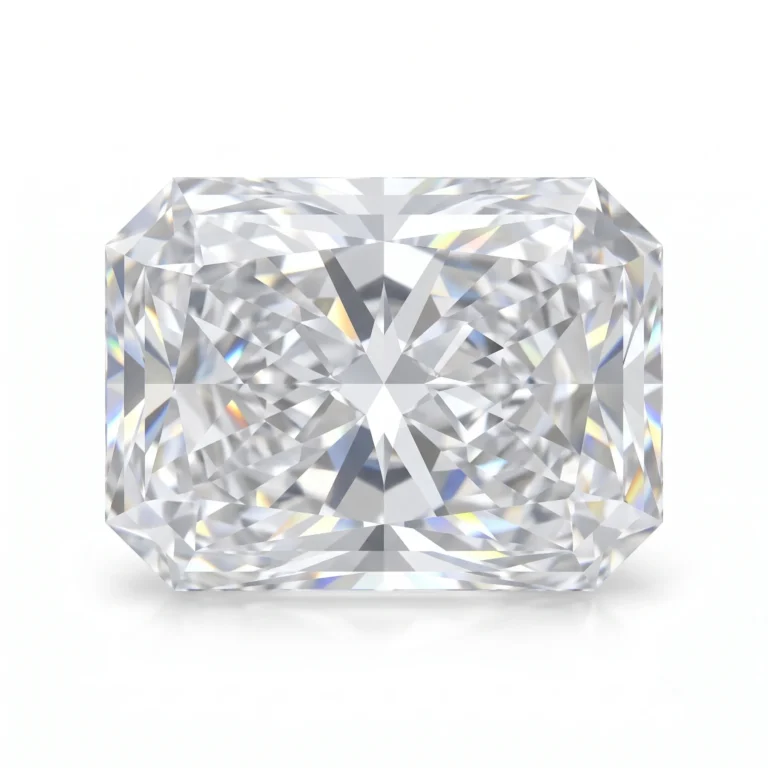
Elegant geometry meets luminous faceting. Our radiant-cut, lab-grown moissanite is a loose gemstone with clipped corners and brilliant-style facets, ready for your choice of custom jewellery design.
Explore the cut, actual product imagery and three simple checks that help you choose a stone with confidence.

Brilliant facets. Structured silhouette.
Radiant-cut gemstones pair a rectangular or square outline with cropped corners and a many-faceted light-returning style. This creates a visual personality unlike the elongated, parallel steps of an emerald cut. Depending on the particular cutting pattern and lighting, a radiant may show splintery, fine reflections sometimes described as a “crushed-ice” appearance.

Know the stone you choose.
Look for the clear clipped-corner outline and a facet pattern that suits your preference. Compare the shape and proportions with your jeweller’s intended design before choosing a setting.
Understanding the radiant cut

Radiant brilliance is not emerald-cut step faceting.
Both shapes may have clipped rectangular corners, but radiant cuts commonly use more complex brilliant-style facets and produce numerous flashes of light. Emerald cuts use long, parallel steps and a broad “hall-of-mirrors” effect. Neither appearance alone confirms a gem’s quality, weight or laboratory grade.
Radiant-cut moissanite is also distinct from diamond: moissanite is silicon carbide; diamond is carbon. Choose your shape by the look you love, the selected stone’s dimensions and the intended setting.
Three checks before checkout

Inspect the outline
Check for balanced clipped corners, length-to-width proportions and the facet character you prefer.
Confirm millimetres
Compare actual length, width and depth with your jeweller’s setting specification, rather than carat alone.
Match the report
Ask us what GRA report or card applies to the chosen variation and compare identifying details.
Custom settings, thoughtful proportions.
A radiant-cut loose stone can suit minimalist solitaires, Art Deco-inspired rings, pendants, and three-stone arrangements. Its clipped corners can work with a variety of prongs or bezels, but the jeweller should always confirm secure support for the exact stone.
Finished ring and pendant examples are design possibilities, not included pieces. We recommend getting the millimetre dimensions and any inscription information before commissioning the setting.
Compare the report to the stone.
The D colour, VVS1 clarity and GRA descriptions are carried over from the listed specifications. A generic document image or label is not, by itself, an independent report for a particular selected gemstone.
Where applicable, compare any supplied document’s report number, shape, weight, dimensions and identifying marks with the actual item.
Moissanite and diamond: different materials.
| Property | Lab-grown moissanite | Diamond |
|---|---|---|
| Composition | Silicon carbide (SiC) | Carbon (C) |
| Mohs hardness | About 9.25 | 10 |
| Optics | Commonly doubly refractive; can show vivid coloured fire | Singly refractive, with a different mix of brilliance and fire |
| Identification | Appropriate moissanite-specific testing and gemological checks | Appropriate diamond identification and grading |
These are general material characteristics, not a quality assessment of the stone shipped with your order. Some basic thermal diamond testers can respond to moissanite and cannot establish diamond identity on their own.
A gentle gemstone care routine

Protect the brilliance.
For a loose moissanite, begin with a clean, lint-free cloth to remove fingerprints. Where appropriate, mild soap and lukewarm water can help; rinse carefully and dry completely. Protect from hard knocks and abrasive surfaces.
Moissanite’s relatively high hardness measures scratch resistance, not immunity to breakage. Finished jewellery requires regular checks of prongs and other mounting details.
Keep the setting secure.
Ask your jeweller to confirm the right orientation and fit for the actual stone. Check prongs periodically, and do not assume ultrasonic or steam cleaning is suitable for every finished piece—adhesives, repairs and accompanying gemstones can change the advice.
Frequently asked questions
What makes our radiant cut distinctive?
A radiant cut combines trimmed corners with brilliant-style facets, giving a different sparkle pattern from the long step facets of emerald cuts.
Is this gemstone moissanite or diamond?
This is lab-grown moissanite, a silicon-carbide gemstone distinct from diamond. Its brilliance and colourful fire make it a popular jewellery choice.
How do I select the correct carat size?
Choose your preferred carat option and check the stone’s length, width and depth in millimetres. Your jeweller can use these dimensions to plan a properly fitting setting.
Does the order include a finished ring or pendant?
We offer this product as a loose gemstone for custom jewellery. Finished jewellery is not included unless a selected option explicitly states otherwise.
How can I review D colour, VVS1 and GRA information?
Our product is presented with D colour, VVS1 clarity and GRA-related specifications. Our team can help you review the documentation associated with the chosen stone.
Which setting is most suitable?
Radiant cuts can look beautiful in contemporary solitaire and halo settings; the chosen stone’s actual dimensions determine the fit.
What is the best everyday care?
Wipe the gemstone with a lint-free cloth; when suitable, clean gently with mild soap and lukewarm water. Avoid hard knocks and have mounted jewellery checked for secure prongs.