
THE DIVINITY JOURNAL · RHODONITE MINERAL & BUYING GUIDE
Rhodonite is loved for its rosy-pink or red-pink colour, often dramatically contrasted with dark manganese-oxide markings. Its banded, patchy, veined patterns can vary from specimen to specimen, creating a recognisable ornamental mineral and attractive bead designs.
Rhodonite is a manganese-rich chain silicate, not Rhodochrosite or Rose Quartz. These pink gemstones have different chemistry, hardness and care needs. Genuine identification should involve more than colour or a marketing photograph.
Review the actual pink-threaded Rhodonite double-row bracelet, original mineral editorials, a clearly labelled Rose Quartz comparison and a detailed guide to natural markings, imitations, physical care and traditional symbolism. The separate Rhodonite & Self-Forgiveness article focuses on reflective practice rather than repeating this buying guide.

ONE ACTUAL RHODONITE PRODUCT · THREE ORIGINAL MINERAL EDITORIALS · ONE REAL ROSE QUARTZ COMPARISON
Rhodonite: real jewellery, mineral studies and an honest comparison
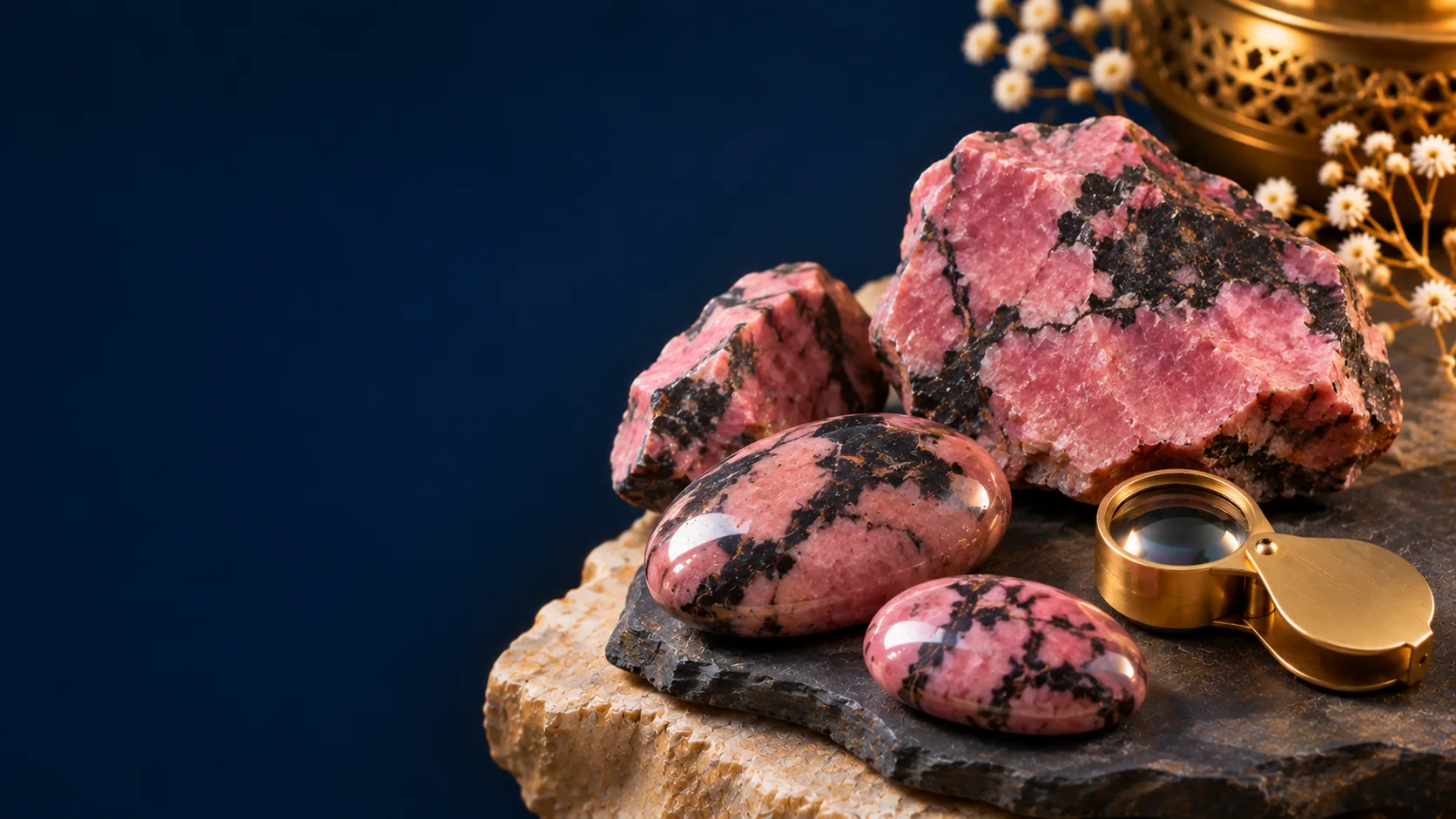
Our genuine published Rhodonite merchandise photograph appears first. The next three images are original Divinity Crystals editorial interpretations of the mineral’s pink-and-black appearance; they do not represent items in stock. The final product photograph is Rose Quartz, a different mineral. Colour and dark markings by themselves do not establish Rhodonite identity.

Real Rhodonite Double-Row Bracelet
Our actual product-gallery photograph, showing the pink-threaded double-row bracelet. See its product page for bead count, fit and any report associated with the jewellery.

Pink–Black Mineral Detail
A conceptual texture study for recognising pink and dark visual patterns. It is not a specimen-identification result.

Stone Pattern Still Life
Original mineral-inspired still life, useful for understanding contrast and shape; do not compare its markings to an exact bracelet.

Macro Appearance Study
A third distinct mineral editorial, not a stock image or an identification certificate.

Rose Quartz — Different Mineral
A separate published Rose Quartz product. Rose Quartz is silicon dioxide, not the manganese silicate Rhodonite.
IDENTIFY THE MINERAL BEFORE THE COLOUR
Rhodonite vs Rhodochrosite vs Rose Quartz
All can be pink. Their mineral composition, natural pattern and physical durability differ.
Rhodonite
Pink manganese-rich silicate; black manganese-oxide veining is common, but not universal.
Rhodochrosite
Manganese carbonate, often pink-and-white banded and softer than Rhodonite.
Rose Quartz
Pink silica SiO₂, usually cloudy or translucent; around Mohs hardness 7.
Illustrative swatches are not a gemstone authenticity test. Use reliable material evidence for exact specimens.
Rhodonite Mineral Properties, Buying Checks & Care
| Feature | What to know |
|---|---|
| Mineral identity | Rhodonite is a manganese-rich chain silicate often containing calcium and related elements; it is not manganese carbonate. |
| Appearance | Characteristic pink to reddish-pink mineral, frequently cut by black manganese-oxide veins; natural patterns vary. |
| Mohs hardness | Approximately 5.5–6.5, depending on specimen; it is brittle and can fracture along cleavage surfaces. |
| Black veining | Manganese oxides may form dark patches or veins in Rhodonite masses; black markings are not exclusive proof. |
| Rhodonite versus Rhodochrosite | Rhodonite is a silicate commonly veined black. Rhodochrosite is a softer manganese carbonate that may show pink-and-white bands. |
| Rhodonite versus Rose Quartz | Rose Quartz is silica (SiO₂), around Mohs 7 and often cloudy pink without the same typical black oxide veins. |
| Imitation and enhancements | Pink glasses, dyes, composites and other pink minerals may look similar. Seller photos alone cannot establish origin or untreated status. |
| Verified store Rhodonite form | The confirmed published Rhodonite listing is a pink-threaded double-row 38-bead bracelet; several tumblestone files carry misleading Rhodonite names. |
| Traditional association | Compassion, forgiveness and the heart chakra are cultural or personal symbolic interpretations, not validated trauma treatments. |
| Care | Use gentle soft cleaning and avoid harsh temperature, ultrasonic cleaning, steam and impacts; preserve elastic, thread and adhesives. |
Gemological background: Mindat Rhodonite mineral record and International Gem Society Rhodonite guide.
RHODONITE · MINERAL IDENTITY, REAL MERCHANDISE & CARE
Check Pink–Black Silicate · Verify the Bracelet · Handle Gently
Three practical gemstone-specific checks for Rhodonite identification, the real product and jewellery care.
RHODONITE SILICATE · MANGANESE-RELATED MARKINGS · REAL JEWELLERY
Choose on mineral evidence, original product images and careful handling
Identify the Pink–Black Mineral
Look for Rhodonite’s pink or reddish-pink base with possible black manganese-oxide markings. Compare against Rhodochrosite and Rose Quartz.
Colour or veining alone does not certify an item.
Verify the Actual Bracelet
The confirmed Rhodonite listing is a pink-threaded double-row beaded bracelet advertised as 38 beads.
Check the actual photograph, bead fit, threading and test report scope.
Protect Polished Stones
Rhodonite may fracture or chip along weakened surfaces. Keep elastic, knots and bead holes away from damage.
Use gentle cleaning; avoid steam, ultrasonics and rough knocks.
Verified Rhodonite jewellery: Rhodonite-Listed Pink-Threaded Double-Layer Bracelet · Rhodonite & Self-Forgiveness Guide
Product-image accuracy matters: similarly named “Rhodonite” tumble media came from a listing previously titled Rhodochrosite. That listing is now labelled “Pink Tumbled Stones — Mineral Identification Pending” in our current catalogue. We have not treated those images as verified Rhodonite inventory.
Before Buying Rhodonite
- Confirm the exact material is Rhodonite, not Rhodochrosite or Rose Quartz.
- Compare real retail photographs with the selected bracelet variant.
- Check the pink thread, two-row design, bead count and finished fit.
- Inspect cracks, polished surface, drill holes and visible dark inclusions.
- Ask about treatments and any sample-specific lab identification report.
- Do not assume a misleading filename establishes stock or mineral identity.
Rhodonite Jewellery Care
- Use a soft clean cloth and avoid harsh scrubbing on cracks or fragile areas.
- Use mild soap and warm water only for suitable sound untreated pieces.
- Keep water away from uncertain dyes, adhesives, threads and closures.
- Never use steam or ultrasonic machines.
- Store separately from hard quartz and metal edges to reduce abrasion.
- Avoid pressure, impact and accidental stretching of the double-row bracelet.
Meaning and mindful use
Choose the mineral for its character — keep the meaning personal
Rhodonite is often associated with forgiveness and emotional balance in modern crystal traditions. Those associations can make a stone a meaningful reminder for a short reflection, but they are not evidence that the mineral can resolve relationship problems, treat anxiety or change another person’s behaviour.
For purchase decisions, use our actual Rhodonite bracelet photographs, check the product’s construction and care needs, and seek item-specific identification evidence for material claims.
The accompanying Indian portrait is original editorial imagery, not a customer testimonial or a photograph of the exact bracelet.

What Is Rhodonite? The Pink Manganese Silicate
Rhodonite belongs to the chain-silicate mineral class and is recognized by its pinkish or reddish colours associated with manganese. Its modern mineral formula is more complex than the older simplified MnSiO₃ notation often repeated on retail sites, because the Rhodonite group includes calcium and various related cation arrangements.
Mindat documents the Rhodonite group’s current definition, colours, vitreous to pearly lustre and approximately 5.5–6.5 Mohs hardness. The mineral often appears in large, opaque or translucent masses used for cabochons, tumbled stones and ornamental carving.
Why Does Rhodonite Have Black Veins?
Many pieces contain black manganese oxides along fractures or alteration zones. These striking dark markings can make each specimen recognizable, but not every genuine Rhodonite stone has the same percentage of black veining, and other pink materials can look similar.
Rhodonite vs Rhodochrosite vs Rose Quartz
These three pink materials are not interchangeable. Rhodonite is a silicate, often rose-pink with dark manganese-oxide markings. Rhodochrosite is a manganese carbonate, generally softer and often showing pink-and-white bands. Rose Quartz is a quartz variety with a different mineral structure and typically a more uniform pink appearance.
Do not decide solely from colour. For high-value specimens, professional gemological assessment may help clarify identity, treatments and possible composite construction. See the IGS Rhodonite overview and the Rhodochrosite guide for differences.
How to Recognize Natural and Imitation Rhodonite
Real Rhodonite is not required to have identical black stripes or a fixed shade of pink. Polishing, photography and stone-to-stone variation can alter appearance. Synthetic substitutes, composite goods, dyed materials and other natural pink rocks can create identification challenges.
Before ordering, request actual item photos, the precise material description, treatment information and, when warranted, a reputable gemological report covering the exact sample. Avoid acid, flame and scratch tests that may permanently damage a finished item.
For related guidance see How to Identify Fake Crystals.
Rhodonite Meaning, Forgiveness & the Heart Chakra
In crystal traditions, Rhodonite is associated with the heart chakra, emotional balance, compassion and forgiveness. Some people select a pink-and-black stone as a personal cue to reflect, journal or reconsider a difficult conversation.
These are symbolic meanings. There is no reliable clinical evidence that Rhodonite immediately ends panic, heals childhood trauma, removes resentment or changes another person’s behaviour. People facing significant emotional distress should seek qualified support instead of depending on gemstone claims.
Three Practical Ways to Enjoy Rhodonite
- Desk display: Put a stable polished piece in a padded tray for colour and decorative interest.
- Beaded jewellery: Wear a bracelet for its design, taking care with elastic or thread and polished edges.
- Reflection: Use a stone as an optional reminder during journaling or meditation without expecting a medical effect.
How to Clean Rhodonite Safely
Rhodonite is often a sound ornamental material, but care depends on cracking, finishes, adhesives and jewellery fittings. The International Gem Society recommends a soft brush, mild detergent and warm water for suitable pieces and cautions against steam and ultrasonic cleaners.
For a fragile or treated specimen, begin with gentle dry cleaning. Never force-brush friable areas; keep polished pieces away from harder stones that can scratch or chip them. Dry carefully and store in separate compartments.
For general material-specific cleaning principles see Crystal Cleansing Methods & Safe Care. Symbolic moonlight or salt rituals do not replace physical cleaning or disinfection.
Shop Rhodonite at Divinity Crystals
Our development catalogue includes a Rhodonite Double Layered Threaded Bracelet. Review the listing for current images, bead count, size, price, available stock and the scope of any advertised laboratory report.
To compare colours and formats, explore Crystal Bracelets, Tumbled Stones and Rose Quartz Tumbled Stones.
Retail phrases such as ‘natural’, ‘untreated’ or ‘certified’ need item-specific evidence rather than assumptions from photos or titles.
Frequently Asked Questions
What is Rhodonite?
Rhodonite is a pink manganese-rich chain-silicate mineral, often with contrasting black manganese-oxide veins.
Why is Rhodonite pink and black?
Pink hues are associated with manganese-rich mineral structure, while black areas often reflect manganese oxides along fractures or alteration zones.
Is Rhodonite the same as Rhodochrosite?
No. Rhodonite is a silicate and Rhodochrosite is a manganese carbonate. Rhodochrosite is typically softer and may show pink-and-white bands.
Is Rhodonite Rose Quartz?
No. Rose Quartz is a form of silica (SiO₂) and generally has a different mineral structure and physical behaviour.
Can Rhodonite be dyed or imitated?
Commercial stones can be dyed or assembled, and other pink rocks can look similar. Confirm seller disclosures and relevant item-specific evidence.
How can I tell natural Rhodonite from Rhodochrosite?
Mineral properties, patterns and credible identification matter. Black veins or colour alone are not conclusive; consult a qualified gemologist for valuable pieces.
Can Rhodonite help me forgive someone?
Its compassion and forgiveness meanings belong to personal crystal traditions. A stone cannot compel forgiveness or replace realistic boundaries and support.
Does Rhodonite heal trauma or anxiety?
No reliable evidence establishes Rhodonite as a treatment for trauma or anxiety; it can be enjoyed for its aesthetics or symbolism.
Does Divinity Crystals sell a genuine Rhodonite bracelet?
The published staging product is a Rhodonite-listed double-layered bracelet with pink thread and 38 beads advertised. The actual photograph verifies its construction, not the precise mineral species or laboratory certificate. Request corresponding evidence before relying on gemstone claims.
Are Rhodonite-labelled tumbles in the media library Rhodonite merchandise?
Not necessarily. Those files were attached to a product previously titled Rhodochrosite, now corrected in our current catalogue to “Pink Tumbled Stones — Mineral Identification Pending.” We continue to exclude them from verified Rhodonite merchandise until the exact mineral is identified.
How should I clean Rhodonite?
For compatible sound untreated stones, mild soap with warm water may be suitable, followed by drying. Start gently and avoid steam, ultrasonics, excessive heat and rough scrubbing.
What makes a laboratory certification relevant?
Look for the actual report number, issuing laboratory, examined sample and stated identification. A product title alone does not prove every bead was tested.
Choose Rhodonite for Real Pink–Black Mineral Beauty
Rhodonite is distinctive for its rosy mineral colour and often striking dark markings. It deserves an accurate mineral description and true product photos, especially where similarly named media could belong to another stone. Choose the actual bracelet by construction, size and treatment information, and care for it gently.
For emotional reflection, our separate Rhodonite self-forgiveness article explores personal practices without confusing tradition with clinical outcomes.